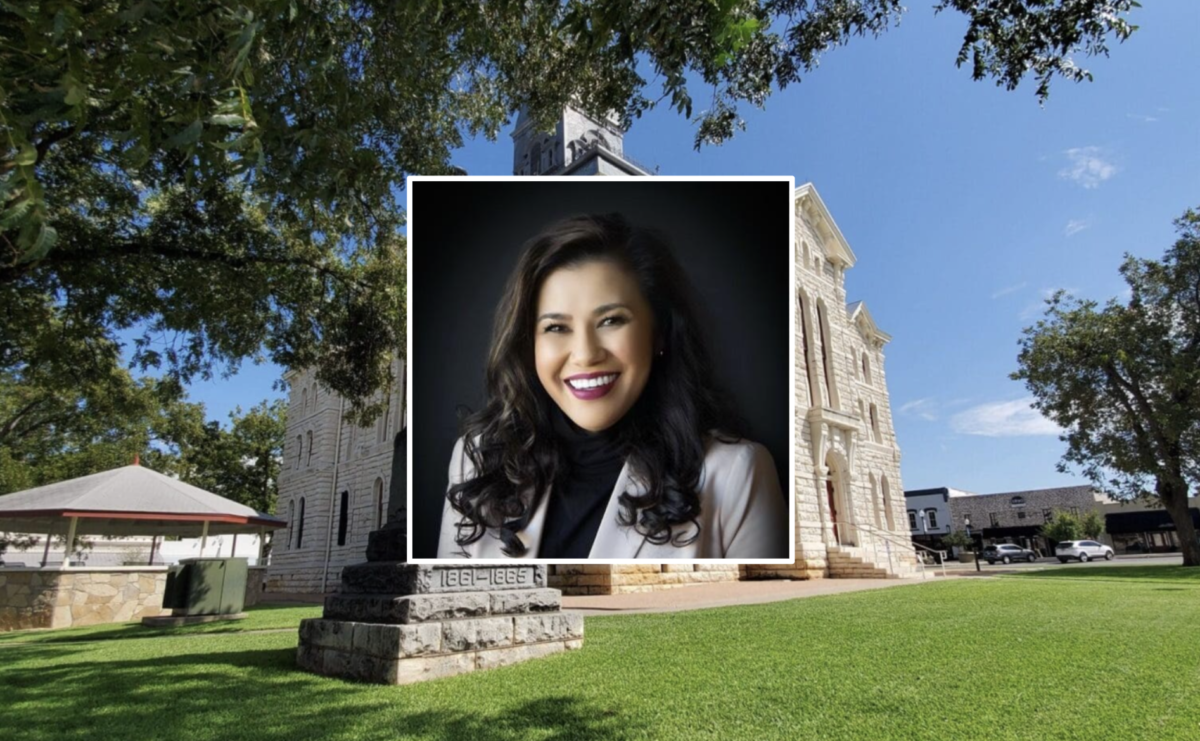
On Tuesday, prosecutors began presenting evidence in the criminal case against Eva Royer, a Hood County Republican Party official who was arrested for allegedly using the wrong address on election paperwork when filing to run for Granbury City Council.
During cross-examination, Royer’s attorney challenged witnesses for the prosecution on the evidence, helping build the case for Royer’s innocence.
Background
As previously reported, Royer filed to run for Granbury City Council in 2024, using a Granbury address. She had reportedly acted on the advice of Granbury Mayor Jim Jarratt, who recruited her to run. Royer is well known in the community for her conservative activism and philanthropy as a real estate agent.
After filing to run, Royer was notified by City Secretary Carla Walker that her residency at this address was being disputed and that the Granbury City Council would need to hold a meeting to settle the matter.
Royer subsequently withdrew her application before a meeting was held. Rather than that being the end of the story, Granbury city officials—who are Royer’s political opponents—sought to prosecute her for election fraud.
In April 2025, Royer was arrested by the Granbury Police Department on one count of perjury, a state jail felony, and election fraud, a Class A misdemeanor. She posted bond and was released the following day.
Rob Christian, Royer’s attorney, went to great lengths to acquire the evidence necessary for his client’s defense, but city officials repeatedly failed to comply with court orders compelling them to turn over information. This almost led Hood County Court at Law Judge Richard Hattox to dismiss the case before trial.
Trial Begins
Nonetheless, the trial against Eva Royer began Tuesday morning. Royer, who is facing up to a year in jail and a $4,000 fine, pleaded not guilty.
As always, the State bears the burden of proving beyond a reasonable doubt that Royer intentionally and knowingly committed election fraud. For a conviction, the six-person jury must come to a unanimous guilty verdict.
In his opening statement, Christian told the jury that if not for the political animus of Granbury city officials, “this would be a nothing burger.”
The State—represented by Hood County Attorney Matthew Mills—called witnesses to testify that the Granbury address was not Royer’s primary residence, as she had claimed in the registration paperwork.
The court primarily considered three addresses—Royer’s Granbury home, her former boyfriend’s Pecan Plantation home, and a condo in Dallas.
Homestead Exemption
Mills’ first argument relied on the fact that Royer had not applied for a homestead exemption at her Granbury address, which would have given her a tax break if she had only claimed it as her primary residence.
To prove this point, the State called upon the scandal-plagued Hood County Chief Appraiser Jeff Law, who had resigned as Tarrant County’s chief appraiser amid accusations that his leadership failures had eroded public confidence in the appraisal district, which sets property values for tax purposes.
During his initial testimony, Law stated that Royer had not filed an application for a homestead exemption, implying that she must not reside at the Granbury address.
Christian argued in cross-examination that to apply for a homestead exemption, the property must be owned by an individual or a qualifying trust. Royer’s property is owned by her LLC, making the exemption inapplicable.
Law reportedly knew this before his initial testimony but made no mention of it. Moreover, he responded to Christian by suggesting that Royer could still have filed for a homestead exemption, though she would have been denied.
Christian pointed out the absurdity of this statement and the irony that the State’s witness was suggesting that Royer should have filed for something that she did not qualify for—precisely what the State is accusing her of doing in the first place.
Also at issue during Law’s testimony was Royer’s Dallas mailing address, implying that she would have used her Granbury address if it were truly her primary residence.
Upon hearing that some people use a separate address to be sent mail, Law stated that he would presume an individual does not reside at their home if they do not receive mail there. He later amended the statement to say that he would presume they live “where their driver’s license says.”
Eva Royer’s driver’s license lists her Granbury address.
Pecan Plantation
The State’s theory for Royer’s primary residence is a home in Pecan Plantation that belongs to her now-former boyfriend, Tim Bolton.
This theory relied upon evidence of her car entering and exiting the gated community consistently over a period of months. The State called Harold Aydelott, the security director for Pecan Plantation.
Aydelott testified that Bolton had acquired a guest pass for Royer’s vehicle, allowing her to enter and exit the community without restriction.
During cross-examination, Aydelott agreed with Christian that a visitor’s consistent presence in Pecan Plantation—particularly when in a relationship with a resident—does not mean they themselves are a resident.
Aydelott added on his own volition that a “guest tag would mean they are not a resident.”
The State also highlighted the fact that Royer utilized a notary in Pecan Plantation when registering as a candidate, insinuating that this implied her residency there. Yet the notary stated that Bolton accompanied Royer, and introduced himself as her boyfriend.
Rental Status
The State argued that Royer’s Granbury home could not be used as her primary residence because she leases it out as a short-term rental. Called to the stand was Cody Nolen, Granbury’s director of community development.
Nolen explained how Royer had applied, as was required, for special use permits to authorize the property for use as a short-term rental. However, he acknowledged that such permits do not have a minimum number of days a holder must rent their property.
As Christian pointed out, a homeowner could simply apply for a permit to “dip their toes in the water” of leasing on weekends, or when on vacation to help pay for the time away. Nolen agreed that an individual could acquire a permit for their primary residence and rent it out sparingly.
Eva’s Arrest
The jury then heard the details of Royer’s arrest from Officer Ty Gregg of the Granbury Police Department.
Gregg had received a notification that a vehicle known to be associated with Royer had passed a flock camera. As it turns out, Bolton’s license plate had been added manually to a “hot list,” due to his known association with Royer.
The Hood County Commissioners Court voted unanimously on Tuesday to terminate the use of flock cameras in the county—all while this testimony was being heard.
When Gregg located the vehicle, he identified Royer and Bolton exiting and heading into Chili’s for dinner. Rather than initiating the arrest, he decided to wait until after they had finished and Bolton began driving, which Christian contended may have been in hopes of catching Bolton drinking and driving. Gregg asserted the Chili’s parking lot “wasn’t the safest option.”
The couple was ultimately pulled over in another restaurant parking lot, where five cop cars arrived on the scene for Royer’s arrest.
Christian asked Gregg why he felt this restaurant parking lot was safer than Chili’s, to which he responded that he was afraid the couple would run into the restaurant and barricade the doors with countless hostages inside.
Following this statement, courtroom laughter could be heard. Royer has no criminal history and is popularly known as a “servant” in the community.
Political Persecution and Collusion?
Granbury Chief of Police Mitch Galvan was the final witness to be called to the stand on Tuesday.
Galvan was confronted by Christian for having provided incorrect testimony during both of his pre-trial hearing appearances. After being subpoenaed and ordered by Judge Hattox to show up in court with all of his information relating to the case, he showed up with nothing—claiming that Lieutenant Russel Grizzard’s thumb drive contained all of the same information and they would have been identical.
He was then forced to return the following week and produce his own flashdrive, which he said contained additional information that Grizzard had not provided—namely his own versions of screenshots from a group message. Galvan then stated that Christian now had everything from him, which turned out to be incorrect.
Christian revealed a text thread that he had received from Granbury City Manager Chris Coffman, who had attempted to withhold the screenshots on the basis of attorney-client privilege, despite the State waiving all such privilege in the case.
The thread was about Royer’s case and included Galvan, but he claimed he did not find it in his phone because it didn’t explicitly contain her name. When asked why he didn’t use the police technology that is used against citizens during criminal investigations to sweep his phone to comply with the court order, Galvan angrily responded that he “didn’t feel a need to.”
He also claimed no memory of the text conversation, despite appearing excited in the messages to send over a copy of the affidavit against Royer to both Coffman and Granbury City Attorney Jeremy SoRelle.
Galvan then admitted that he had given incorrect testimony during both of these appearances, but that they were not intentional. Christian pointed out the irony in regard to Royer’s current situation.
In the messages, SoRelle stated that he was “dying to see” the affidavit, to which Galvan replied, “I have a copy!” When learning that the Mayor had defended Royer and may not support the prosecution, SoRelle called him a “POS.”
Galvan claimed to not remember the messages shown on the screen, which he did not produce himself.
Christian then revealed another series of group messages—this time the ones originally provided by Grizzard, also including Galvan, Coffman, and SoRelle. Galvan acknowledged that neither Coffman nor SoRelle would normally be involved in such criminal matters.
The messages revealed SoRelle telling the others that he had heard Bolton accompanied Royer to the notary in Pecan Plantation. He pointed out that Bolton could be held criminally responsible for aiding her, stating, “My thought is that if we are going on this we go all the way, but leave it to your discretion.”
Finally, Christian highlighted the city’s conflict of interest in the case.
Galvan acknowledged that the Granbury City Council is above each of the members involved in the text threads, including himself, and that Royer was filing for a position in that very body. He also acknowledged that the department has a responsibility to avoid conflicts of interest when possible.
When asked why he did not defer the case to the Texas Attorney General’s election fraud unit that is designed to handle these types of claims, Galvan stated that the Office of the Attorney General does not respond to such inquiries.
What Happens Next
Royer’s trial is expected to continue through Thursday. Royer supporters in the courtroom appear optimistic about the proceedings and are anticipating the appearance of witnesses for the defense.
If you or anyone you know has information regarding court cases, please contact our tip line: scorecardtips@protonmail.com.