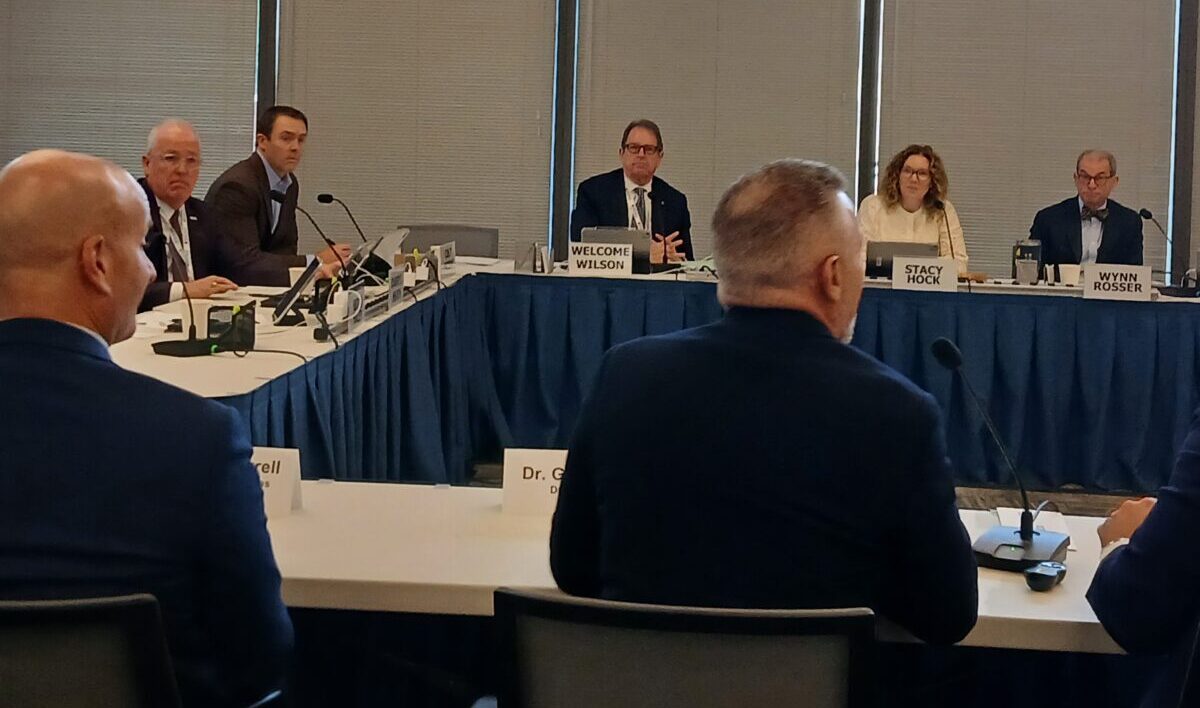
AUSTIN—Texas’ Higher Education Coordinating Board voted Monday to recommend a series of changes to statewide general education requirements designed to ease the burden of these mandates while increasing their relevance to students.
The recommendations, part of a report from a General Education Curriculum Advisory committee, are designed to apply to all taxpayer-subsidized institutions, from the state’s flagship campuses to community colleges.
The board recommended reducing core requirements from 42 to 30 semester credit hours. Semester credit hours are a common metric used to track degree completion.
The recommended changes would cover approximately ten percent of the total coursework towards a typical four-year degree.
“Nothing upsets me more than wasted time and wasted resources,” board Chair Stacy Hock told colleagues. Hock also suggested that streamlining these requirements could allow students to add a minor degree.
As part of that reduction, requirements will drop from nine “component areas” to four “knowledge domains.”
Communication Methods, Scientific Qualitative and Analytical Concepts, Human Society, and Civic Foundations are the proposed knowledge domains.
The report recommends revisions to history and government requirements to focus on three semester credit hours each alongside three hours on “global economics” and “personal finance.”
The board unanimously voted to approve the report.
While some of the changes can be enacted via rulemaking at the coordinating board, others would require statutory changes by the legislature. The reduction in semester credit hours would require legislative approval.
The report in question is required under legislation state lawmakers passed in 2025. That law overhauled several aspects of university governance, including general education.
The proposed statewide framework follows a series of revisions at the system and campus level.
General education requirements are a set of courses all students must complete, regardless of major. Higher education authors Jason Brennan and Phil Magness have criticized these mandates as a subsidy for economically unsustainable programs that frequently protect woke curricula from accountability.
Earlier in the meeting, board members approved an “implementation impact study” detailing the impact of Texas’ ban on DEI policies in several aspects of day-to-day university governance.
The report examined “application rate, acceptance rate, matriculation rate, retention rate, grade point average, and graduation rate of students at institutions of higher education” and found that all metrics were at or near all-time highs.
Board members also approved a report detailing foreign gifts and contracts from across Texas’ taxpayer-subsidized universities.
The report outlines a series of gifts and contracts with foreign nations at institutions across the state. While the majority of these arrangements appear non-controversial, several institutions held contracts with hostile nations such as China and Saudi Arabia.
UT-Austin reported a series of contracts with Saudi Arabia while UT-MD Anderson reported several from China. Several UT-System institutions reported contracts with both.
Texas A&M reported a contract with Saudi Arabia.
The board approved this report without discussion.
Texas’ Higher Education Coordinating Board oversees a series of functions related to the state’s taxpayer-subsidized higher education institutions. It consists of members appointed by the governor and confirmed by the Texas Senate. Stacy Hock of Austin is the current board chair.