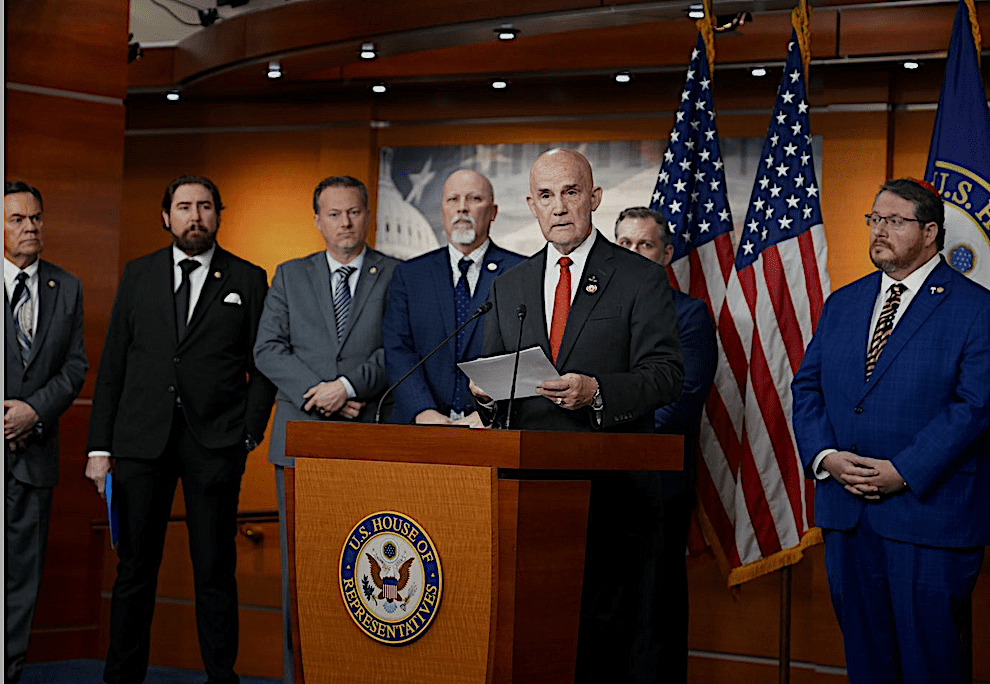
U.S. Rep. Keith Self has asked the Internal Revenue Service to investigate an Islamic non-profit for 501(c)(3) violations in a letter to U.S. Secretary of the Treasury Scott Bessent.
The letter sent Wednesday highlights the organization’s recent involvement in the campaign of Democratic nominee for U.S. Senate in Michigan Abdul El-Sayed, and draws the connection between the Holy Land Foundation case and ISNA.
The Islamic Society of North America (ISNA) describes itself as “a membership-based 501(c)(3) not-for-profit organization” dedicated to “advancing the American Muslim community through education, civic engagement, interfaith collaboration, youth empowerment, and various other programs.” ISNA boasts 62 years of activity, and states one of its strategic goals is to “promote involvement with public affairs in community and democratic processes.”
The letter by Self (R-McKinney) draws attention to an ISNA convention held over Labor Day weekend 2026 in Detroit, Michigan. Self states that a campaign booth for El-Sayed was set up at the convention displaying “Abdul for U.S. Senate” and “Muslims for Abdul” banners. Campaign personnel distributed flyers and literature, exchanged t-shirts for campaign donations, and provided QR codes for donating or volunteering opportunities.
Self also notes that ISNA’s Chief Executive Officer Azhar Azeez introduced El-Sayed to approximately 1,000 attendees as “Michigan’s 2026 Democratic nominee for U.S. Senate,” praised El-Sayed, allowed El-Sayed to speak to the audience, and, despite acknowledging the organization’s inability to endorse a political candidate, stated that the Muslim community was “very smart and very wise” and “they know exactly what decision to take.”
According to the IRS exemption requirements, an organization filing as a 501(c)(3) non-profit “may not attempt to influence legislation as a substantial part of its activities and it may not participate in any campaign activity for or against political candidates.”
“This was not simply a candidate attending a religious organization’s event,” wrote Self. “This is an example of an active political campaign operating within the space of an ISNA convention and using this as an opportunity to solicit money, recruit volunteers, and advocate for the election of a specific candidate.”
ISNA’s scrutinized conduct does not stop with the recent El-Sayed involvement.
In “the Holy Land Foundation case, a federal prosecution involving the financing of Hamas,” ISNA was identified as an unindicted co-conspirator, according to Self.
“A federal district court stated that the government has produced ‘ample evidence’ establishing associations between ISNA, the Holy Land Foundation, and Hamas,” wrote Self. “This history warrants consideration when evaluating whether ISNA maintains adequate controls over its organizational activities and resources today.”
Self also drew attention to the suspension of the Canadian branch of ISNA by the Canada Revenue Agency in 2018 for “suspicion of funneling money to the terrorist group Hizbul Mujahideen.”
In addition to the issues highlighted by Self, ISNA has as its predecessor the Muslim Students Association, an organization with ties to the Muslim Brotherhood that has recently come under fire online for accusations of organizing Muslim-only prayer spaces in high schools and public universities, though these allegations have been denied by administrative faculty.
Self ended his letter with multiple requests of the IRS which can be generally summarized as asking for an investigation into whether or not ISNA has violated its 501(c)(3) requirements and to what extent the organization is involved with the El-Sayed campaign.
“To the extent that the IRS encounters information concerning a reported solicitation of a non-U.S. citizen by the El-Sayed campaign, I respectfully request that the IRS refer that information to the appropriate agency,” added Self.
When asked about his thoughts on the letter, Azeez told Texas Scorecard that Self was, “in [his] opinion, the most Islamophobic member of Congress that we have today,” listing various instances where Self opposed Islamic projects in Texas and stating that members of the Middle East Forum were “leeches” on the Muslim community. The Middle East Forum was a group cited as a source in Self’s letter.
“[ISNA] invited Abdul El-Sayed, the first Muslim Senatorial candidate, and we had invited his opponent, Mike Rogers. We sent him multiple emails and messages. He never responded,” stated Azeez.
Azeez noted that his comments at the convention in regards to El-Sayed were to imply that “[voters] would know who to vote for based on what these candidates have to offer.”
When asked about the accusations of ISNA’s involvement with Hamas and Hizbul Mujahideen, Azeez stated that Self was “a habitual liar.”
“If any organization has done anything wrong, the law will take its own course,” stated Azeez. “We are a respectable, religious, national, Muslim organization. We have a history and track record of more than six decades. We have not done anything wrong, there is no evidence against this organization. It is the Islamophobes who keep on trying to spin stories. And we outrightly reject their narrative, their lies.”
Azeez noted that numerous individuals from the Muslim community, and other faiths, would vouch for the organization and its role in the common good.
The letter comes after Self filed a concurrent resolution in early September to denounce Sharia law on a federal level, stating that “the United States Constitution is the supreme law of the land. We cannot allow Sharia law or any competing legal framework to undermine the liberties generations of Americans have fought and died to protect.”