Republican U.S. Sen Ted Cruz of Texas has introduced bi-partisan legislation with Sen. Maria Cantwell (D–WA) designed to address a series of issues currently plaguing college athletics. Cruz and Cantwell are the chairman and ranking member, respectively, of the U.S. Senate Commerce Committee.
The Protect College Sports Act of 2026 establishes a national framework for college athletics, designed to unify standards across conferences and institutions.
Its centerpiece is the name, image, and likeness (NIL) compensation rule, which guarantees student‑athletes the unrestricted right to earn money from endorsements, sponsorships, and personal branding. Schools and the NCAA cannot limit these opportunities, though athletes must disclose NIL deals exceeding $600. Institutions may participate in NIL arrangements under regulated conditions, ensuring fair‑market value and transparency through a national NIL database.
The proposed measure differentiates between student-athletes earning outside income through traditional advertising, revenue sharing payments directly from universities, and what Cruz called “Fake NIL deals.”
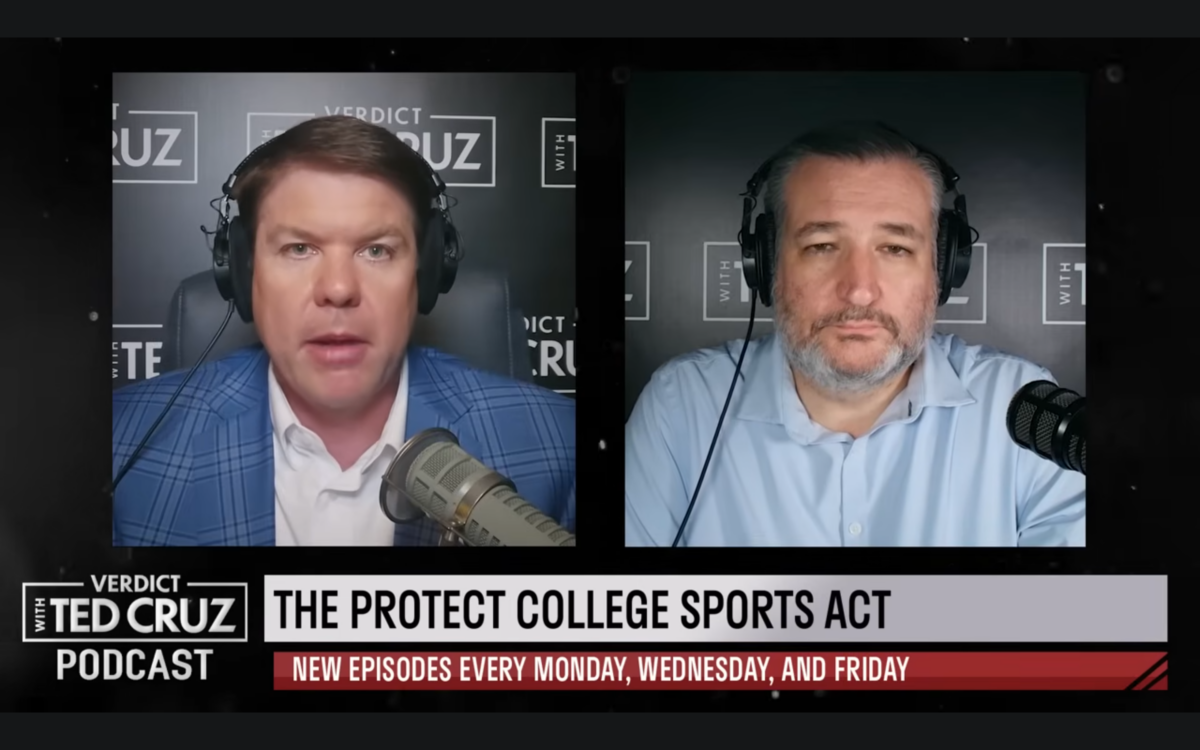
“What [this legislation] doesn’t allow is a booster handing a bag of cash to an athlete in a dark alley,” Cruz recently stated on his Verdict podcast.
“It draws the line between real NIL and fake boosters trying to game the system.”
The bill also introduces provisions for Collective Media Rights, creating a limited anti-trust exemption to allow the NCAA to sell media rights as a whole rather than on a conference or school basis.
Cruz argues that this collective framework will “significantly increase” the revenue pool from which university athletic programs can draw. Cruz contrasts college football viewership with the NBA, pointing out that the former receives far less revenue than the latter despite far higher viewership numbers.
Another major reform is the one‑time transfer policy, which standardizes transfer procedures nationwide. Under this rule, student‑athletes may transfer once without penalty or delay, regardless of conference affiliation. The policy eliminates inconsistent restrictions that previously varied by league or institution, ensuring athletes can pursue academic and athletic opportunities freely while maintaining eligibility.
The act expands agent regulation through amendments to the Sports Agent Responsibility and Trust Act (SPARTA). Agents must register with a state, comply with NCAA standards, and use written contracts with specific required terms. Fees for endorsement contracts are capped at 5 percent, and athletes harmed by agent misconduct gain a private right of action. The bill also bans pre‑dispute arbitration clauses, strengthening athlete protections and accountability in representation.
Health and safety provisions include long‑term medical coverage for sports‑related injuries. Division I schools must pay all out‑of‑pocket medical expenses during participation and for five years after eligibility ends. Institutions must follow national standards for concussion management, heat illness prevention, and other conditions, while maintaining independent medical decision‑making.
The NCAA must maintain a $60 million fund to assist schools and athletes with catastrophic or long‑term injury care.
Finally, the bill enforces mid‑season football coaching restrictions, prohibiting staff from switching schools mid‑season and immediately serving as head coaches. Violations result in season‑long ineligibility.
Alongside these measures, the act establishes an independent student-athlete ombudsman, mandates gender equity in championships, and strengthens academic and scholarship protections. Collectively, these reforms create a transparent and athlete‑centered system for college sports nationwide.
Regarding a timeline for passage of the bill, Cruz stated last week, “This is far from a done deal.”
The U.S. Senate’s Commerce Committee will hold a hearing on the bill Wednesday.