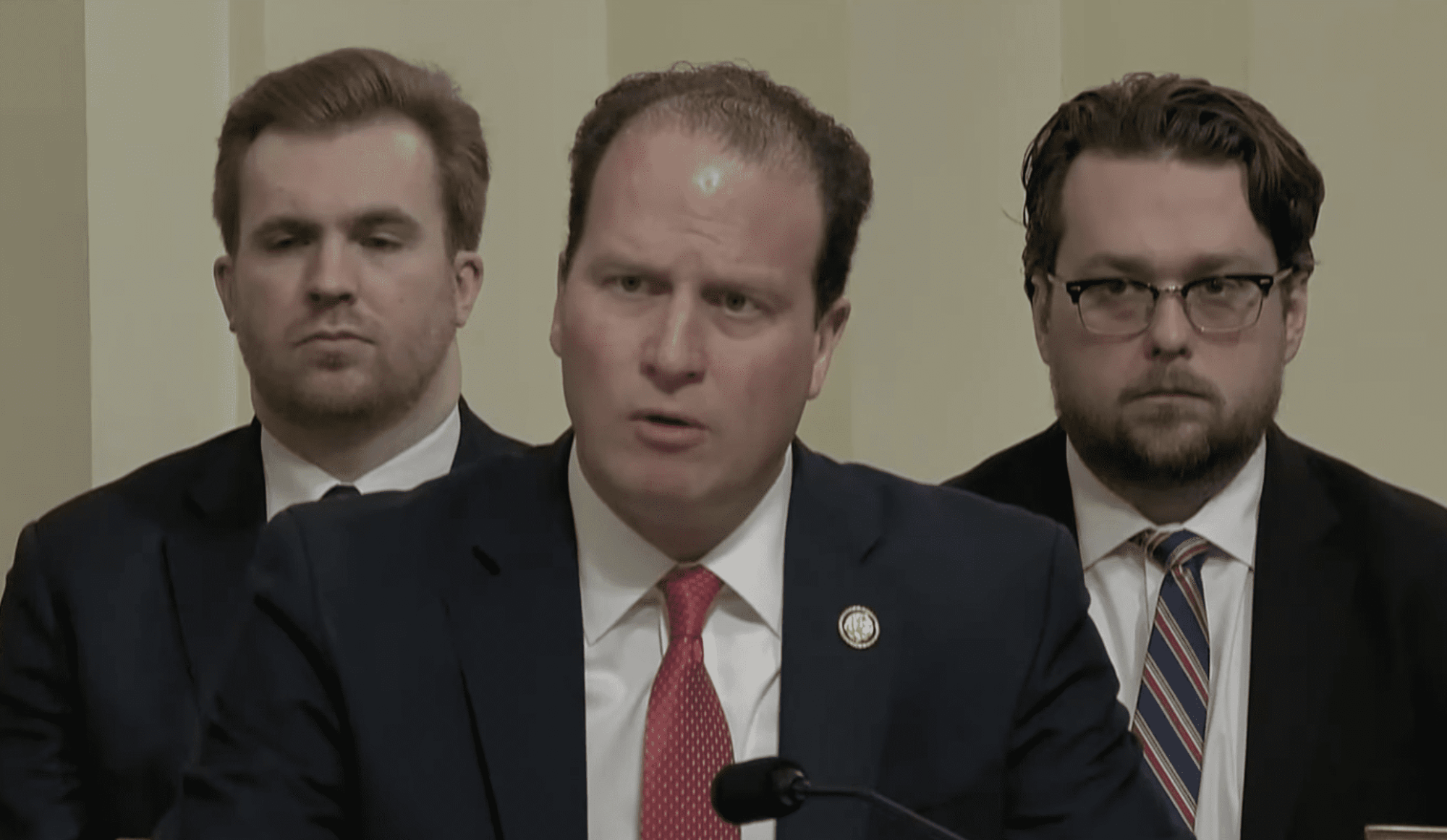
Republican U.S. Rep. August Pfluger of Texas used a Tuesday hearing before the House Homeland Security Committee to draw a sharp line between enforcing existing immigration law and organized efforts to nullify it on the streets—and in city halls.
Pfluger opened his questioning by framing the fundamental split as he sees it.
“Why are we here?” he asked. “It seems like one side of the aisle is in favor of open borders and wants to abolish ICE … and the other side of the aisle wants to enforce the laws that are on the books.”
Pfluger stressed that those laws are not new.
Questioning U.S. Customs and Border Protection Commissioner Rodney Scott, he noted Scott has served since the Clinton administration “under multiple Republicans [and] multiple Democrats.” Scott confirmed that entering the country illegally, skipping court, and ignoring a notice to appear have been crimes the entire time.
“Has that changed since you started working for President Clinton?” Pfluger asked. “No,” Scott replied.
Pfluger then pointed to the scale of the current crisis, saying a “conservative estimate” is that 10 to 12 million people entered illegally during the Biden administration, and tied today’s hearing to sanctuary policies: “There are sanctuary cities all throughout the United States who have said we will not comply with federal laws. That’s why we’re here today.”
Pfluger shifted his focus to the conditions facing front‑line officers.
“I can’t imagine being a DHS officer, an ICE officer, and being threatened with violence, having death threats, being doxxed, having your family identified … and violently telling you that they are going to kill you because you are enforcing the laws … passed by both sides of the aisle in this body,” he said.
ICE Director Todd Lyons answered that the threat environment has exploded: “We’ve had over 8,000 percent increase on death threats.”
In his testimony, Lyons described it as “the deadliest operating environment in our agency’s history,” warning that “the current operational environment puts our officers, agents, and even their families, at tremendous personal risk of violence.”
Lyons linked that atmosphere to years of anti‑ICE rhetoric, saying, “This rhetoric has fomented violence against dedicated American patriots defending our homeland, and this must stop.”
Pfluger spotlighted Defend 612, a Minneapolis‑based group he said is part of an “ICE watch” network that actively interferes with enforcement operations.
He described their published “tactics, techniques and procedures” as encouraging protesters “to impede law enforcement, to push civilians towards legally and physically risky confrontations… [and] to aid illegal immigrants to avoid detention,” citing investigative reporting titled “Inside Minneapolis ICE Watch Network” by Christina Buttons.
Lyons confirmed that ICE is familiar with Defend 612 and similar organizations. “We have multiple groups around that in all 50 states.”
Pfluger contrasted Minneapolis with his home state, saying, “We don’t see any of this in Texas,” he said, noting that ICE runs many operations there without the same kind of orchestrated street‑level resistance.
Lyons testified that local and state non‑cooperation in Minnesota dramatically increased the danger for federal officers during recent operations.
“At the beginning of the Minneapolis operation, we didn’t see any cooperation at the state or the local level, whether it be from the Minneapolis Police Department or the Minnesota State Police,” he said. That left ICE and other federal agents “pretty much having to defend themselves from whatever impediment, riots, or protests.”
Asked whether local elected officials had instructed police not to cooperate, Lyons replied that officers “were ordered not to stand out” and said he assumed that directive came from political leadership.
Pfluger referenced reports that the mayor had publicly said “F ICE” and pressed Lyons on morale, asking, “How did it make you feel … when you hear the mayor of Minneapolis say, ‘F ICE’?”
“From a morale standpoint, it hurts us,” Lyons answered. “For decades, and I’ve worked since President Bush, ICE has always been in Minneapolis. We’ve always been in every major city and state… So that’s demoralizing.”
The hearing also tied current enforcement operations to the Biden‑era surge and failures documented by federal watchdogs.
Lyons’ testimony pointed to an August 2024 DHS inspector general report finding that more than 291,000 unaccompanied alien children were released from federal custody without being placed in removal proceedings, leaving their whereabouts unmonitored.
“These children were simply ‘lost’ by the system,” he testified, charging that the prior administration “made ghosts of these children, denying them any meaningful legal or physical protection” and calling it “one of the greatest humanitarian tragedies in our history.”
By contrast, Lyons said the current administration has tasked ICE with “mass deportations” and that the agency “is fulfilling that mandate.”
From January 20, 2025, to January 20, 2026, ICE conducted nearly 379,000 arrests and more than 475,000 removals, including over 7,300 suspected gang members and 1,400 known or suspected terrorists, according to his testimony.
Pfluger asked Scott about “family separation” and whether CBP is “separating families.” Scott replied, “No,” and explained that when a parent is arrested, “we don’t necessarily prosecute the children, but when someone’s deported, if they want to take their children with them, they have that right. We do not separate them.”
Scott acknowledged that “policies, how things are enforced, do change,” but emphasized again that “the laws have not changed.”
Lyons’ testimony also outlined how U.S. Citizenship and Immigration Services and ICE are working with states to safeguard elections by helping verify voter rolls using DHS’s SAVE system. Since January 20, 2025, SAVE “has processed over 58 million voter verification queries,” with 27 states entering memoranda of agreement for voter verification, according to the document.
Pfluger, who co‑leads a bipartisan domestic terrorism working group, wrapped up his questioning by urging Democrats to look at groups like Defend 612 through that same lens.
“If this is domestic terrorism, or we have a group that is… calling out agents and doing things to interrupt, intercede and prevent law enforcement from carrying out the laws that this body passed,” he said, members should “have the courage to call it domestic terrorism, if it is that way.”