Houston Independent School District officials are facing a new federal civil rights lawsuit after police escorted conservative activist Bonnie Wallace out of a school board meeting where she read from a sexually explicit library book the district makes available to students.
The suit argues Houston ISD violated her First Amendment rights by silencing her because of her viewpoint and then having her removed even after she complied with the presiding officer’s order and returned to her seat.
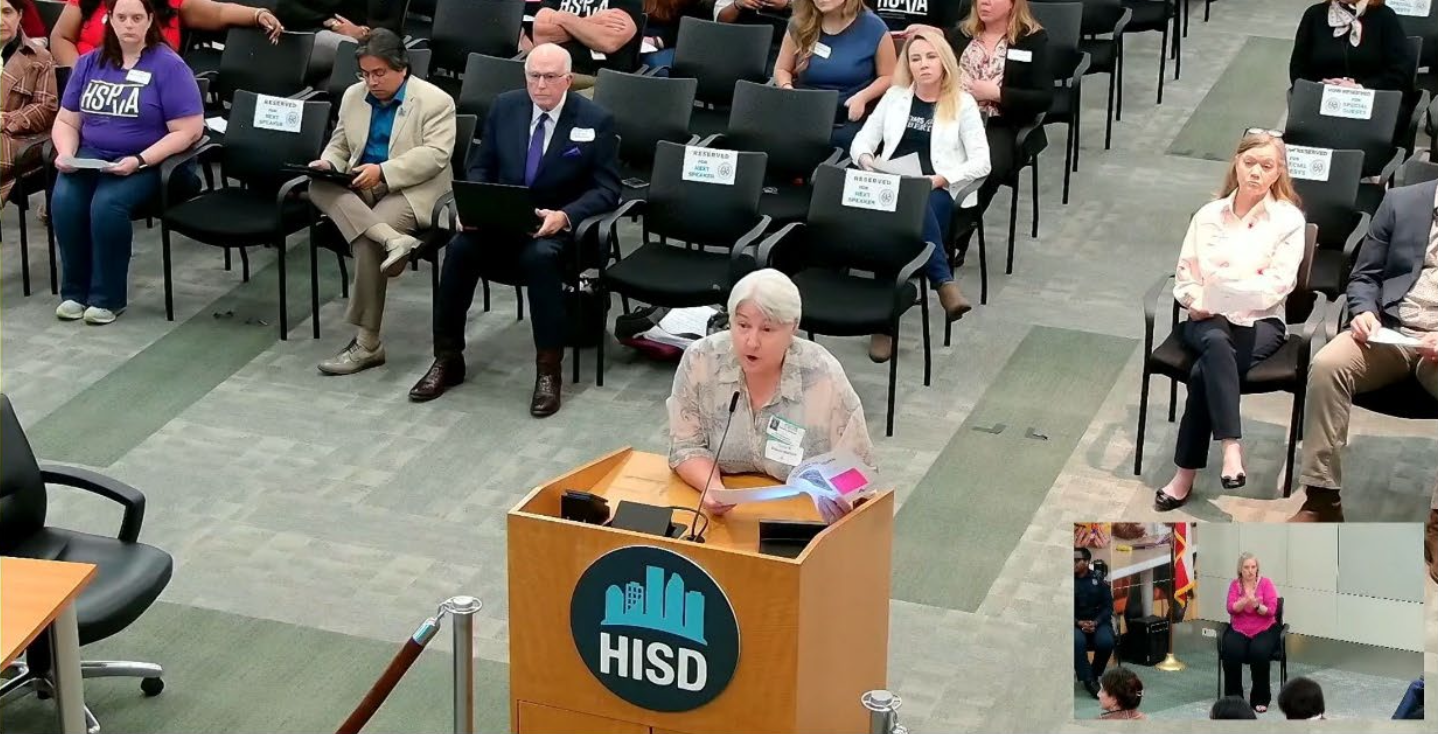
On March 19, 2026, Wallace spoke during the public comment period of an HISD board meeting that included an agenda item on “instructional materials and library content.”
Before reading, Wallace warned that her remarks would include explicit language and suggested that any children present leave the room, saying she was addressing sensitive material that is already available to students in HISD libraries. She then began reading verbatim from “A Court of Silver Flames” by Sarah J. Maas, a book her complaint says is on the shelves of at least three HISD school libraries and contains graphic sexual descriptions.
According to the complaint, HISD’s own meeting video shows Wallace speaking calmly, within her allotted time, and staying on-topic as she used the passages to criticize district library policies.
The filing says the presiding officer, Board Vice President Angela Lemond Flowers, interrupted Wallace, ordered her to stop, and issued “escalating warnings” even after Wallace explained that the explicit language was the point of her criticism.
Wallace ultimately stopped, left the podium, and returned to her seat.
Even after she was seated and no longer speaking, Flowers directed three police officers to remove Wallace from the meeting and escort her out of the building and off district property.
Wallace was not cited or charged with any crime, but the complaint notes that Texas law makes it an offense to intentionally disrupt a lawful meeting and argues that nothing in the record shows Wallace disrupted the proceeding.
Filed April 30 in the U.S. District Court for the Southern District of Texas, the lawsuit names HISD, Board President Richard Campo in his official capacity, and Flowers in both her official and individual capacities.
Wallace is represented by attorneys with Remnant Law, who describe her as a taxpayer, “community parent and child rights activist,” and regular school board speaker.
The complaint calls Wallace’s remarks “core political speech” on a matter of public concern—whether sexually explicit and profane books should be accessible to minors in school libraries.
By opening a public comment period tied to a posted agenda item, HISD created at least a “limited public forum” where it cannot discriminate against speakers based on the content or viewpoint of their speech, the suit argues, citing Supreme Court and Fifth Circuit precedent.
Wallace’s attorneys say she did not exceed her time limit, go off topic, or cause any disruption, and that she was removed “solely because of the content and viewpoint of her remarks,” specifically her criticism of HISD’s decision to purchase and circulate “sexually explicit” books.
The filing labels HISD’s actions “textbook viewpoint discrimination,” claiming the district allowed favorable speech but shut down criticism of its library policies when that criticism highlighted passages the board did not want heard aloud.
The complaint leans on a recent U.S. Supreme Court decision, Chiles v. Salazar, which it says reaffirmed that government bodies cannot silence speech simply because they “disfavor the viewpoint expressed or find the content uncomfortable” and cannot rebrand speech as “conduct” to escape First Amendment scrutiny. It also cites Fifth Circuit decisions holding that presiding officers who remove speakers from a public comment forum because of their viewpoint can be held personally liable.
Wallace brings multiple claims under federal civil rights law and the Texas Constitution. First, she alleges HISD and Flowers violated her First Amendment rights through content‑ and viewpoint‑based discrimination. Second, she claims they retaliated against her for engaging in protected speech by interrupting, censoring, and removing her, which she says has created a “chilling effect” that makes her hesitant to speak at future meetings for fear of removal or even trespass charges.
A separate claim seeks to hold HISD itself liable by arguing that its written board policies and unwritten customs give the presiding officer “unbridled discretion” to silence speakers based on subjective notions of “decorum,” “offensiveness,” or “inappropriate content.”
Wallace contends those policies are unconstitutionally vague, fail to define disruption or inappropriate content, and have been enforced in a way that targets criticism of district library policies while allowing other viewpoints.
At the state level, Wallace argues HISD violated the Texas Open Meetings Act by removing a non‑disruptive speaker who was addressing a posted agenda item, contrary to Government Code section 551.007’s requirement that boards allow public comment on agenda topics.
She also asserts claims under Article I, Sections 8 and 27 of the Texas Constitution, which protect free speech and the right to petition the government.
Wallace is asking for a declaratory judgment that HISD’s actions were unconstitutional and for injunctions blocking the district from removing speakers based on viewpoint, including critics of its library policies.
She also seeks nominal and compensatory damages, punitive damages against Flowers personally, and attorney fees.
The complaint says HISD’s treatment of Wallace sends a message that “undesired voices” risk removal or even trespass charges if they attempt to read from books the district itself makes available to students.
Wallace argues that the outcome doesn’t just affect her case—it “implicates the right of all Americans to freely speak and seek redress from their government” in public meetings.
HISD did not respond to Texas Scorecard’s request for comment before publication.