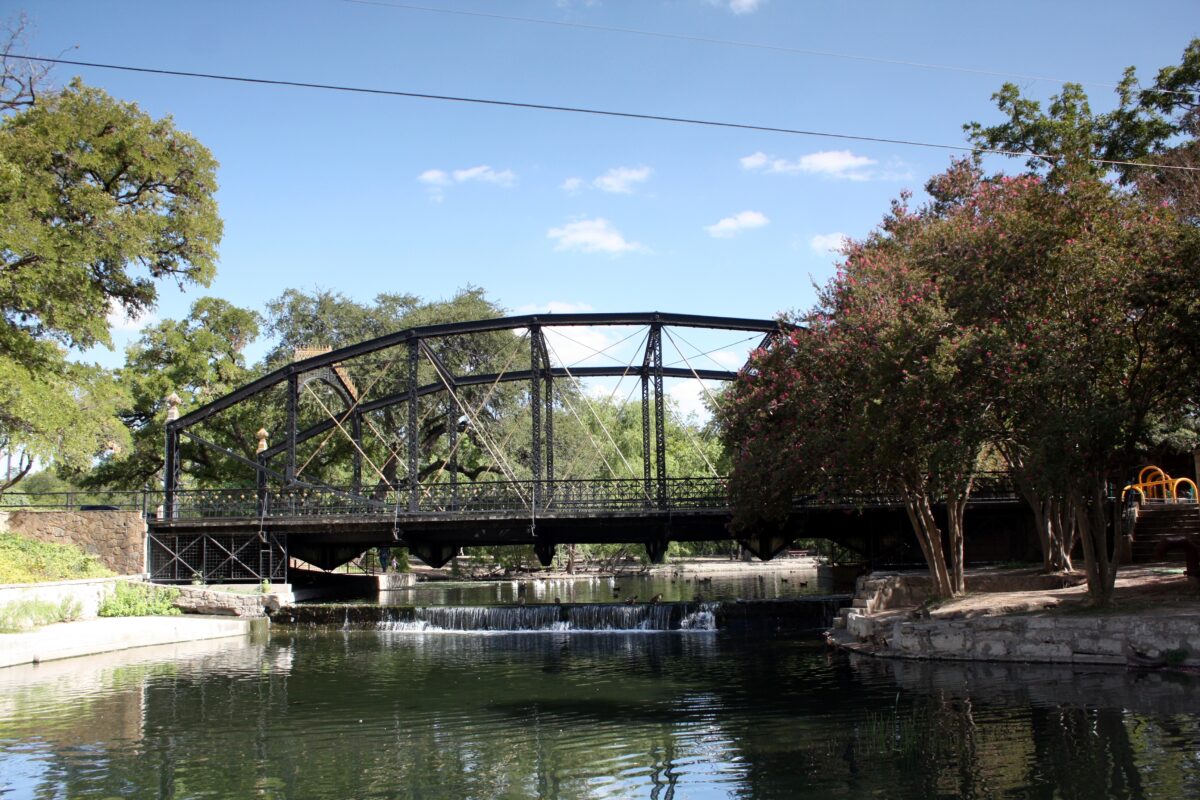
A Native American church is asking the U.S. Supreme Court to block the City of San Antonio from destroying a sacred religious site at Brackenridge Park. The city plans to redevelop the area by restricting access, cutting down trees, and preventing migratory birds from nesting.
Multiple conservative organizations have since stepped in to back the fight, citing concerns over religious liberty.
Background
In May 2016, San Antonio voters approved Proposition 3, which included $7.75 million for Brackenridge Park improvements. The city later adopted a project that included cutting down trees around the riverbend and implementing measures to drive off migratory birds nesting there.
This led Gary Perez and Matilde Torres, both members of the Lipan-Apache Native American Church, to sue the City of San Antonio in federal court, alleging that the development plan prevented the church from performing ceremonies necessary for their religious practice.
For centuries, indigenous worshippers have performed religious ceremonies at the site, and the plaintiffs contend that particular physical features, including the riverbend, trees, and nesting double-crested cormorants, create the religiously necessary “spiritual ecology.” Native American artifacts dating back several thousand years have been discovered at the site, and it is listed on the National Register of Historic Places and designated as a State Antiquities Landmark.
Perez and Torres sued under the First Amendment Free Exercise Clause, the Texas Religious Freedom Restoration Act, and the Texas Constitution. They asked the court to order the city to grant them access to the area for religious worship, minimize tree removal, and allow cormorants to nest.
The city fought back, reportedly telling the church that it could engage in its religious practices elsewhere.
Litigation
The district court acknowledged that the plaintiffs’ religious beliefs are sincerely held but found that the city’s plans did not substantially burden their free exercise of religion.
Judge Fred Biery did order the city to grant them “access for religious services in the Sacred Area,” but only involving fifteen to twenty people for approximately an hour on specified astronomical dates coinciding with their spiritual beliefs.
Perez and Torres appealed the decision to the U.S. Fifth Circuit Court of Appeals in New Orleans, where a three-judge panel asked the Texas Supreme Court whether the Texas Constitution’s religious-service protections extend to the government’s preservation and management of public land.
In June 2025, the Texas Supreme Court concluded that they did not, siding with the city. As a result, the panel affirmed the district court order in December.
The plaintiffs sought rehearing before the full Fifth Circuit, but were denied in an 11-6 vote. They subsequently appealed the panel’s ruling to the U.S. Supreme Court.
Conservative Support
Multiple conservative religious liberty organizations have since stepped in to support Perez and Torres’ case.
Groups including the Religious Freedom Institute, National Constitution Center, National Religious Broadcasters, CatholicVote.org Education Fund, Ethics and Public Policy Center, and Jewish Coalition for Religious Liberty filed briefs urging the Supreme Court to grant review.
After filing a brief in support of Perez’ case in the Texas Supreme Court in 2024, First Liberty Institute joined the plaintiff’s legal team in May 2026.
First Liberty Institute, in collaboration with the University of Texas Law’s Law and Religion Clinic, filed the petition for writ of certiorari, asking the U.S. Supreme Court to take up the case.
“San Antonio can redevelop the area without bulldozing a centuries old native American religious site,” stated Stephanie Taub, Senior Counsel for First Liberty Institute. “The Lipan church relies on the unique spiritual ecology of the ancient riverbend. The city telling them they can ‘just go worship elsewhere’ is nothing short of the government redefining their religious beliefs.”
Professor Steven T. Collis, director of the UT Law and Religion Clinic, further highlighted how the city’s actions violate the plaintiffs’ federally recognized religious liberties.
“Bulldozing a religious site is the definition of burdening religious practice,” said Collis. “Both the courts and the city are aware that our clients can worship nowhere else but this site, yet both have told them they are mistaken in their religious beliefs and can just go somewhere else. That violates the Religion Clauses of the First Amendment, as does refusing to do available, less-destructive alternatives.”
What Happens Next
The U.S. Supreme Court has not yet decided whether to hear the Lipan-Apache church members’ appeal, and the odds of review remain uncertain.
However, their petition highlights two asserted circuit splits on recurring religious liberty questions, meaning different circuit courts have reached separate conclusions, resulting in inconsistent federal law across the nation.
This factor makes the case more appealing to the Supreme Court, as it can clarify federal law and ensure consistent application from circuit to circuit.
If you or anyone you know has information regarding court cases, please contact our tip line: scorecardtips@protonmail.com.