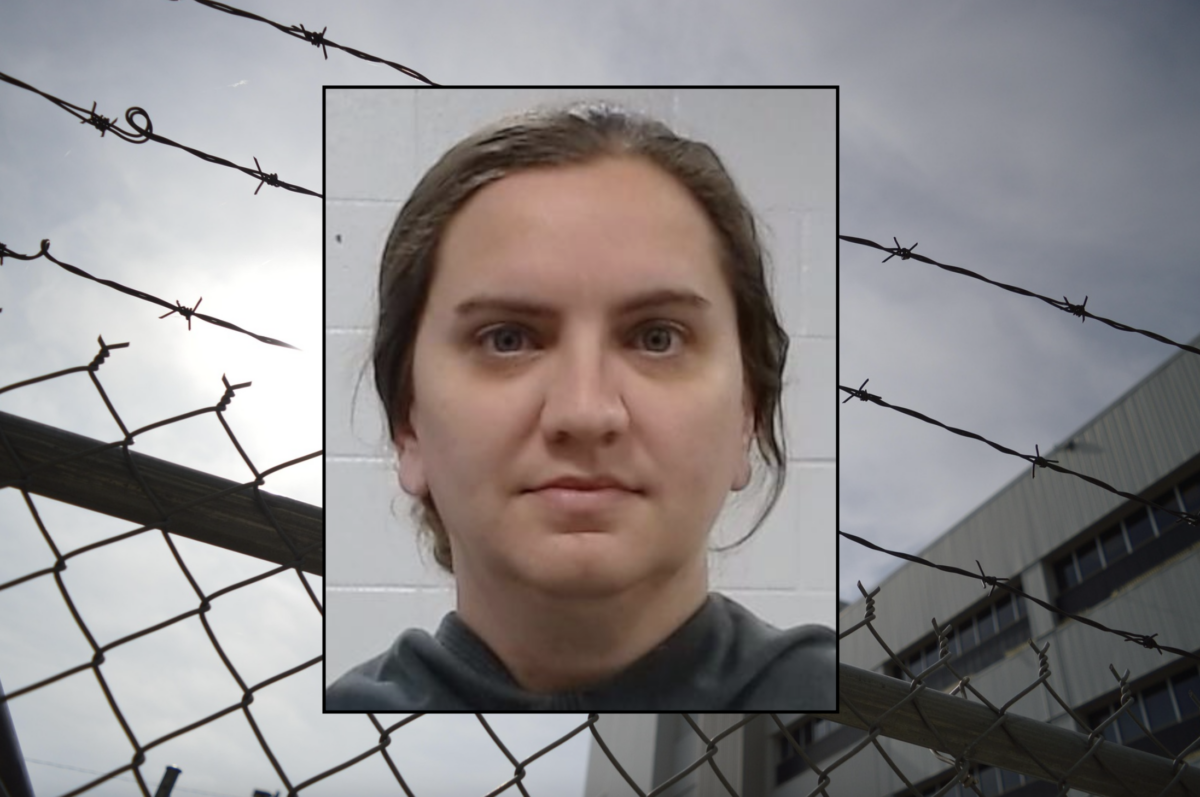
A Collin County jury sentenced a McKinney high school athletic trainer to five years in prison for sexually grooming and assaulting a 14-year-old female student.
Lindsey Elizabeth Post, 36, pleaded guilty to three felony charges, two counts of sexual assault of a child and one count of improper relationship between educator and student, as her trial began Monday in the 366th District Court of Judge Tom Nowak.
The jury of six men and six women then heard evidence to decide Post’s punishment. The defense asked for probation; prosecutors asked for prison time.
The penalty range for each of the second-degree felonies Post admitted to is 2 to 20 years in prison.
After a day and a half of deliberation, jurors sentenced Post to five years in state prison for one count of sexual assault. For the second count, the sentence was three years in prison probated to 10 years of community supervision. For the improper relationship charge, the sentence was two years probated to 10 years of community supervision.
Jurors included a $10,000 fine for each charge.
Post’s sexual assault convictions require lifetime sex offender registration and a lifetime protective order prohibiting Post from ever contacting the girl or her family.
During two days of emotional testimony, jurors heard how Post began grooming the girl in the fall of 2025 while in her first year of working at McKinney North High School. The girl was a freshman student-athlete at the school who began seeing Post for treatment of a sports injury.
Witnesses including the student and her parents described to jurors how Post used her position of authority to befriend the girl as a “trusted adult,” escalated to sexual grooming via tens of thousands of text messages, and physically assaulted the 14-year-old while on campus and in the back seat of her car while driving the girl to school-sponsored events.
Post did not testify.
The defense argued that Post is sick and needs help that she might not receive in prison.
A sex-offender expert testified that Post has “a thinking error” that causes her to believe a sexual relationship with a child is okay, but she concluded based on “empirical test results” that Post has a “low risk” of reoffending and was a good candidate for probation.
Post’s attorney also suggested the trainer’s “repressed homosexual desires” prompted her to prey on a child. Testimony revealed Post was engaged to marry a man at the time she was sexually abusing and declaring her love for the young girl.
Prosecutors said Post betrayed the trust of the girl’s family and the community, abused the young girl multiple times over the course of months, and knew her actions were wrong, as evidenced in 66,000 pages of text messages.
Several of Post’s texts to the student were read in court. Some were explicitly sexual, some declared her love for the girl, and others suggested ways to hide their illicit activity while acknowledging it was wrong.
“She was years away from being able to consent to anything that happened to her in the back seat of that car,” prosecutors said of the girl Post confessed to assaulting.
Background
Post was first arrested in January and charged with sexual assault of a child under the age of 17, the age of consent in Texas, and improper relationship between educator and student, which applies to students of any age. She was released from jail on bond.
In February, McKinney Independent School District trustees voted to fire Post.
Also in February, the student’s family filed a civil lawsuit against Post and McKinney ISD, accusing the district of gross negligence for enabling Post’s abuse of the girl. The suit is currently scheduled for a jury trial in February 2027.
Post was arrested again in March and charged with two counts of indecency with a child by sexual contact and violating a protective order issued as a condition of her bond by contacting the girl. She has remained in the Collin County Jail since then.
A grand jury indicted Post in April on five charges.
On Monday morning, Collin County prosecutors amended the indictment to include just the sexual assault and improper relationship charges.
Justin Alexander and Claire Kirk, felony prosecutors in the Collin County District Attorney’s Office Crimes Against Children Division, presented the case against Post.
Jeremy Rosenthal, a partner with Texas Defense Firm, represented Post.
Prosecution
Prosecutors called several witnesses, including the girl Post assaulted and her parents.
The girl’s mother testified first, explaining that her daughter broke her arm playing volleyball in June 2025 and began receiving physical therapy at McKinney North in August, at the school’s suggestion. Lindsey Post was assigned as her trainer.
The mother said she was close with her daughter and monitored her cell phone but never suspected Post was preying on the girl.
“You put your trust in someone to take care of them and then send them back home at the end of the day.”
She described how the family discovered the sexual abuse in January 2026, when her husband found the girl “acting really weird over her cell phone.” They checked her phone and found “explicit” text messages from Post. The girl then acknowledged the sexual “relationship” and assaults, and the parents contacted police, leading to Post’s first arrest.
The mother also testified that Post violated her protective order while out on bond by contacting her daughter. The parents again notified police, and Post was rearrested.
In a disturbing detail, testimony revealed that the sexual assaults in Post’s car occurred close to where the mom works. “I can see the street from my office building,” she testified.
Although Post had asked the girl to turn off the location tracking app on her phone, one day the mother spotted her daughter one street over from her job. She texted the girl, who made an excuse.
“The day we confronted her about the assaults, she confirmed she was there and being sexually assaulted,” she said. “Now it’s a daily reminder.”
The mom said she wanted the jury to give “the maximum” sentence to the person who molested her daughter.
Post’s attorney asked the girl’s mother about the civil lawsuit, after challenging the state’s motion to exclude mention of the suit as irrelevant to the criminal case.
The girl, now 15, testified that Post had been interested in her personal life in a way other teachers weren’t and became someone she could confide in. She described her surprise when Post grabbed her face and kissed her while they were alone in the office. “It felt wrong, but I didn’t know what to do.”
It happened a second time, also on campus, but the girl didn’t tell anyone.
“I didn’t want to get in trouble, or get her in trouble,” she said. “I thought it would go away. At the time, she was a friend and someone I could talk to.”
That’s when they started texting. Post also began taking the girl off campus during the school day to get food, which they would bring back and eat in Post’s office.
The girl testified that the first sexual assault occurred when Post was driving her to a competition for which the school did not provide transportation. On the way, Post parked in a secluded spot in a neighborhood, which happened to be within view of where the girl’s mother worked.
She said Post got in the back seat and asked her to get in the back too. Post then sexually assaulted the girl. The girl said this happened four or five times, the last time being on January 9, her father’s birthday.
Each time, they went back to school “like nothing happened,” she testified. She testified that Post asked her to take precautions so they wouldn’t get caught, such as turning off the locator on her phone, and to never tell anyone.
The girl also described an “awkward” situation when Post and her fiancé came to her home for her father’s birthday party.
She said when her parents finally found out in late January, it was “a relief, a weight off my shoulders.”
Since then, she’s had “some days good, some bad,” but said her parents have been very supportive and therapy has given her coping tools. “At the beginning I didn’t want to go, but looking back I was really in need of help.”
Prosecutors then questioned Joselyn Rivera, a former student trainer who graduated from McKinney North High School in 2026. She testified that Post’s relationship with the girl appeared “odd,” but she didn’t know what was going on. She said the girl was around Post so much, “many thought they were related.” Rivera testified that Post told her they had “like a mother-daughter bond.”
The defense attorney introduced the subject of other victims, prompting Rivera to agree that if Post had groomed or assaulted other students, “we would have heard about it.”
Kimberly Oku-Forrester, a McKinney North High School athletic trainer who shared an office with Post, testified that Post and the girl were “very close,” and that the girl called Post by her first name. She also said Post appeared to have a “trusting” relationship with the girl’s parents, which is “typical” with students’ coaches and trainers.
Oku stated emphatically that students were not allowed to be in the training room during instructional periods, but said the girl was often there because she had “passes” from her teachers. She also said it was uncommon for staff to give students rides in their personal cars, and that staff were not supposed to connect with students on social media.
The trainer testified that she was so angry Post had hurt one of her students that she said, “I have not spoken her name since this happened.” She has also been left to deal with the fallout of broken trust with parents and students since Post went to jail and the school’s other trainer, Logan Steiner, moved to Houston.
Asked by defense counsel why she didn’t say anything, Oku testified that did she ask both Post and the girl about the student spending class time in the training office. She did not report it to administrators because she “didn’t know” about other interactions between the two and the girl “had passes” from teachers.
The girl’s father testified that they are a “tight-knit family” that is very involved in sports, and that he and his wife go to all their daughter’s games and events. He described the girl as outgoing with lots of friends.
He said he first met Post at the beginning of the school year and sensed “nothing out of the ordinary.” He knew Post was providing therapy for his daughter and that they talked frequently at school, but he did not know that Post had started texting the girl every day.
The dad confirmed he interacted with Post again when she attended his birthday party with her fiancé, but said he still detected no “red flags.”
“Never, not once,” he said. “She wouldn’t have been welcome if we thought anything else was going on.’
He described discovering Post’s sexually explicit texts on his daughter’s phone. He said his wife went through the messages. “Being dad, I didn’t want to see that stuff. That’s my little girl.”
Once the girl told her parents the whole story, they contacted the police and the school.
The dad said his daughter “needed to understand that what was going on was wrong, an absolute betrayal of trust.”
He testified that counseling has helped, but knowing that a predator was able to find a way in and sexually assault their daughter has shaken their family.
“It’s broke my heart,” he added. “As the dad you’re the rock and the protector, and to see my wife and my oldest go through this is tough.”
McKinney Police Detective Jamie Voetz, a digital forensics specialist, testified about extracting cell phone data that confirmed the location of Post’s assault of the girl, near her mother’s office, and revealed the tens of thousands of text messages that Post sent the girl.
Prosecutor Alexander read aloud a sampling of the messages for the jury. Some were explicit, describing sex acts. In others, Post expressed love for the girl and also acknowledged that she knew it was wrong and took responsibility:
“Baby I’m so in love with you.”
“This sounds so bad, me saying this to someone who can’t even drive yet.”
“I feel really bad that you fell in love with me and I’m f***ing 35 and it’s not fair to you.”
In the notes section of the phone, police found more messages from Post to the girl:
“I love you more today than when I first met you… I will never stop loving you… I only meant to love you.”
“I’m so sorry… In so many ways, I blame myself for everything… I will love you forever.”
Defense
Post’s defense attorney Jeremy Rosenthal relied on testimony from an expert witness, Anna Shursen, who is a licensed sex offender treatment provider and a “de-registration specialist.”
Shursen testified Tuesday that she had interviewed Post and run five diagnostic tests, from which she concluded that Post was at “low risk” of reoffending and a good candidate for probation, also called community supervision.
“Extensive research shows us that sending low-risk people to prison increases their risk,” she testified, adding that not all women’s units have sex-offender treatment programs. The defense also stated that “our prisons are full,” so if Post were incarcerated, the state was “likely” to release someone who is a higher risk.
Shursen explained that on a six-question test to assess risk for female sex offenders reoffending, Post scored one out of six, with age (between 31 and 40) being her only risk factor. The other factors were past offenses involving child prostitution, drugs, any felony, any misdemeanor, or a prior child victim.
According to Shursen, other test results showed Post at low risk for general criminality (used to determine appropriateness for community supervision) and for nonsexual crimes or violence. She testified that a psychological test revealed Post suffered from “major depressive disorder,” and an IQ screen verified Post’s competency to stand trial.
She agreed with defense counsel’s assertion that Post’s behavior suggested a “thinking error” called cognitive distortion in which an adult cannot recognize something is wrong, such as believing a child is a “compatible sexual partner.”
She also agreed that Post’s criminal behavior could be impacted by “repressed desires” and being a survivor of sexual assault.
Prosecutor Alexander questioned Shursen about her process, which included reviewing the offense report, police notes, and “some” of the text messages, along with interviewing Post and administering standardized tests.
He noted that Shursen’s report stated her opinion was based on investigative information and “interpretation of the tests,” which she acknowledged are “about 70 to 75 percent foolproof.”
Shursen said none of the other information informed her conclusions.
“I give the tests, they give the answers,” she said. “Texts do not affect my opinion. The tests affect my opinion.”
She said the other information “isn’t a part of my evaluation” and “doesn’t come into my assessment of risk,” which is guided by her “extensive training by the authors of the evaluations.”
“My opinion is based on the empirical tests, the data that is truthful,” said Shursen.
Shursen also testified that Post violating her bond conditions did not change her assessment that Post is “motivated to comply” with conditions of community supervision.
Alexander also asked Shursen if Post’s alleged “cognitive distortion” could have just been grooming. Shursen responded that “Grooming is an act, not a thought … It’s not a thinking error.”
Post’s father and sister, who are both educators, testified for the defense as character witnesses.
Her father, Keith Post, a retired minister and former baseball coach who currently teaches philosophy at McKinney Christian Academy, testified that he and his daughter had a good relationship and were “very involved” through sports and church.
He confirmed that Post had helped care for her ailing grandfather in Midland for about two years. Post previously worked as an athletic trainer in Midland ISD from 2022-23 through the 2024-25 school year.
Post’s father also confirmed to prosecutors that Post had a fiancé and was planning a wedding with him at the same time she was sexually assaulting a young girl.
He testified that Post was “remorseful” and deserved a second chance, adding that his family would be “devastated” if Post was incarcerated.
“As a minister, I believe in grace and mercy,” he told prosecutors. Asked if there was any case of sexual assault in which someone deserved to go to prison, he answered “maybe.” Asked if the other affected family’s wishes regarding punishment should also be considered, he replied, “I suppose.”
Post’s older sister, an elementary school teacher, described Post as kind, compassionate, and selfless, and described their relationship as “close.” She said media coverage of the case had made her job “hard.”
She told prosecutors she believed the media coverage was due to attorneys “trying to get a rise out of people” because school employees sexually abusing students is “a hot topic in the state of Texas right now.”
The sister said she only learned about Post’s specific interactions with the student during opening statements in the trial.
Closing Arguments
In closing, Post’s attorney asked jurors for probation on all three charges, noting that “people get probation on these kinds of cases every single day.”
Rosenthal emphasized that Post “took accountability” by pleading guilty, and said “the most important thing is to make sure this does not happen again.”
Closing for the prosecution, Kirk told jurors that no penalty can make up for Post’s abuse, which “will affect this family for the rest of their life.” But she asked for prison as punishment for a “nightmare scenario” of a faculty member trusted by the community sexually assaulting a 14-year-old student, on her father’s birthday and in view of her mother’s window at work, and the student having to face her abuser in court then “go back to school and deal with everyone knowing what happened.”
Alexander added that the facts of the case, a 35-year-old in a four-month “relationship” with a 14-year-old in which multiple sexual assaults happened, called for punishment over rehabilitation.
“Also, this was someone who recognized what they were doing was wrong,” he added, citing Post’s texts. “So much for Dr. Shursen’s ‘cognitive distortion.’”
Alexander told jurors that, contrary to Post’s sister’s assertions, the media cares about this case “because it’s shocking.”
He added that media coverage of the punishment might also serve as a deterrent, especially on the charge of improper relationship between educator and student.
Why do we have this charge? Because the people of Texas want it. We want to know we can send our kids off to school and have them come home without this happening to them.
“Yes, you’ll see it in the news,” he told the jury, noting that “a lot of people will be interested in your decision,” including the public, prosecutors, defenders, police, everyone in McKinney North High School, and especially the assaulted girl’s family.
“Twenty years is on the table,” he concluded. “It’s yours to consider.”
After about 12 hours of deliberation, the jury settled on just five years of prison time, which began Thursday with credit for 221 days already served in Collin County’s jail.
Impact Statements
After sentencing, the girl’s parents read statements about the lasting impact Post’s crimes and the broken trust they caused will have on their family and others.
“When I sent my daughter to school, I believed she would be safe. I believed the adults would help her and protect her,” the girl’s mom said. “I couldn’t do anything to protect my child from someone she should have been able to trust.”
She said what breaks her heart the most is knowing the last parts of her daughter’s childhood were stolen by a trusted adult who knew better, leaving the girl with lasting emotional scars.
The girl’s mom closed by quoting Mark 9:32: “Whoever causes one of these little ones who believe in me to sin, it would be better for him if a great millstone were hung around his neck and he were thrown into the sea.”
“The judgment and the sentence does not reflect the lifetime sentence that we got as a family in January,” said the girl’s dad, directing his comments to Post. “We trusted you to do what’s best for our child. Instead you abused that trust.”
“We know you got your judgment down here, but you’ve got another one coming,” he added.
Post does not hold a Texas teaching certificate, but the Texas Education Agency added her to the state’s Do Not Hire Registry as “not eligible for hire” in a Texas public school. Sex offender registration will further prohibit Post’s activities once she is released from prison.
She is among hundreds of Texas school employees charged with sex crimes involving students and other children in just the past few years.
The TEA is currently investigating thousands of educator sexual misconduct complaints.
Texas Scorecard maintains a map of known educator sexual misconduct arrests.