School Resource Officer David Gomez lives in Idaho, but he’s nationally known for dispensing practical—and sometimes shocking—digital safety advice to parents and educators across America.
Gomez’ presentations are based on his years of experience working with students and tracking down predators as a middle school SRO and law enforcement officer.
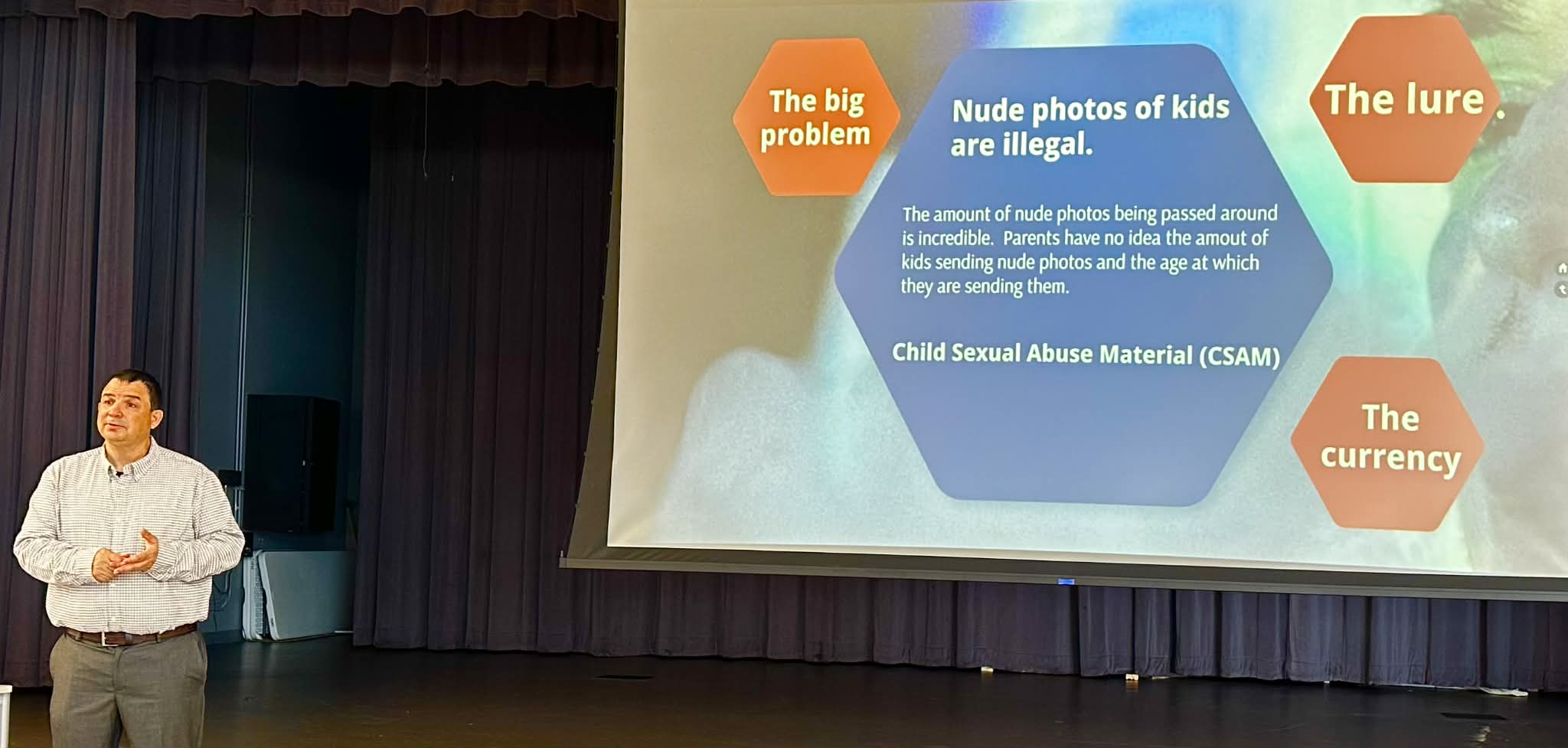
Officer Gomez, as he is known to more than 400,000 Facebook followers, recently visited a troubled North Texas school district to share straight talk about the dangers social media and online sexual exploitation pose to children.
He explained the many ways child predators are able to sexually exploit minors online.
“Nudes are the new currency,” Gomez said during a presentation at Moore Middle School in the Celina Independent School District, where a scandal began unfolding last year over a middle school coach secretly recording students undressing in the boys’ locker room.
Gomez said that by 8th grade, 50 percent of girls have sent nude photos of themselves to someone online, and by 11th grade the number jumps to 80 percent of girls.
“Basically grooming kids for sex trafficking,” Gomez warned.
Boys are targeted too and are often victims of “sextortion” schemes in which a predator convinces a boy to share nude pictures—often by pretending to be a girl and sending him female nudes first. The predator then threatens to expose the boy’s pictures unless he meets a demand for payment, which may be money or more nudes.
Officer Gomez said that in recent years, 22 young men have committed suicide over sextortion.
“We stop this by having the conversations,” he said, encouraging parents and educators to talk openly with kids about the tactics of online predators.
Social media applications are the tools most commonly used by predators to access potential victims.
Snapchat is the most dangerous social media app, according to Gomez.
“All Snapchat does is groom kids to be sexualized,” he said. “It’s very predator-friendly, and every predator knows that.”
He said creepers can use the app’s live mapping feature to find specific kids they’ve seen online.
Instagram is often used in middle schools for bullying, said Gomez. One problem for parents trying to monitor their kids’ social media is that users can have up to five different accounts.
Roblox, an online gaming platform, has the “most predators per user,” according to Gomez.
It’s popular with 6- to 12-year-old kids—and with predators.
“Almost every predator arrested has a Roblox account,” said Gomez. “It lets predators start grooming kids early.”
Due to recent lawsuits filed against Roblox, the age recommendation for the app just increased from 4 and up to 13 and up.
Gomez cautioned that kids can also use their school-issued Chromebooks to log into Snapchat and other apps.
“Kids can get around everything,” he said.
Officer Gomez believes schools should limit or eliminate devices during school hours, including cell phones and Chromebooks.
“You can have cell phones at school, or you can have education at school,” he said, adding that cell phone bans should be “bell to bell.”
Bipartisan legislation passed in 2025 as House Bill 1481 requires all Texas school districts to set policies that will prohibit students from using smartphones and other personal electronic communication devices from bell to bell.
“Unless it’s enforced, it’s meaningless,” said Gomez. “When enforced, it’s a beautiful thing.”
He said controlling students’ cell phone use at school, despite pressure from parents to allow it, requires “strong leadership and strong policies.”
“It can’t be left up to teachers,” he said. “It should come from the superintendent.”
“There is no reason why elementary kids should have Chromebooks,” Gomez added.
Officer Gomez offered “best practices” for families to keep their kids safe from online predators.
- No wifi-connected devices in bedrooms, including Chromebooks
- Conduct random cell phone checks
- No private messaging with random adults
- Set and stick to screen time limits
- Limit friends to less than 200 per app
Gomez said kids should not have smartphones until at least age 16, noting there is “no way to make them safe.”
“They will never be the same,” he said. “The longer you wait, the better.”
He also suggested family-building practices such as no devices at the dinner table, picking a sports team to watch as a family without wifi, and engaging in outdoor activities together.
At the end of his presentation in Celina, Gomez announced that he will soon be retiring from law enforcement and devoting more time to training students, parents, and professionals about digital safety.
More information about Officer Gomez and his educational programming is available on his website.
His “happy parenting” advice can also be found on Facebook and YouTube.