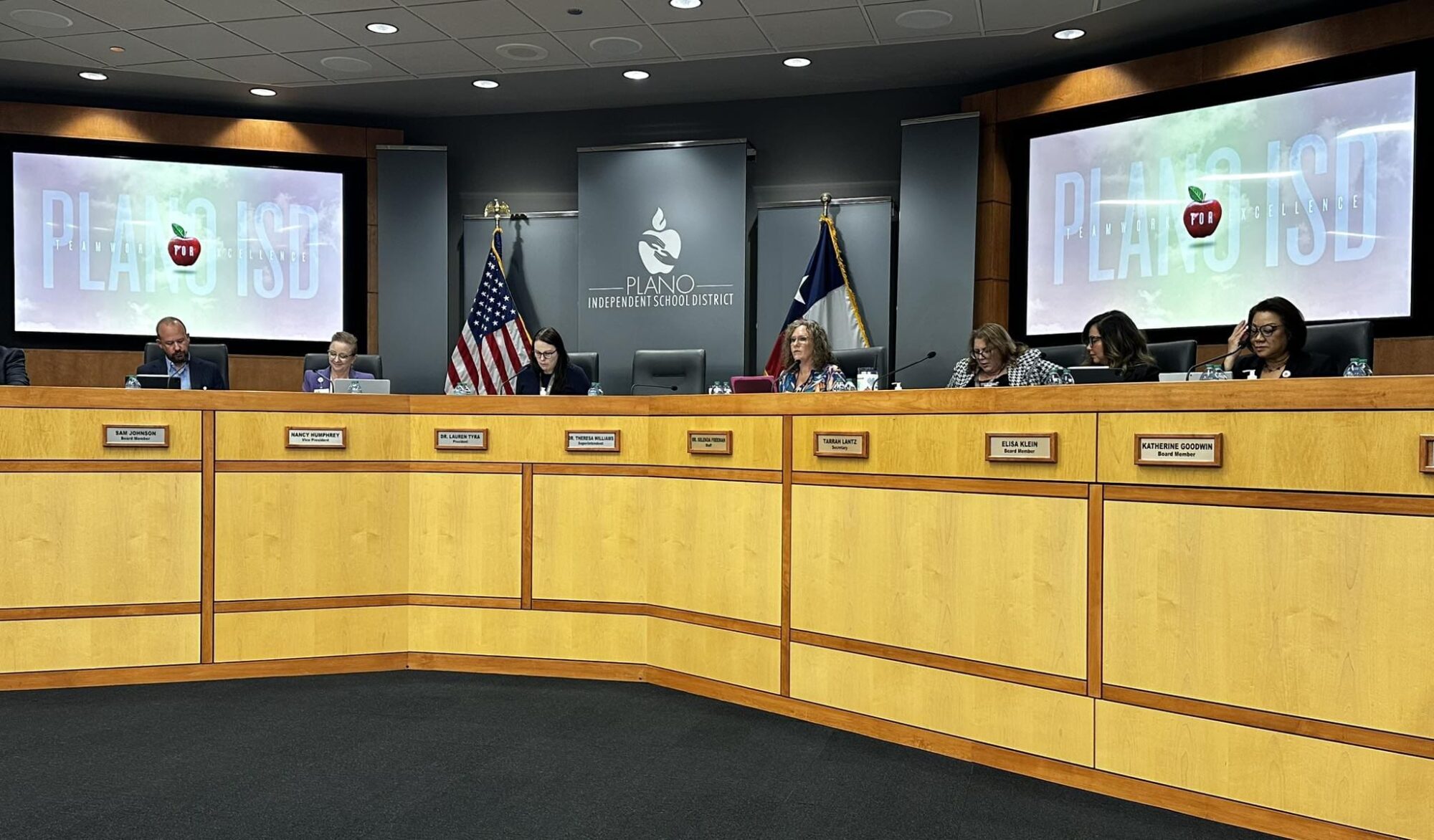
In a split vote, trustees in Plano Independent School District approved a new policy eliminating public comments on non-agenda items during board meetings.
The stated plan is to have occasional “community input meetings” instead, but such meetings are not required by the new policy.
Trustees voted 5-2 to restrict public comments to agenda items only during a board workshop on Tuesday night.
Trustees Michael Cook and Sam Johnson voted no.
Cook asked why the board was even considering the policy change.
“We’re solving a problem we don’t have,” said Cook.
About 20 citizens signed up to speak on the issue, with most opposed to the change.
Former Plano ISD Trustee Cody Weaver called the board’s plan to end non-agenda public comments “a blatant attempt to silence dissent.”
Plano parent Lisa Smith told trustees she’s a “strong opponent to removing non-agenda public comments” and said alternatives like the Let’s Talk messaging system are “not a substitute for an open forum where parents can speak freely about topics of concern.”
“You’re called trustees. We’re supposed to trust you. We don’t,” she added.
“If you don’t want to hear from the ones you serve, you’re in the wrong business,” Plano ISD mom Meghan Vecchio told trustees.
“We just want you to listen … just pretend to listen,” added Plano parent Richard Camacho.
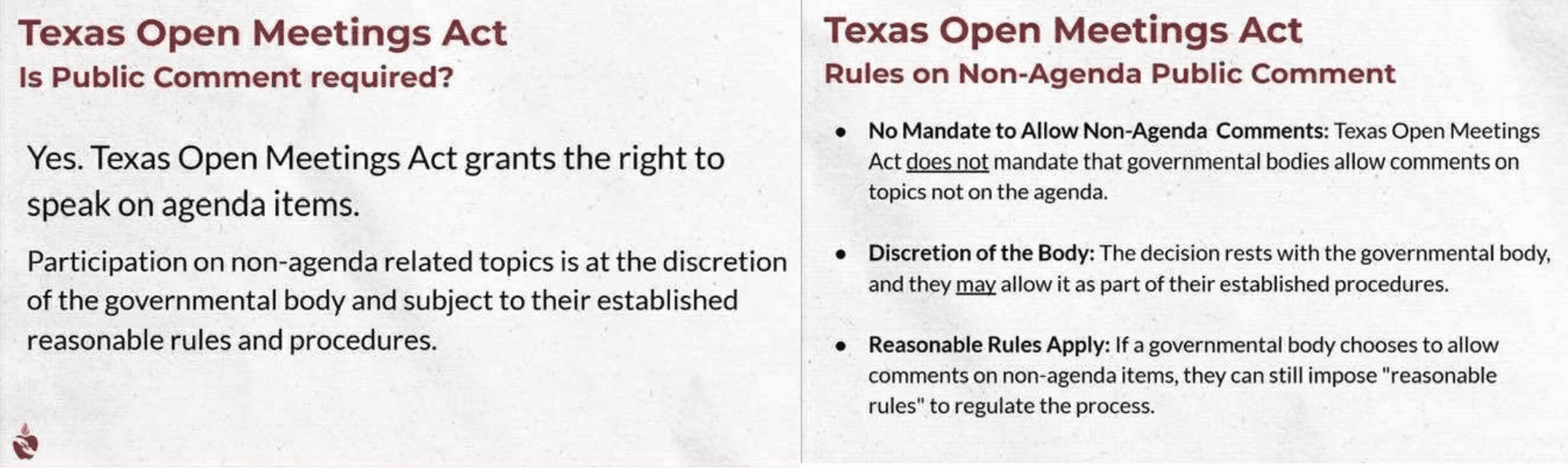
A presentation prior to the board vote indicated that the Texas Open Meetings Act (TOMA) does require public comments on agenda items, but public participation on non-agenda items is at the discretion of the board.
As proposed, the community input meetings would be held every month or two during the evening and attended by just three trustees so TOMA rules would not apply, allowing board members to have two-way communication with the public.
“I don’t see how this change is better,” said Cook, noting that it provides fewer opportunities for families to speak.
Board President Lauren Tyra said she would like the opportunity to interact with parents, which can’t happen during board meeting comments.
Tyra added that board meetings already go late, and separate meetings would alleviate that.
“Our board meetings are long, but not because of public comments,” replied Cook. “It seems like we’re putting together a flawed solution to something that isn’t a problem.”
Plano ISD’s underlying legal policy on public participation at board meetings, adopted in 2019, affirms that public comments must be allowed on agenda items. It also allows for “reasonable” restrictions and “alternative” forums.
Other districts also adopted that legal framework, recommended by the Texas Association of Schools Boards, and many have already eliminated public comments on non-agenda items.
Nearby Frisco ISD replaced public comments on non-agenda items with community input meetings that are attended by the full board and allow no interaction.
In another split vote, Round Rock ISD trustees eliminated public comments on non-agenda items in 2023, and directed the community to the Let’s Talk messaging system.
“What are we getting from this?” Cook asked other trustees prior to the vote. “A lot of people upset and less opportunity to hear from people.”
Many parents said they believe the policy change is intended to squelch public complaints about controversial issues such as sexually explicit books and harassment of Jewish students.
Trustees also voted unanimously Tuesday night to hire a third-party investigator to look into ongoing complaints of antisemitic behavior on campus.
Delivering prepared remarks lasting almost 10 minutes, Tyra attributed public complaints to “political grandstanding” and said the district’s focus is on the safety of students.
“As a board and as a district, we strongly reject and will not tolerate antisemitism, racism, or any form of hate in our schools,” said Tyra.
Tyra acknowledged that there have been “individual incidents of antisemitic behavior and bias in Plano ISD schools,” but said they had been investigated and consequences imposed.
“Let me be clear to all of our students and all of our families: we will see you and we will hear you,” said Tyra.
Yet the very families who have complained publicly during school board meetings about systemic antisemitism can no longer do so unless trustees place the topic on their agenda.
In addition, the board approved a property tax rate for 2025-26 of just under $1.04 per $100 of taxable valuation, the highest rate allowed by state law without a public vote.
The new rate will collect more tax revenue, but the average homeowner’s 2025 tax bill will drop slightly from $4,691 to $4,670.