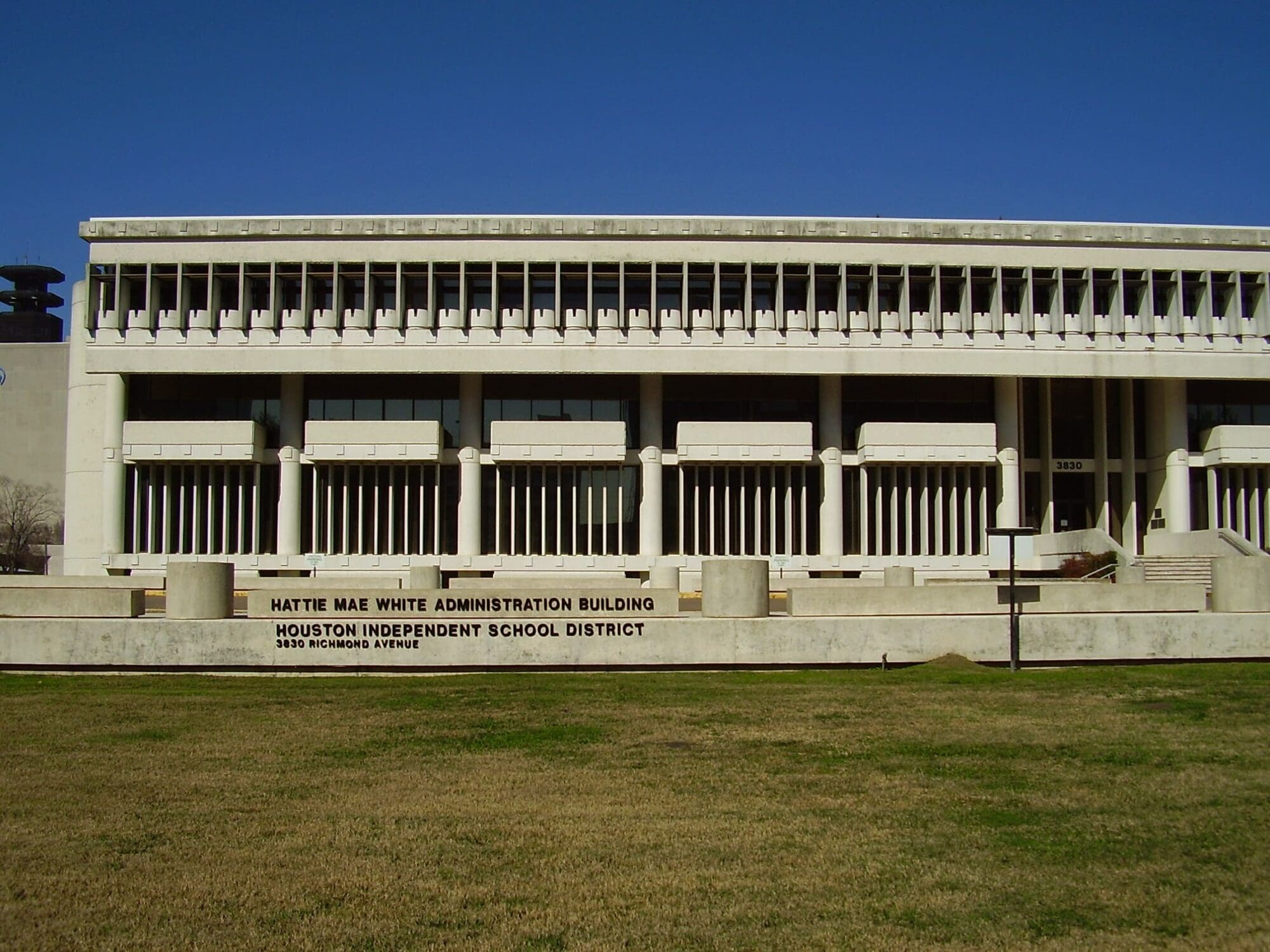
Houston Independent School District has lost more than 13,000 students since 2023, according to a newly released report from the University of Houston.
Researchers found that enrollment declines accelerated after the Texas Education Agency took control of the district due to failing schools and management problems.
The decline has been driven largely by families opting out at key decision points.
The analysis, conducted using data from UH’s Education Research Center, found that enrollment losses have been occurring year-over-year since the 2016-17 school year, with only one year, 2019-20, seeing an increase. After the 2022-23 school year, enrollment declines have increased more rapidly.
By 2024-25, the district was serving 176,693 students—down from 216,098 in 2016-17—with the steepest declines occurring in entry grades such as kindergarten, first grade, and ninth grade.
“The fact that the post-takeover enrollment declines are the largest in entry grades — early elementary and early high school lost the largest shares of students — suggests that when families are faced with an active decision, they are increasingly choosing to opt out of the district,” said Blake Heller, a co-author of the report and assistant professor at the Hobby School of Public Affairs.
Students leaving Houston ISD are largely transferring to neighboring school districts, charter schools, or leaving Texas public education entirely. Researchers noted that the enrollment decline has taken place before the expansion of school choice under Senate Bill 2, meaning additional competition could still be forthcoming.
The report also documents changes to the district’s teaching workforce since the takeover. The number of first-year teachers has increased substantially, while the share of uncertified teachers has risen to nearly one in five.
Toni Templeton, a senior research scientist at UH’s Institute for Education Policy Research and Evaluation, cautioned that replacing experienced educators with less experienced and uncertified teachers represents “an untested experiment,” particularly given longstanding research connecting teacher experience and certification with stronger student outcomes.
Enrollment declines have also had financial consequences. State-appointed Superintendent Mike Miles has said the district is losing approximately $50 million to $60 million per year in funding as student counts fall. That reality has fueled renewed discussion about school consolidations and alternative education models.
In recent weeks, Miles has also outlined plans to pilot two so-called “Future 2” schools, K–8 campuses designed around the expectation that artificial intelligence will become a dominant feature of the modern workforce. The proposal would rely heavily on accelerated online coursework and AI-focused instruction, though many details remain unclear.
“If you don’t attempt to envision and act upon some likely future, then any path forward will do — and it’s likely to be the path you’re on,” Miles told the board of managers, arguing that traditional public education has failed to keep pace with technological change.
Under the proposed model, students would complete semester-long courses focused on AI tools, design thinking, and cultural studies. Additional requirements would include learning a musical instrument and participating in after-school activities such as team sports, community service, or swimming.
As enrollment continues to fall, particularly among families making initial or transitional enrollment decisions, the UH report raises broader questions about whether state intervention alone can stabilize a district losing both students and veteran educators.