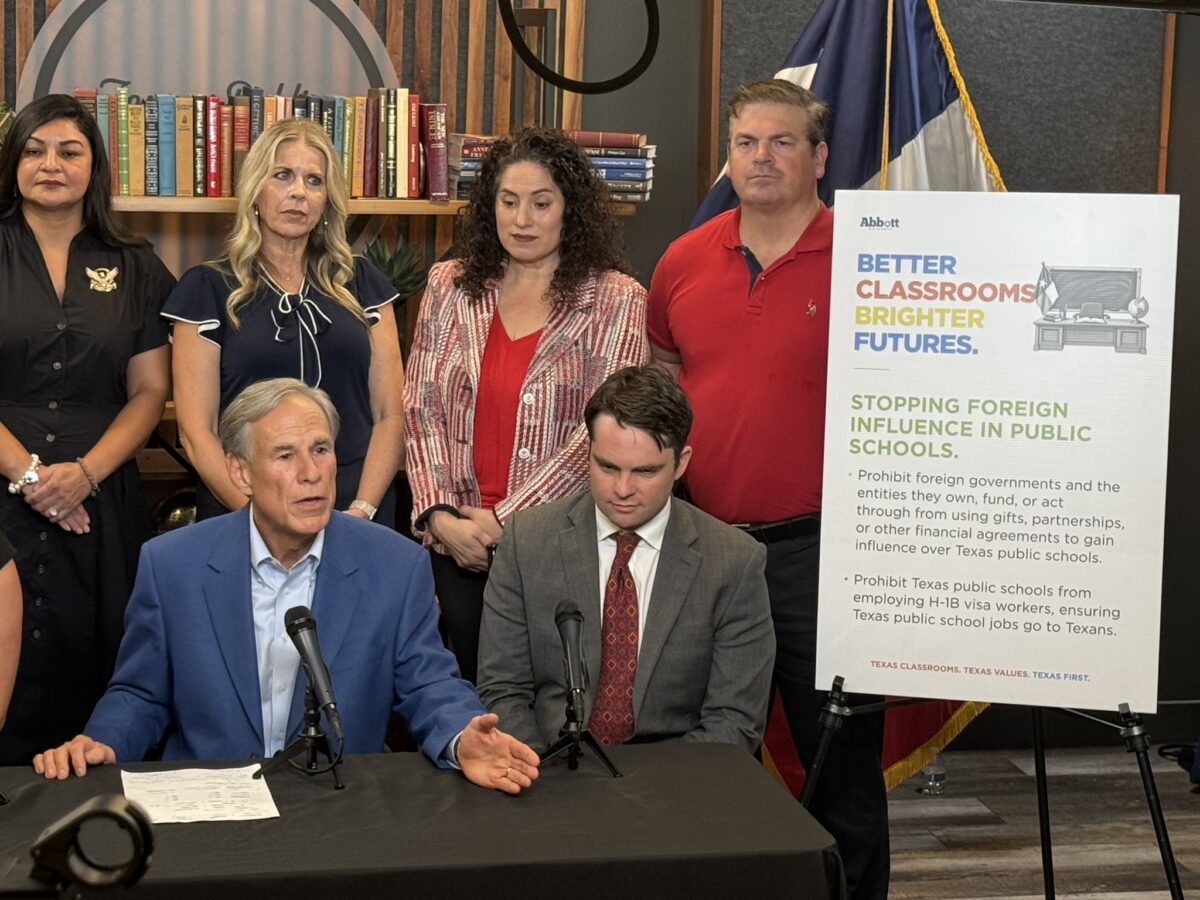
Gov. Greg Abbott is calling on Texas lawmakers to ban foreign funding in public schools and prohibit districts from employing workers through the federal H-1B visa program.
Abbott announced the proposals Tuesday as part of a broader push aimed at eliminating foreign influence in Texas classrooms.
“The minds of our students are driven by influences that they are exposed to in our public schools,” said Abbott. “Those minds should be shaped by policies that are approved by state lawmakers.”
Abbott pointed to Austin Independent School District’s acceptance of hundreds of thousands of dollars from Qatar to support Arabic language and culture instruction, as well as school districts that have participated in Confucius Classroom programs affiliated with Chinese government-backed entities.
“We cannot condone the quiet indoctrination of our children in the classroom,” said Abbott.
The governor said he will ask lawmakers to prohibit public schools from accepting gifts, money, or property from foreign sources or entering into partnerships or financial agreements with them.
Abbott was joined at the announcement by officials from the Texas Public Policy Foundation, who highlighted examples they say demonstrate foreign and Islamist influence in Texas education.
Kate Bierly said public records obtained from Austin ISD revealed classroom materials associated with Arabic language and culture programs, including an activity in which second grade students were instructed to create a greeting card praising the Prophet Muhammad and attach a cutout of the Kaaba, Islam’s holiest site.
Bierly said the extent of foreign influence in K-12 education is difficult to determine because reporting requirements are less extensive than those governing higher education.
“There is no circumstance in which it is acceptable that Texas children should be indoctrinated with radical Islamist ideologies in Texas schools,” she said.
Abbott is also asking lawmakers to prohibit Texas public schools from employing H-1B visa holders.
An H-1B visa is a temporary U.S. work visa that allows employers to hire foreign workers in certain specialty occupations that typically require at least a bachelor’s degree.
“Exactly zero Texas public school employees should be here on H-1B visas,” said Abbott. “This expands on my prior directive, freezing new H-1B visa petitions in all state agencies and all state universities.”
In January, Abbott ordered an immediate freeze on new H-1B visa petitions by Texas state agencies and public institutions of higher education, arguing that the federal program had been abused to displace American workers.
Under that directive, no state agency controlled by a gubernatorial appointee or public institution of higher education may initiate or file a new H-1B visa petition without written approval from the Texas Workforce Commission. The freeze is scheduled to remain in effect through May 31, 2027, the end of the next regular legislative session.
At the time, Abbott argued the program was created to supplement the American workforce rather than replace it and said state government should ensure taxpayer-funded jobs are filled by Texans first.
His latest proposal would go further by extending the crackdown to public schools and barring both new and existing H-1B workers from employment.
“We’re tired of the federal government not putting limits on who can come in under H-1Bs, and because of the federal government’s failure to control H-1B visas, Texas is having to put our foot down,” said Abbott.
“We need to find Texans or Americans who can educate our students. Period.”
When asked by Texas Scorecard whether the proposed ban would apply only to new H-1B applicants or also those already working in Texas public schools, Abbott said it would apply to both.
“The law that I’m proposing would apply to all H-1Bs,” said Abbott.
Asked specifically whether that includes workers seeking to renew their visas, Abbott confirmed it would.
“For public schools, no H-1B visa applicants or current users can be employees in Texas public schools.”
The governor said he will address H-1B visas in higher education separately in the coming weeks.