Recent actions from an advisory-only faculty group highlight the changing nature of university governance in the Lone Star State.
During a meeting of Texas A&M’s Faculty Advisory Council last week, members declined to recommend changes to a series of courses despite concerns that the courses in question would promote far-left content in an “unbalanced” manner.
Business professor Adam Kolasinski had requested the removal of two courses from the consent agenda to challenge their content and syllabi.
Kolasinski argued that course materials for the first course, Stereotypes and Prejudice, presented a narrow, one-sided perspective that promoted DEI and systemic racism narratives without offering counterarguments or a broader scholarly spectrum. He moved to send the course back for redesign.
Representatives from the department and others said the council should trust the expertise of the department faculty. The motion to send it back failed, and the course was subsequently approved.
Kolasinski also objected to the use of an “advocacy textbook” in Sociology 421: Gender and Crime, that promoted so-called “prison abolition.”
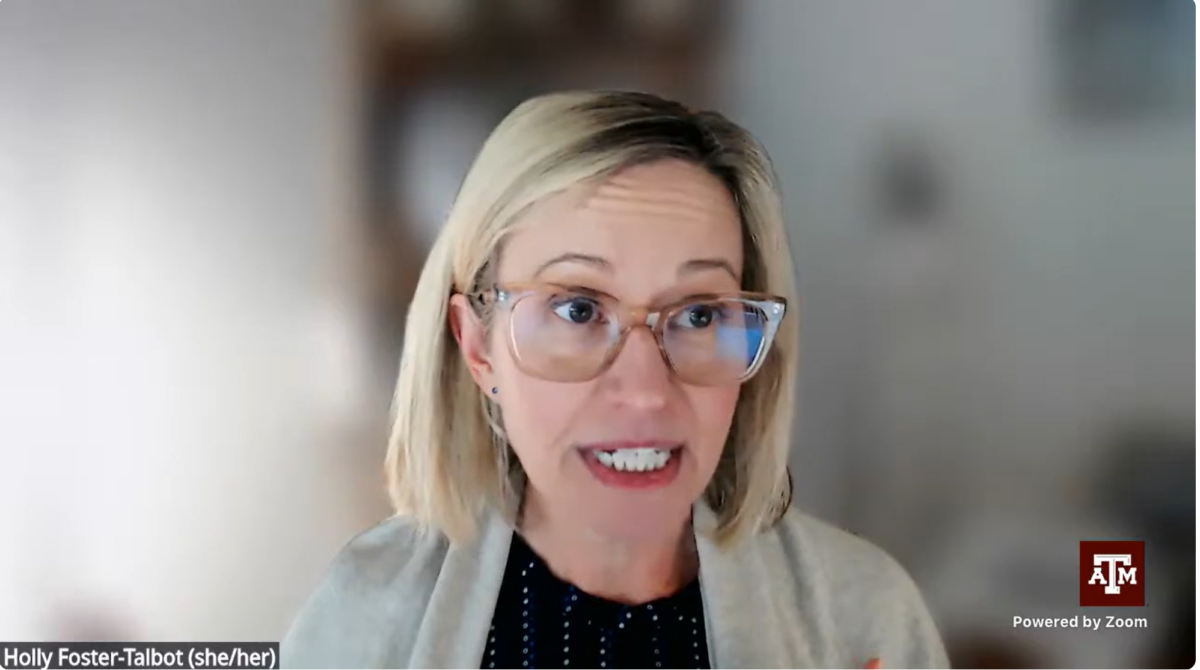
The instructor, Holly Foster-Talbot, countered that the readings are meant to be engaged with critically, not blindly accepted.
The motion to return this course to the department also failed, and the course was approved.
While the faculty advisory committee declined to consider these objections, Texas A&M is not obligated to follow their recommendations.
In 2025, state lawmakers passed Senate Bill 37, which abolished the practice of shared governance. Under that system, boards of regents and university presidents would delegate formal decision-making authority to selected faculty.
Current law permits universities to establish faculty advisory groups that have no final decision-making authority.
University President Susan Ballabina retains final authority on all matters of campus governance.
Later in the meeting, Kolasinski asked Ballabina about issues of public trust and academic intellectual diversity. Referencing a study by the Claremont Colleges, he noted that professors often insulate students from differing viewpoints on controversial topics and expressed concern that this is a persistent problem in many Texas A&M syllabi.
President Ballabina responded that she was unfamiliar with the specific study mentioned but gave a statement in favor of “public trust” as an abstract concept.
Texas A&M University is a component of the Texas A&M System. The Texas A&M System is overseen by a Board of Regents that is appointed by the governor and confirmed by the Texas Senate. Robert Albritton of Fort Worth is the current board chair.
If you are a student, parent, faculty member, or concerned citizen who would like to partner with us to promote transparency in taxpayer subsidized higher education, please email scorecardtips@protonmail.com.