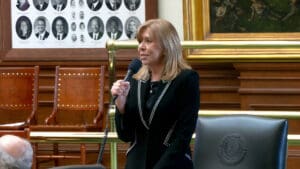
Democrat State Rep. Lauren Simmons filed legislation to allow public employees to engage in collective bargaining and to strike.
House Bill 1257 by Simmons (D–Houston) would replace Texas’ prohibition on public-sector collective bargaining with language allowing state and local officials to negotiate contracts with unions over public employees’ wages, benefits, and working conditions. It would also replace the ban on recognizing labor organizations as bargaining agents with language permitting, but not requiring, officials to recognize them.
The proposal would also allow public employees to engage in a strike or “an organized work stoppage against the state or a political subdivision of the state.” It would also remove Chapter 617’s requirement that striking employees forfeit civil service rights, reemployment rights, and other employment benefits and privileges.
Current state law allows individuals to get a job without being required to join a labor union, making Texas a “right to work” state. This provision remains unchanged under the bill.
John Bonura, a policy analyst for the Texas Public Policy Foundation, warned that “allowing public employees to strike and pursue collective bargaining agreements is fraught with danger.”
Bonura told Texas Scorecard that the main issue with the proposal is that because public employees are paid by Texans through property taxes, the government-sector bargaining changes the “mental model” from “‘worker’ versus ‘management’ into ‘public employee’ versus ‘taxpayer’” and pits “the governing class against the governed.”
He also raised concerns about public safety, posing the question of what happens to crime, fires, and the safety of Texas children when public employees go on strike. Separate laws already provide collective bargaining rights to certain police officers and firefighters. Chapter 174 establishes bargaining and dispute-resolution procedures in jurisdictions that adopt it, while separately prohibiting strikes. HB 1257 does not expressly amend that chapter.
“This is another ploy by the Education Cartel to lobby government for more government, using kids and classrooms to their political advantage,” said Bonura. “Teacher unions and professional associations use their member dues to establish and maintain PACs to support candidates who run on platforms of ending school choice, reinstating DEI, and view taxpayers as ATMs.”
“School districts are already the largest portion of property tax bills for families who are having to cut back in every area,” he added. “If we are really looking out for the best interest of our teachers, we should be passing legislation that ensures money stays in the classroom.”
If enacted, HB 1257 would take effect September 1, 2027.
Democrat Gov.-elect Gina Hinojosa, who began her career as a labor lawyer representing several unions, is likely to favor such legislation.
While Democrats will hold the majority in the Texas House, Republicans will maintain a majority in the state Senate.