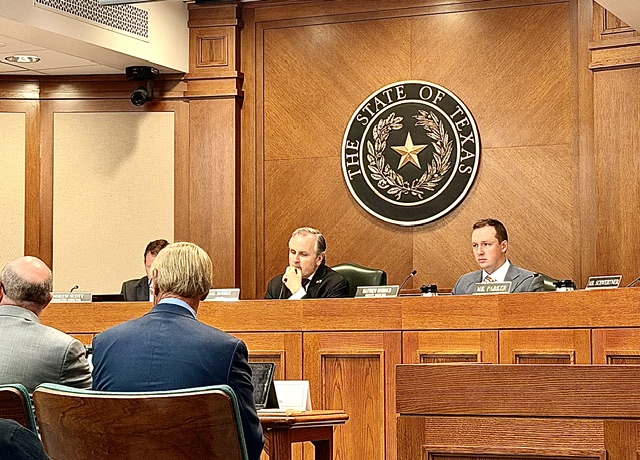
In an hours-long committee hearing, Texas senators questioned policy experts and officials on issues like proxy advisory firms’ influence over corporate ESG and DEI decisions, enforcement gaps in Texas’ voter registration system, and shortfalls in enforcing the state’s abortion pill ban.
Members of the Texas Senate State Affairs Committee also examined how recently passed legislation is being implemented and sought to gather information ahead of the 2027 legislative session during Tuesday’s hearing.
Chairman Bryan Hughes (R–Mineola) opened the hearing by outlining the committee’s concern that proxy advisory firms—created to give companies neutral guidance on shareholder votes—have increasingly pushed political and ideological positions rather than financial ones. Texas, he said, is trying to rein that in.
Senate Bill 2337, passed last session, requires proxy advisors to disclose when their voting recommendations are based on nonfinancial factors such as ESG or DEI considerations.
Institutional Shareholder Services and Glass Lewis, who together control over 90 percent of the proxy advisory market, sued in federal court to block enforcement. Litigation remains ongoing.
The senators expressed disappointment in the firms’ refusal to show up and raised the possibility of issuing subpoenas to compel them to appear. “The fact that they’re not here speaks volumes to what their position is,” said State Sen. Paul Bettencourt (R–Houston).
Witnesses claimed proxy advisors blocked nearly $1 trillion in Texas-bound corporate capital by advising against redomiciling in Texas, notably in ExxonMobil’s case.
“A trillion dollars of total effective wealth … they’ve advised not to come to Texas, and for what I believe is purely political activism,” Bettencourt said.
Eric Bledsoe from the American Resolve Institute testified that proxy advisory firms have issued voting recommendations driven not by financial analysis but by political agendas, citing race and gender-based criteria as an example.
The hearing soon turned to election security.
Sen. Charles Perry (R–Lubbock) echoed the frustration of several citizens testifying to issues with the state’s election system. He noted that the problem remains ongoing, and the same data integrity problems return every legislative session. “Garbage in and garbage out. Groundhog Day for me again,” he said. “This is getting old.”
Senate Bill 16, introduced last session, would have required proof of citizenship for voter registration, but the bill died in the House Calendars Committee.
However, Christina Adkins, director of the Secretary of State’s Elections Division, said they ran the state’s entire voter registration list through the federal SAVE immigration database and identified approximately 2,700 potential noncitizens. She said the work means her office has already “done most of the heavy lifting” to implement SB 16 should it pass next year.
Senators also pressed Adkins on chronic failures with TEAM, the state’s voter registration database used by all but 15 counties. Bettencourt warned the vendor is behind on delivering fixes ahead of the November election.
Bettencourt offered an example of Harris County having verified approximately 1,700 registered voters in Seabrook, but the TEAM system shows 181,000.
“If we don’t have voter roll integrity, we won’t have faith in the election process,” he said.
Adkins responded that there is “nothing more important in our office than this problem.”
Jennifer Doinoff, Hays County elections administrator and legislative chair for the Texas Association of County Election Officials, said her members have managed by running workarounds for four to eight consecutive election cycles.
“They are secure,” she said. “I just don’t know if that’s sustainable moving into November.”
Election consolidation drew significant discussion.
Sen. Bob Hall (R–Edgewood) blamed the sheer number of elections, even overlapping, that took place in May for low turnout and voter confusion, pushing for a single election each year.
Chuck DeVore of the Texas Public Policy Foundation supported the idea with data, as recent May local and primary runoff elections drew between 4.9 percent and 17.8 percent turnout, compared to 61.2 percent in November 2024.
Sen. Tan Parker (R–Flower Mound) also suggested directing the new Texas Cyber Command’s talent toward election monitoring, which Adkins called “two sides of the same coin.”
Hall further called the multi-vendor voter registration system unworkable, urging a single state-run system. “We’ve got to set aside the money and do this. It will save us money … in the long run.”
The committee’s final agenda item focused on the enforcement of Texas’ abortion pill ban.
Witnesses argued that despite the passage of the Woman and Child Protection Act in 2025, billed as the nation’s first law targeting the abortion pill distribution chain, significant enforcement gaps remain. Multiple individuals testified that abortion pills continue to enter Texas through the mail, across the border, and via online distributors.
“Abortion is illegal in Texas, but abortion is happening every single day,” said Jana Pinson, executive director of the Pregnancy Center of the Coastal Bend.
She and others urged lawmakers to strengthen enforcement, arguing that online distributors remain accessible, drug manufacturers face little liability, and the attorney general needs broader investigative authority.
They also raised concerns about coerced abortions.
Dr. William Lile, a board-certified OB-GYN, recounted the case of a Louisiana girl who delivered a 23-week-old baby after her father allegedly administered abortion pills without her knowledge.
A similar case in Corpus Christi could not be prosecuted because no commercial test exists to detect the drug.
Dr. Lile testified that the abortion pill is more dangerous than the FDA originally reported, citing a study of approximately 865,000 women.
“I cannot understand how a procedure that nearly killed a woman in a third-world country is still available in the wealthiest nation on earth,” said Sara Huff, who testified about her horrible experience with the abortion pill in her native Brazil.
Witnesses also highlighted the role of pregnancy resource centers, with Pinson urging lawmakers to expand access, particularly along the Texas-Mexico border.
Hall noted that his office is distributing heart-shaped flash drives that allow pregnancy centers to send expectant mothers home with ultrasound images and recordings of their baby’s heartbeat. Pregnancy centers can contact his office to receive them.
The next legislative session begins on January 12, 2027.