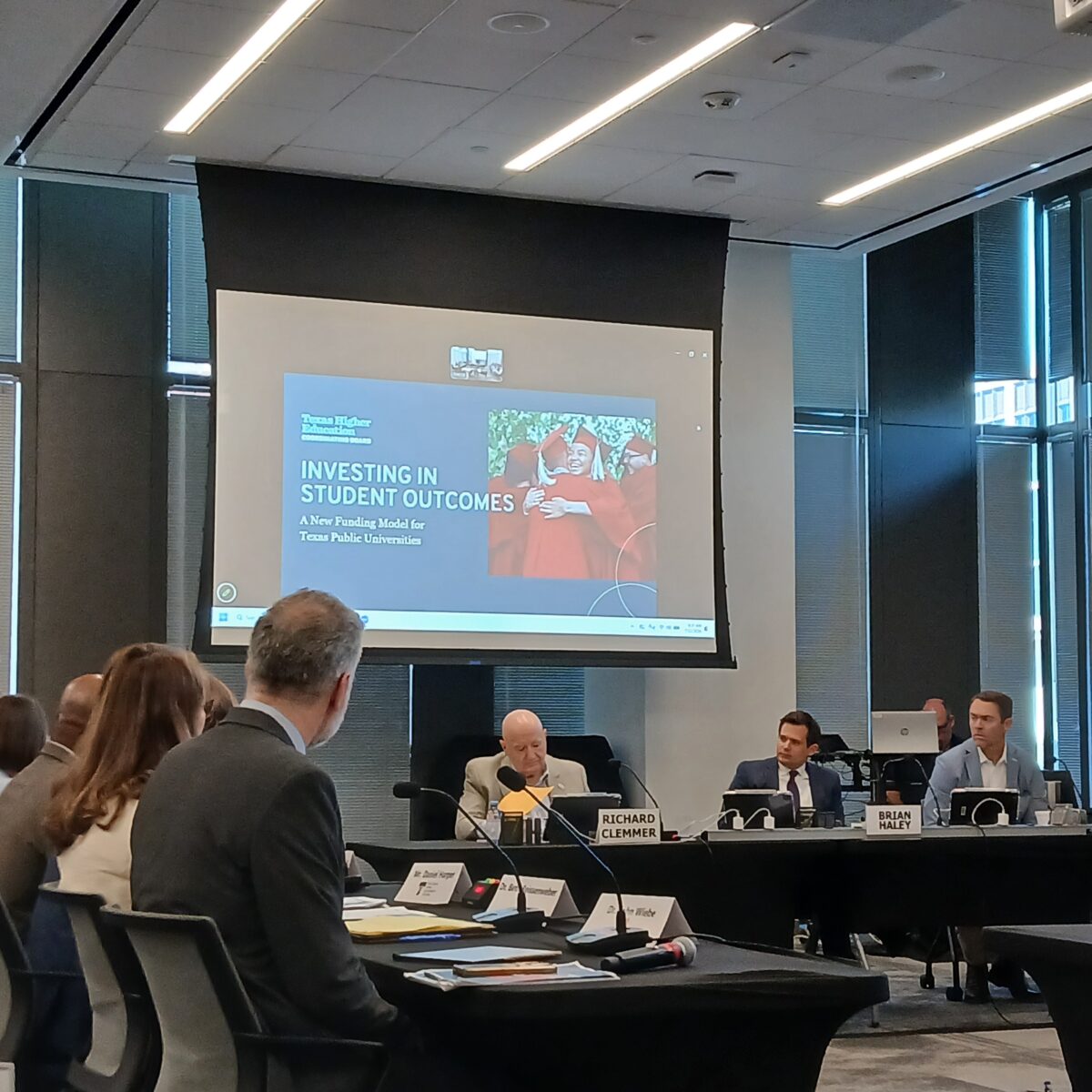
The Texas Higher Education Coordinating Board took action on a series of agenda items during its quarterly meeting Wednesday.
The board approved moving toward funding formulas that prioritize a measurable return on investment for students. Additionally, the board initiated a rulemaking process to allow the use of new college entrance examinations based on classical education principles.
A presentation on a report that recommended revisions to so-called “performance-based” funding formulas suggested moving away from arbitrary “institutional enhancement” standards to funding based on a discernible return on investment for students.
The report was created in response to a legislative rider in the current state budget.
Members of the board voted to approve sending the report to state lawmakers, who are expected to revisit this issue next session.
Board members also voted to begin a rulemaking process regarding the entrance examinations considered “rigorous and reliable” to be eligible for use at taxpayer-subsidized universities.
This rulemaking process is based on a report that recommends a “conditional and evidence-based” approach without defining those terms.
A representative of the Classic Learning Test (CLT) spoke of the need to “break up the SAT and ACT’s duopoly.” He also spoke of the need for a vendor to create new tests following Texas’ recent revisions to K-12 social studies standards.
The CLT exam is popular with advocates of classical education and homeschooling. It became popular following a series of woke controversies in older, more established examinations. Florida Gov. Ron DeSantis has promoted its usage.
The board is expected to finalize these rules for its January 2027 meeting. If adopted, they would go into effect for the Fall 2028 admissions cycle.
A rule clarifying the definition of “de minimis” as “a non-cash item with a value of less than $50 that is unsolicited, non-recurring, and not offered in exchange for any official action” for higher education employees who accept gifts from foreign adversaries was approved by the board. All gifts above that threshold are prohibited without special authorization.
Chief Financial Officer Anthony Infantini gave a presentation regarding legislative appropriations requests for the 2027 legislative session. The coordinating board must submit its initial appropriations request by August 14.
The coordinating board is expected to request approximately $2.5 billion in so-called “baseline” funding.
Infantini also stated that the staff is likely to seek board authorization to issue bonds at its October meeting. State statute authorizes the coordinating board to issue General Obligation (GO) College Student Loan Bonds to fund low-interest education loans for eligible Texas residents.
The board passed its 78-page consent agenda without discussion.
This was the first board meeting for commissioner Brian Haley, a recent Democrat donor who Gov. Greg Abbott appointed to fill a vacancy on the board. Haley delivered remarks about advancing higher education.
The Texas Higher Education Coordinating Board oversees a variety of functions related to the state’s taxpayer-subsidized universities. Stacy Hock of Austin is the current chair.