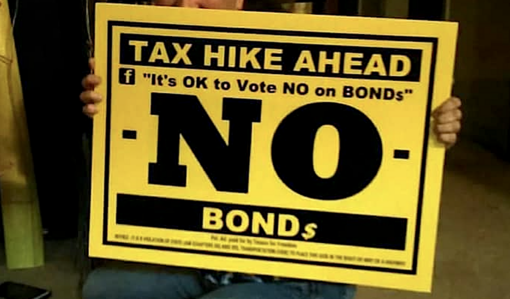
Texas lawmakers should require stronger voter support and clearer financial disclosures before local governments can authorize bond debt, according to a new Texas Public Policy Foundation report.
The report by TPPF’s John Bonura and Sukhadeva Mitta recommends requiring 60 percent approval for bond propositions, establishing minimum voter turnout requirements, moving bond elections to November, and disclosing estimated repayment costs, including interest, on ballots.
“Although there have been many strides taken at the state level to reduce the property tax burden, local governments’ incessant and reckless spending continues to drive up the bill,” wrote Bonura and Mitta.
Citing a 2025 analysis, the report puts Texas local governments’ combined principal and interest obligations at $552 billion. “This saddles every man, woman, and child in the state with $18,939 in debt. This debt is driven entirely by unrestrained local government spending,” the authors noted.
In May 2026, voters approved 63 percent of proposed bonds.
Yet this past Tuesday, voters rejected approximately 75 percent of bonds and voter-approval tax rate elections (VATREs) on the ballot.
Bond elections authorize borrowing. VATREs allow school districts to seek approval for operating tax rates above a statutory threshold; they do not authorize new debt.
Currently, a simple majority is required for a bond to pass. Bonura and Mitta argued the benefit of a 60 percent supermajority instead, which could have saved taxpayers nearly $6.4 billion in debt in May.
Another suggestion is to establish a minimum turnout requirement. Senate Bill 702 sought to require a 30 percent minimum participation in bond elections but did not pass in 2017.
“A minimum turnout floor would ensure that decisions reflect a true community consensus rather than the preferences of a select few,” wrote Bonura and Mitta.
The report highlights how a single person voted in the Denton County Municipal Utility District 7 Proposition C election and approved more than $5.9 billion in taxpayer-backed debt.
The City of Saginaw’s Proposition B sought $9.6 million in debt and won by a margin of 1 vote.
“Relatively few residents can authorize debt obligations worth tens or even hundreds of millions of dollars,” the authors argued.
Tarrant County had 4.1 percent of registered voters show up in May 2026, but in November, 55 percent turned out.
To mitigate low voter turnout, Bonura and Mitta recommended a uniform November election date.
Bonura and Mitta also argued that bond ballots need more transparency, calling ballot language “vague and structured in ways that obscure rather than illuminate the financial commitment being made.”
Instead, the report recommends universal distribution of Voter Information Documents and bond ballot language that includes estimated total repayment, with interest.
Current bond ballots only include principal without interest, debt which taxpayers are also responsible for.
The report also contends that unrelated projects should not be bundled into single propositions and that property tax estimates should be based on a home value of $339,000 instead of $100,000.
Bonura and Mitta noted that their recommendations “are not punitive measures against local governments, but ways to put the decision to incur debt more firmly in voters’ hands.”