This article has been updated since publication with comments from SBOE member Will Hickman and Next Gen Personal Finance.
As the State Board of Education prepares to vote Tuesday on new personal financial literacy course standards for Texas students, a social media post and an internal record revealed that a California nonprofit helped shape key language while free‑market lessons were changed and entrepreneurship was quietly stripped from the course.
District 2 board member LJ Francis (R) proposed changes that would remove learning about entrepreneurship from the course.
Texas Scorecard obtained an internal state board document tracking proposed changes for state PFL standards. According to this document, the justification for striking entrepreneurship is that this is “a PERSONAL Financial Literacy course,” and “entrepreneurship content belongs in Business & Industry” courses.
It also showed that the language in the requirement to teach free enterprise in a PFL course was changed from “describe characteristics of free enterprise” to “analyze characteristics of free enterprise … through discussion, including multiple perspectives.”
This document notes that an individual named “Mitchy” recommended language that included “multiple perspectives” requirement “per social studies skills integration.” Francis stated he was “not advised of where” this language “originated.” The document also noted that Mitchy had not included the entrepreneurship section in her proposed language.
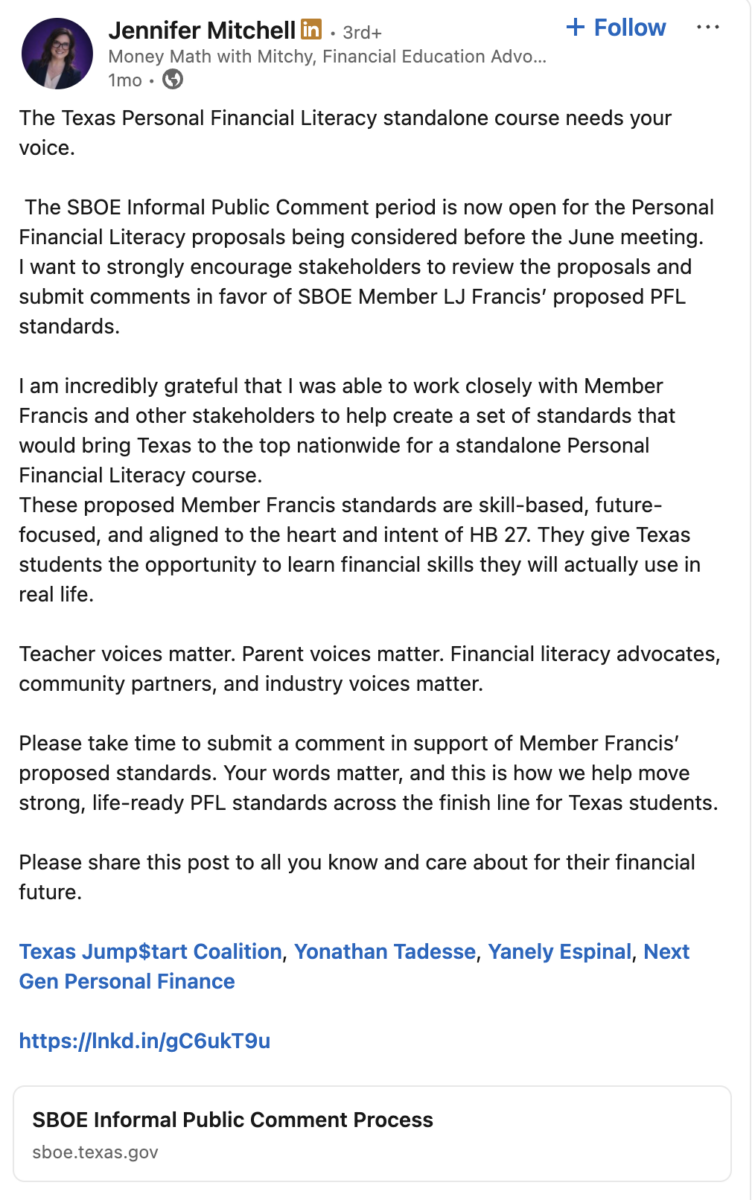
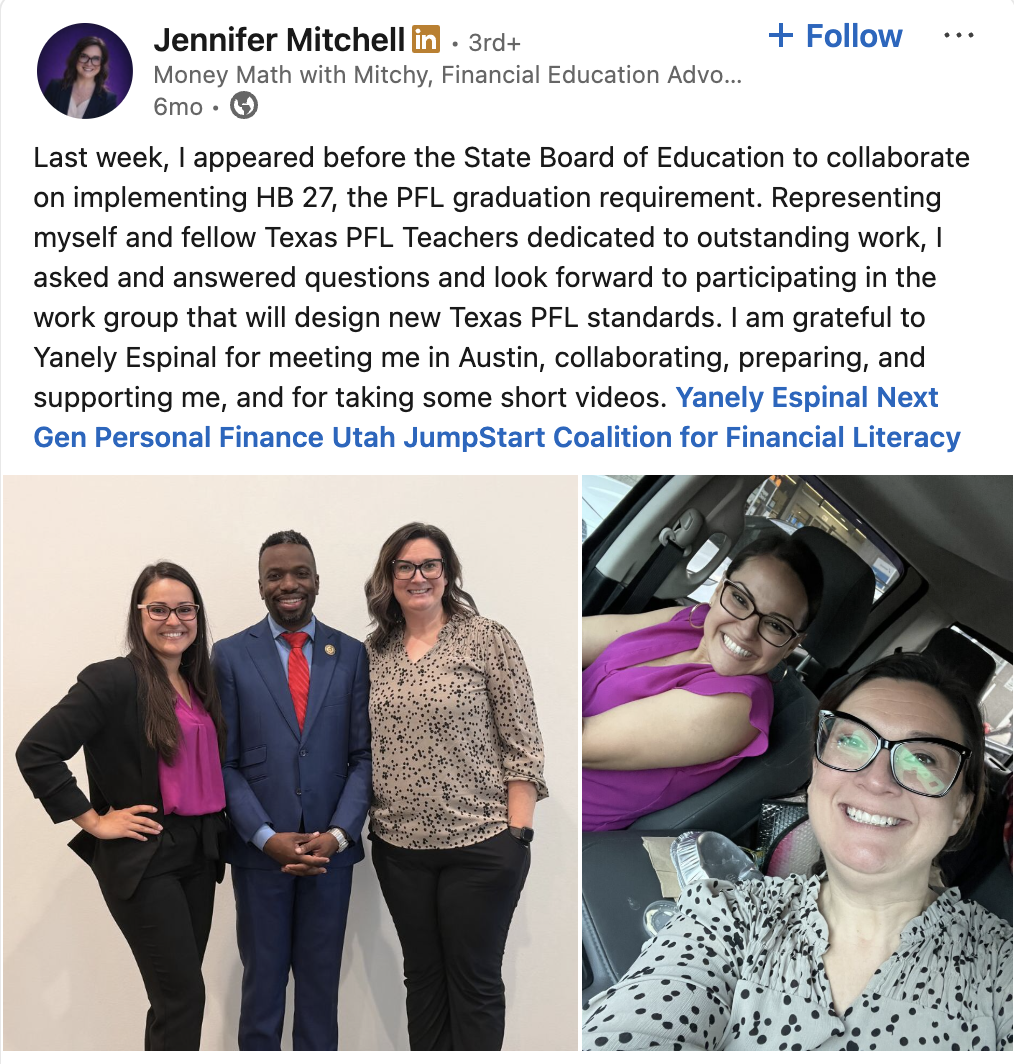
Jennifer Mitchell, whose LinkedIn banner read Money Math with Mitchy and identifies her as a 7th Grade Math teacher with Pine Tree ISD, posted on LinkedIn that she worked “closely” with Francis and others to create PFL standards aligned with House Bill 27.
Jointly authored by State Reps. Ken King (R–Canadian), Linda Garcia (D–Mesquite), and Suleman Lalani (D–Sugar Land) in 2025, HB 27 directed the Texas Education Agency to “develop a list of free, open-source, and publicly available curricula” that a school district may use to provide a “personal financial literacy course” for high school students. The law also split personal financial literacy from economics. Under the new law, PFL is a required half-credit, of three total social studies credits, that high school students must take. Economics is now one choice among three full credit courses to fulfill the social studies requirement.
Mitchell posted a photograph of herself and Francis with Yanely Espinal of Next Gen Personal Financial, a California-based nonprofit that provides personal financial literacy curriculum and educator professional development. NGPF’s website states that it offers its services at “no cost.”
Espinal testified in favor of House Bill 27, and her name appears in the internal SBOE document, indicating her possible involvement in drafting language alongside “Mitchy.”
According to Open Secrets, NGPF’s co-founder Tim Ranzetta has donated to Democrats, including Congressman Ro Khanna and former U.S. Sen. Sherrod Brown (D–OH). In a May 2026 press release, NGPF expressed support for the PFL language Francis proposed.
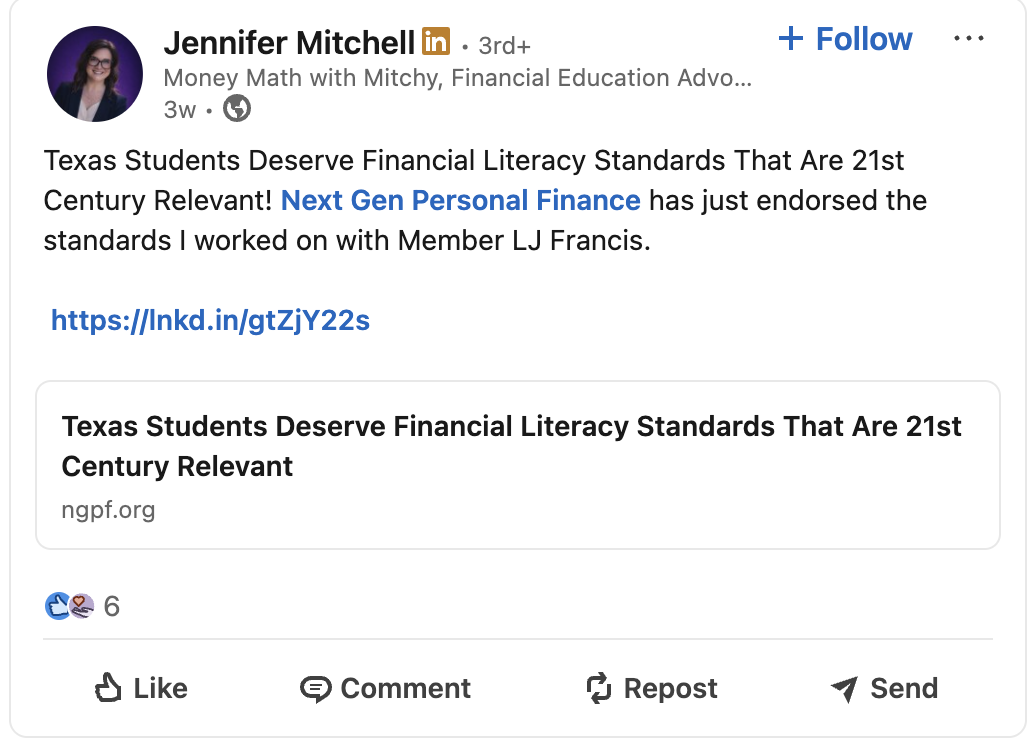
Three weeks ago, Mitchell posted that NGPF “endorsed the standards I worked on with Member LJ Francis.”
The organization applauded Gov. Greg Abbott’s signing of the law in June 2025, making Texas the 29th state to approve such legislation. In June 2024, California Gov. Gavin Newsom (D) jointly announced with NGPF Mission 2030 a new state law that required financial literacy in order to graduate high school.
NGPF lists Katy ISD as one of the 12 school systems in the nation it currently works with.
When asked how many vendors are presently available to provide PFL materials, Francis said that before Texas Essential Knowledge and Skills (TEKS) standards are passed, “we would have an idea of that,” but he did not have the data at the time. “It’s not customary that we would have that information at this time in consideration.”
Texas Scorecard asked members of the SBOE and State Rep. King if PFL courses would fall under the same quality and suitability review processes for instructional material as found in 2023 law House Bill 1605. The Texas Public Policy Foundation supported this law, finding it “strengthened parental rights, ensured school materials were age appropriate, and directed TEA to establish a set of state-owned curriculum.”
Francis said, “Not currently,” but that after the SBOE passes the proposed language, HB 1605’s review processes would then apply to these PFL courses. What is adopted in 2026, he said, will not be fully in schools until 2030. After the SBOE passes a new set of TEKS, it will issue a call for publishers to submit new instructional materials.
District 6 SBOE member Will Hickman concurred. “Once we adopt the TEKS, then we will start IMRA, which is the [HB] 1605 process, and Next Gen and any other publisher that wants to participate will then submit textbooks to be considered for the SBOE approved list. That’s in the coming years.” He said that open education resources “go through the IMRA 1605 process just like anyone else.”
Hickman said he doesn’t know if NGPF is “currently in Texas,” and thinks it is a publisher with a PFL textbook or program it is trying to bring into Texas.
District 12 SBOE member Pam Little wrote to Texas Scorecard that, in her opinion, “the safeguards from HB1605 should apply to any instructional material. As of now I do not support Next Gen Personal Finance as it strips out entrepreneurship which is very important for students.”
In a statement to Texas Scorecard, NGPF wrote:
NGPF has and will continue to be transparent in disclosing our involvement. State Board of Education (SBOE) member Will Hickman asked teacher Jennifer Mitchell for help in drafting alternative TEKS for a personal finance course, and Ms. Mitchell contacted Yanely Espinal, NGPF’s director of educational outreach. Ms. Espinal has engaged transparently with SBOE members to share NGPF’s 12+ years of expertise in implementing personal finance education for high schoolers, and as a nonprofit we provide free resources and have no financial interest in the outcome. And once Texas finalizes its TEKS under HB 27, we would welcome submitting our materials for review like any other provider.
After reviewng the NGPF statement, Hickman wrote that he had “not received any proposals for new TEKS from [M]s Mitchell or [M]s [E]spinal,” then added that he does “receive thousands of emails each meeting. Following a busy meeting, Ms[.] Mitchell did email me a PFL proposal in March which I have not yet reviewed.”
Francis wrote the following response when asked about his working relationship with Mitchell and Espinal. “When I am leading any initiative for my work on the Board, I have generally worked with all Texans who express an interest. I try my best to do my due diligence and review all suggestions before I make the final decision—which I then offer to my colleagues on the Board for debate, more public comment and Final adoption.”
He also expressed his thanks to teachers in North Texas and business individuals in South Texas he has worked with.
King and Mitchell did not provide responses to requests for comment before publication.