Texas lawmakers are examining whether local governments have adequate safeguards when they use taxpayer money to hire nonprofits and other outside providers for public services.
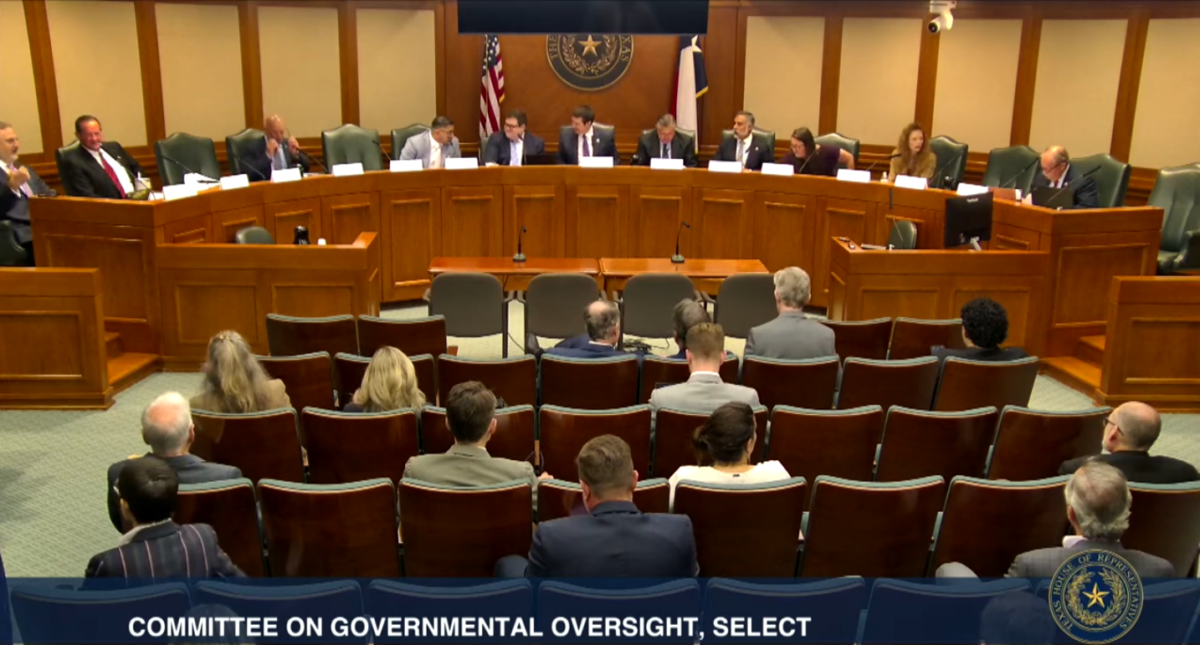
The House Governmental Oversight Committee scrutinized taxpayer-funded nonprofits and contractors at a hearing Wednesday.
The hearing, chaired by Rep. Cody Vasut (R–Angleton), examined how local governments spend taxpayer money on contracts with consultants and nonprofits that provide services such as health care, public safety and homelessness programs.
Larry Satterwhite, director of the Office of Public Safety and Homeland Security for Houston, said nonprofits and third-party providers can sometimes be the best option for a city in addressing certain issues, such as homelessness.
“The city views contracting not as a substitute for accountability, but as a tool for delivering services effectively, efficiently, and at the scale that our communities require,” said Satterwhite.
“Individuals experiencing homelessness may need behavioral health services, substance use treatment, case management, medical care, and other specialized interventions. It would not be practical or in the best interest of the public, the people that we serve, for the city to build every one of these specialized capabilities internally,” added Satterwhite.
Satterwhite pointed to the Harris Center for Mental Health and IDD, which he credited as playing a pivotal role in the city’s ability to serve the homeless population.
“That is an important principle of effective government,” said Satterwhite. “The questions should not always be who can perform the service directly, but who is best qualified to deliver the service while maintaining public accountability.”
Other witnesses noted that certain audits of third-party contracts produced problematic findings.
Austin’s Chief Financial Officer Ed Van Eenoo noted that an audit of 25 social service providers contracted with or provided grants by the city showed that 76 percent of those contracts “failed to meet one or more performance expectations.”
“I want to assure the committee that’s not something the city takes lightly. Our central procurement office is working very closely with our departments to administer those contracts, to really figure that out,” said Van Eenoo.
Rep. Ellen Troxclair (R–Lakeway) asked what the consequences were for these nongovernmental organizations if they did not meet performance expectations. Van Eenoo admitted that “right now, there are not good consequences in place for that contract, and so based on that auditing, that is something staff is going to be working on as part of this comprehensive reset.”
The reset referenced by Van Eenoo would be an “in-depth, comprehensive review of [Austin’s] entire social services contracting world.”
Ben Crockett of the Texas Public Policy Foundation expressed concerns around the possible political influence that might be produced by these nonprofits and third-party providers.
Crockett noted how the 501(c)(3) organization Workers Defense Project, an “organization that is building power with latine workers in Texas for immigrant and worker justice,” receives about $3 million each year, with about $1 million of that coming from the city of Austin.
“Then they’ll gift to their 501(c)(4) somewhere in the neighborhood of about $500,000 to $600,000,” added Crockett. “Now, 501(c)(4)s can engage electorally, and they have very little limits in the city context.”
“What you have in practice is taxpayer-subsidized political activities,” noted Crockett. “The point being is that government shouldn’t be dipping its toes in electoral activities, and taxpayer money shouldn’t be tipping the scales of elections.”
Various local government officials offered models to address the issues highlighted in the hearing.
San Antonio Assistant City Manager Jeff Coyle explained some of the processes in place to ensure nonprofits are held accountable, including broadcasting clear “requests for proposals,” requiring monthly performance reports, and retaining the right to withhold funds if performance is not met.
“We did an audit in December of 2025 of all of our delegate agencies (i.e., contracted third-party providers). It is our independent auditor who reports to the city council, not to the city manager,” explained Coyle. “It was a clean audit that the Department of Human Services was tracking all of the performance, all of the financial metrics, and the auditor had no recommendations for improvements to our monitoring process.”
Dallas council member and former nonprofit executive Cara Mendelsohn laid out her own reform agenda, including a “naughty list” for poor-performing vendors.
“If you’re a road construction crew and you are not following code, you’re going on the naughty list and we’re not using you for three years,” said Mendelsohn. The risk of going on such a list that is publicly available would ensure better behavior from third-party providers, according to Mendelsohn, due to the risk of financial liability.
The hearing comes ahead of the next legislative session scheduled to begin on January 12.
House Speaker Dustin Burrows wrote that the hearing laid “important groundwork” for next year.