Texas House lawmakers discussed possible state action to strengthen parental controls and protect minors online following testimony that social media platforms’ design features may be contributing to a growing youth mental-health crisis.
The House Committee on Public Health met Thursday to examine social media’s impact on minors’ health and well-being.
Witnesses urged lawmakers to focus less on individual content moderation and more on platform features—including personalized algorithms, infinite scrolling, autoplay, push notifications, and data collection—that they argued are designed to keep young users engaged.
Dr. Daniel Flint, a pediatric psychologist who treats adolescents with eating disorders, told lawmakers that parents cannot simply “out-parent an algorithm.”
Flint said the reward centers in teenagers’ brains develop before the parts responsible for self-control and long-term judgment, making minors especially vulnerable to platforms engineered to maximize attention. He asked one patient to estimate her daily screen time; the teen guessed 10 hours, but her phone showed 14 hours.
“If she’s sleeping every night, which she probably isn’t, that leaves her two hours per day left of real life,” Flint said.
Flint testified that social media use is associated with depression symptoms in teenagers, particularly girls, and said younger children are more vulnerable to harmful effects. He also cited research linking social media and screen use to disordered eating, fear of weight gain, low self-worth, and binge eating among young adolescents.
He called on lawmakers to require platforms to disable “inherently addictive” features—including infinite scrolling and personalized algorithms—by default for minors. Flint also recommended clearer standards addressing minors’ exposure to self-harm and pro-eating-disorder content, as well as evidence-based warning labels for parents and adolescents.
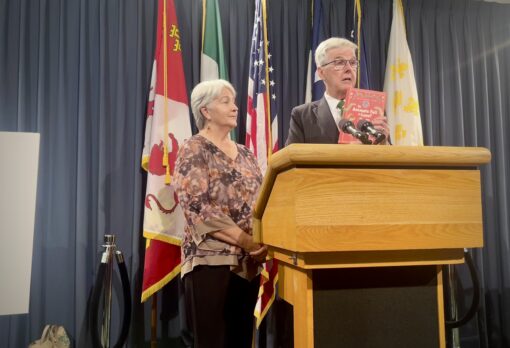
Maurine Molak, co-founder of David’s Legacy Foundation and Parents SOS, testified about the death of her 16-year-old son, David, who died by suicide after what she described as a yearlong struggle with social media and online gaming addiction, as well as months of cyberbullying.
His death prompted the passage of Texas’ 2017 cyberbullying law, known as David’s Law.
Molak said online harms facing children can involve cyberbullying, dangerous viral challenges, illegal drug sales, sextortion, and AI chatbots. She argued the common factor in such cases is not merely harmful content but platforms’ product-design choices.
“These harms our children experienced were driven by platform design choices, not content,” Molak said.
She urged lawmakers to build on recent Texas laws by requiring child-safety settings by default, limiting the collection and sharing of minors’ personal data, restricting addictive feeds driven by personal data, and enacting protections addressing the growing use of AI chatbots.
David Dunmoyer of the Texas Public Policy Foundation similarly argued the harms are not accidental. He said social media companies create a “choice architecture” intended to keep minors on their products longer, collect more behavioral data, and improve systems that serve personalized content.
Dunmoyer cited reporting on internal Facebook documents and argued platforms have known about risks to young users, especially teenage girls. He also described how TikTok’s recommendation system identifies the content a user lingers on and can steer vulnerable minors toward increasingly harmful material.
“Their vulnerability,” he said, is language platforms use to identify what can hold a user’s attention.
Lawmakers pressed witnesses on what Texas can do if federal lawmakers do not pass comprehensive online child-safety legislation. Witnesses pointed to the state’s App Store Accountability Act, which requires age verification at the app-store level and parental approval before minors download apps.
Dunmoyer said the framework treats account creation and app downloads like other contracts involving minors, where parental consent is normally required. He also suggested lawmakers consider extending that framework to AI chatbot services and revisiting proposals to limit social media access for children younger than 16.
Members also questioned whether existing parental controls actually give parents meaningful authority. Molak testified that certain platforms require a child to approve a parent’s effort to supervise or change settings on the account, allowing the minor to reject or later remove that oversight.
Public comments submitted for the hearing reflected broad concern about the effects of social media and artificial intelligence on young Texans, though commenters differed on the appropriate role for the state.
The Texas Medical Association and Texas Pediatric Society, representing more than 60,000 physicians and medical students, cited research associating more than three hours of daily social media use with a higher risk of depression and anxiety symptoms, while calling for additional research and safeguards as AI chatbots become more common among teens.
Other commenters pressed lawmakers to restrict product features rather than online speech.
Texas Values called for meaningful and continuing parental control over minors’ accounts, restrictions on endless scrolling, autoplay, engagement metrics, and other addictive design features, and limits on the use of children’s behavioral data to create personalized feeds or targeted advertising.
Some comments also cautioned against broad new mandates.
Texas Policy Research Action’s Jeramy Kitchen argued that lawmakers should preserve parental authority, individual privacy, and First Amendment protections while evaluating existing laws such as the App Store Accountability Act and the SCOPE Act. Kitchen warned that age-verification requirements can require Texans to provide sensitive identifying information, potentially creating new privacy and data security concerns.
The committee did not consider legislation Thursday, but the hearing signaled lawmakers may pursue additional restrictions on social media design, parental-control tools, age verification, and chatbot safeguards when the Legislature reconvenes in 2027.