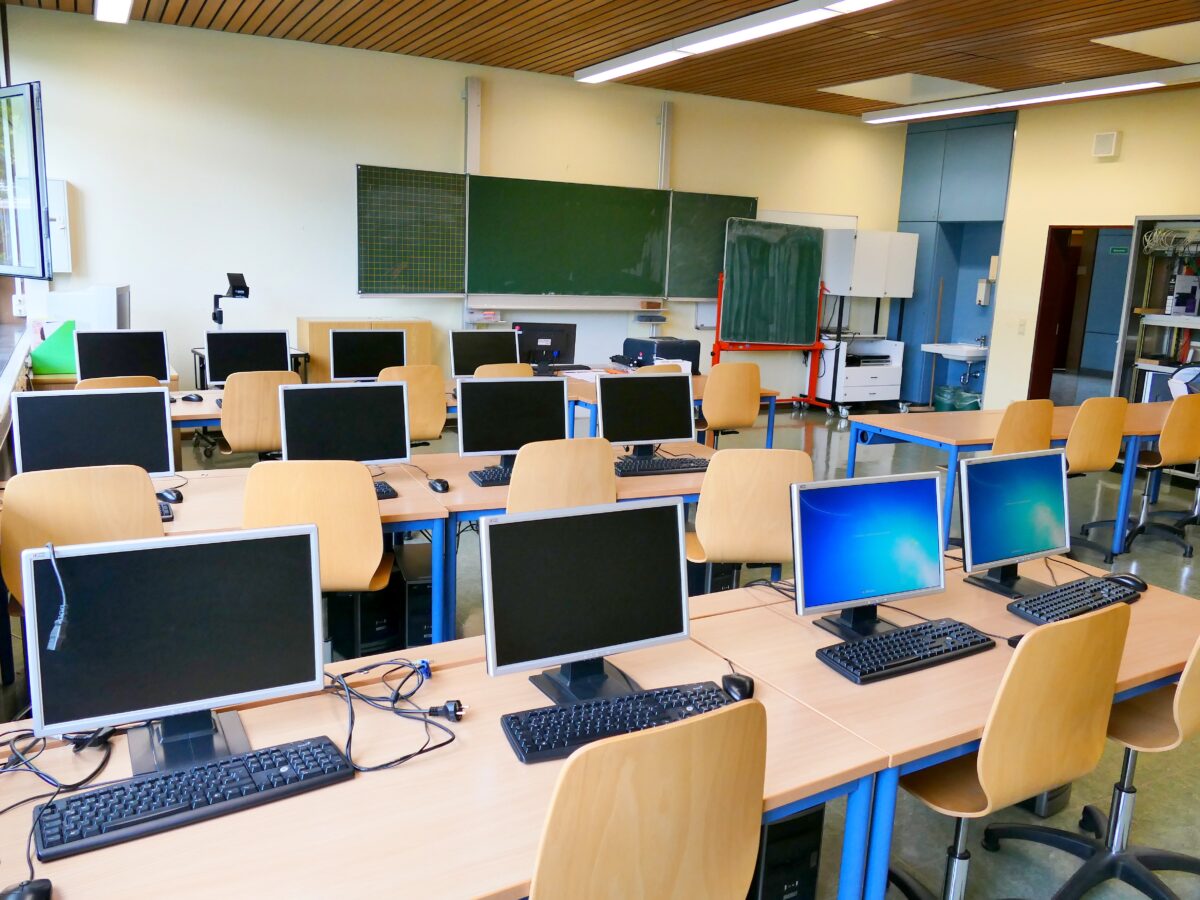
Texas public schools have been expanding the use of laptops, tablets, online curricula, and digital assessments for the past decade. But as lawmakers restrict student cellphone use, a broader question is arising of whether the state should continue treating school-issued technology as a central instructional tool.
According to research from the Texas Public Policy Foundation’s Matthew McCormick, during the 2025-26 school year, $364 million was disbursed from the Instructional Materials and Technology Allotment. Of that money, $247 million went toward online or electronic materials. In addition, $18.6 million went toward laptops and tablets.
The spending reflects a policy shift that began in 2011 when the 82nd Texas Legislature expanded the Instructional Materials and Technology Allotment (IMTA) to allow public schools and charter schools to use state funds for educational technology, including digital instructional materials and classroom devices.
The state’s transition to online STAAR testing and the COVID-19 pandemic further accelerated the use of one-to-one student devices.
That investment has drawn growing scrutiny over whether digital instruction delivers better academic results. Research suggests that increased use of screens does not necessarily translate into better academic output.
Students can perform worse when reading from screens than from physical materials, with one study cited by McCormick finding a difference equivalent to roughly two-thirds of a grade level.
“For too long, the proliferation of technology in Texas public schools has gone unexamined,” wrote McCormick. “Far from delivering the promised revolution in education, educational technology has produced lackluster results while importing novel and unavoidable harms into the classroom.”
The concerns with technology in classrooms are not limited to academics.
Common Sense Media reported in 2022 that 31 percent of surveyed teens had viewed pornography while at school, with 44 percent of those who viewed it during the school day saying they had done so on a school-owned device.
Lawmakers across the country have begun to push back.
During its 2026 legislative session, Utah passed a law prohibiting screen time for students in kindergarten through third grade, with exceptions for computer literacy courses and standardized testing.
Texas has taken a narrower approach.
So far, the state’s approach has focused primarily on personal devices rather than school-issued instructional technology.
In 2025, the Texas lawmakers passed House Bill 1481, requiring school districts to prohibit students from using personal communication devices during the school day.
The Texas Education Agency was allocated $20 million in state grant funding to help schools implement the law.
In 2025, State Sen. Lois Kolkhorst introduced Senate Bill 966, which would have directed the Department of State Health Services and the Texas Education Agency to study the public health effects of digital learning, including its impact on student mental health and academic performance.
With Texas already restricting personal devices in schools, the question now is whether the state will stop at cell phones.
McCormick suggested that lawmakers could revoke the 2011 expansion that allowed the IMTA to be used for technology as one avenue of curtailing the explosion of digital learning.
Additionally, school districts currently seek voter approval for taxpayer-backed bond debt to issue student devices. McCormick recommended disallowing this as an acceptable bond purchase.
“If legislators want to provide effective instruction to Texas students while ensuring their safety and protecting their mental health, they must break schools’ addiction to technology,” concluded McCormick.