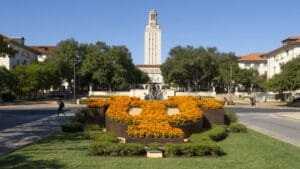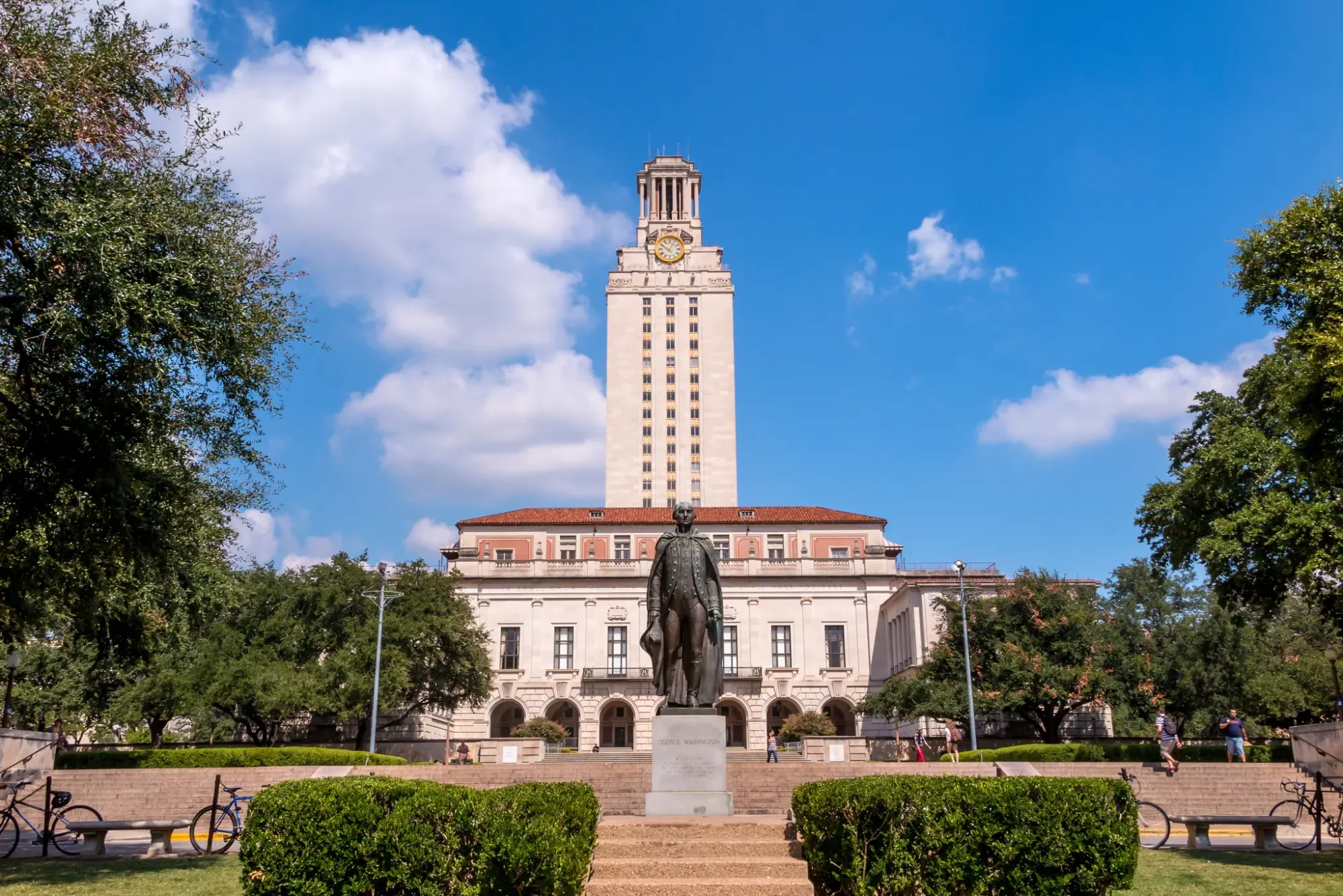
The University of Texas at Austin has been invited to participate in a major Trump administration higher education reform initiative.
As first reported by the Wall Street Journal, on October 1, the Trump administration announced the creation of the Compact for Academic Excellence in Higher Education that contains a number of items sought by reform advocates.
The administration invited nine universities nationwide to participate in an initial cohort and give feedback. UT-Austin was the only Texas university selected. The Trump administration will grant priority access to federal taxpayer-monies to universities that abide by the compact. Those in violation may have to return these funds.
“The University of Texas System is honored that our flagship —The University of Texas at Austin—has been named as one of only nine institutions in the U.S. selected by the Trump Administration for potential funding advantages under its new ‘Compact for Academic Excellence in Higher Education,’” UT System Board of Regents Chairman Kevin Eltife wrote in a statement sent to Texas Scorecard. “We enthusiastically look forward to engaging with university officials and reviewing the compact immediately.”
The reform initiative contains ten components intended to spur changes in university behavior.
It prohibits any form of admissions discrimination based on demographic characteristics, such as race, sex, sexual identity, or religion. The compact requires participants to make admissions decisions “based upon and evaluated against objective criteria published on the University’s website and available to all prospective applicants and members of the public.”
Participants are specifically required to use standardized tests as part of the admissions process, such as the Scholastic Aptitude Test.
Similar to the admissions reforms discussed above, the compact states that participating universities must commit “to rigorous and meritocratic selection based on objective and measurable criteria” in hiring. Participants may not hire based on any form of demographic characteristics, except what is approved in federal law.
Sweatt v. Painter originated at UT-Austin. That was the landmark 1950 U.S. Supreme Court ruling that originally banned racial discrimination in college admissions.
Compact participants must foster a broad “marketplace of ideas” on campus, while maintaining protections for “civility” to prohibit bad-faith actors from weaponizing speech protections. The document distinguishes between “debate” and “harassment” and requires participants to “commit to using lawful force if necessary to prevent” the latter.
The compact requires participating institutions to maintain official neutrality on political issues outside of those that directly impact them. Students, faculty, and staff are “encouraged to comment on current events in their individual capacities,” but not as representatives of the institution.
Regarding student equality, the compact calls for the preservation of sex-based privacy and competition standards, particularly in sports and facilities. It also calls for fair grading and access to resources.
Financial responsibility and foreign entanglements round out the rest of the compact. The administration urged universities to reduce administrative costs, freeze tuition for five years, optimize or eliminate programs not serving students, and provide transparency around student outcomes and program value. Institutions with endowments of more than $2 million per undergraduate must offer tuition-free education in hard sciences, with optional exemptions for families of significant financial means, and support military veterans through credit transfers.
Strict compliance with anti-money laundering laws and foreign funding disclosures is required, along with caps on foreign student enrollment and vetting for alignment with American values.
Enforcement mechanisms include annual certification, public polling, and penalties for violations.
In his statement, Eltife expressed the UT System’s enthusiasm at the Trump administration’s announcement.
“Today we welcome the new opportunity presented to us and we look forward to working with the Trump Administration on it,” he said. “Higher education has been at a crossroads in recent years, and we have worked very closely with Governor Abbott, Lt. Gov. Patrick and Speaker Burrows to implement sweeping changes for the benefit of our students and to strengthen our institutions to best serve the people of Texas.”
UT-Austin is a component of the University of Texas System. The UT System is overseen by a Board of Regents that is appointed by the governor and confirmed by the Texas Senate. Kevin Eltife is the current board chairman.