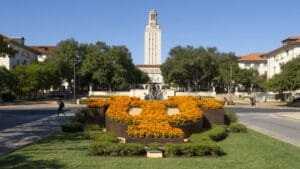
As the University of Texas at Austin implements governance and curriculum reforms, President Jim Davis is touting strong faculty interest, including 1,200 applications to teach its new core curriculum within days of the announcement.
According to Davis, this upswing was accompanied by record levels of student applications, degrees issued, and fundraising.
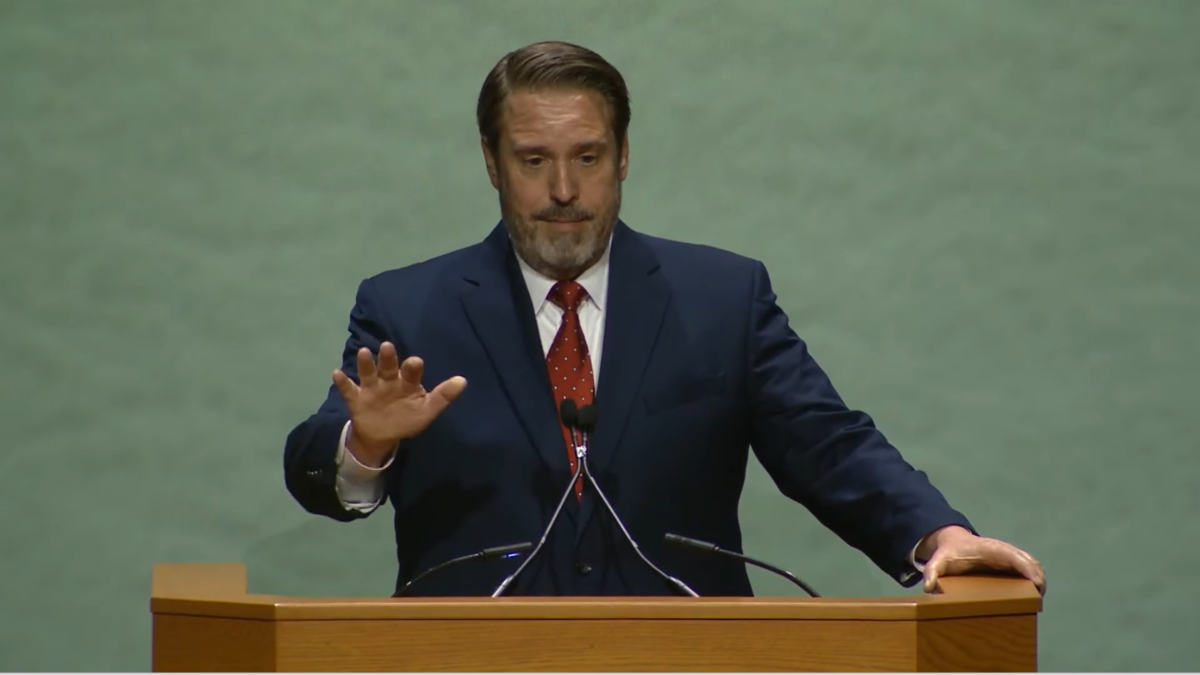
Davis delivered this news during his annual State of the University address Wednesday.
“Last year, we had nearly 12,500 applications for 92 open faculty positions,” the printed transcript of Davis’ remarks stated. “Within a few days of announcing the new Core Curriculum, we had 1,200 more—just to teach in the Core.”
“We recently opened the position for the Dean of the College of Liberal Arts. And we’ve already had more than 500 applications,” Davis added.
Davis unveiled the new core curriculum at the August meeting of the UT System Board of Regents.
A curriculum review was undertaken after the passage of Senate Bill 37, a 2025 state law that reformed several aspects of university governance.
As part of those changes, the new law requires governing boards of taxpayer-subsidized university systems to conduct a review of all general education curricula every five years. General education requirements are a set of courses all students must complete, regardless of major.
Higher education authors Jason Brennan and Phil Magness have criticized these mandates as a subsidy for economically unsustainable programs that frequently protect woke curricula from accountability.
The new core has a series of requirements in arts and humanities, artificial intelligence, social sciences, and STEM. Provost William Inboden recently rejected a series of grievance-studies-themed materials for it.
SB 37 also abolished so-called “shared governance,” which had previously permitted regents and university presidents to delegate formal decision-making authority to selected faculty. The new law permits universities to establish faculty advisory groups that have no final decision-making authority.
Davis also announced the creation of a new “University College to be the guardian of the Core Curriculum.” Devin Stauffer, currently the co-director of the Thomas Jefferson Center for Core Texts and Ideas, will serve as the inaugural dean.
Elsewhere in his speech, Davis announced the creation of a new “patient-centered” health care initiative as part of the expansion of the Dell Medical School.
“No longer will patients move from office to office to get the next test, next diagnosis, the next treatment, then another next test, and on and on. Instead, the patient is surrounded by UT, world-class physicians and staff, all working together as one team.”
UT will build an AI-integrated technology platform designed to improve healthcare and treat disease.
UT-Austin is a component of the University of Texas System. The UT System is overseen by a Board of Regents that is appointed by the governor and confirmed by the Texas Senate. Kevin Eltife of Tyler is the current board chair.