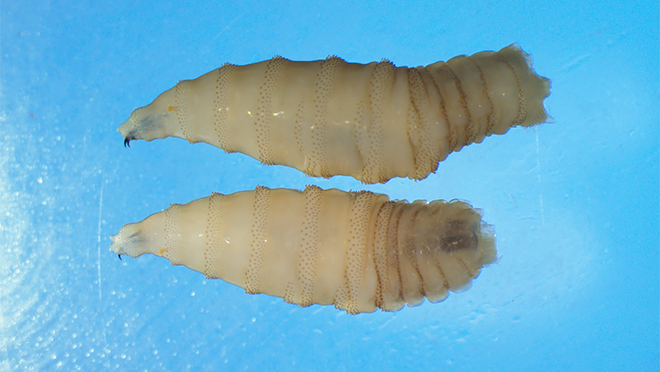
A case of New World screwworm has been detected in Texas, according to the U.S. Department of Agriculture. Secretary Brooke Rollins confirmed the case Wednesday evening.
Outbreaks of the flesh-eating parasite have recently occurred within a hundred miles of the U.S. border; however, none were confirmed in Texas until today.
Rollins assured Texans that the case is being “fully contained” and the nation’s food supply is “100% safe.”
State Rep. Don McLaughlin (R–Uvalde) issued an urgent call to action on Monday regarding a potential outbreak of New World screwworm, stating it was detected a mile off of the U.S. border. In a letter to state leaders, he urged action to be taken to prevent the spread of screwworms to preserve livestock health across the state.
He was rebuffed by the USDA on X, and has since stated that perhaps “we should listen to our state representatives.”
Kinney County Judge John Paul Schuster declared a local state of disaster over the threat posed by the New World screwworm. The order from the border county activates local and interjurisdictional emergency management plans, authorizes use of all necessary county resources, and directs county officials to coordinate with state and federal agencies on surveillance, reporting, public information, and response.
The declaration is effective for up to seven days unless extended or renewed by the commissioners court. In addition, Kinney County asked that the governor temporarily relax certain state commercial‑feed regulations in the Agriculture Code to allow medicated “feed‑through” products used to control screwworm to be approved and deployed more quickly if normal licensing and labeling requirements would slow the emergency response.
The most recent cases of New World screwworm were detected in a 5-year-old-goat in the Mexican state of Coahuila, which neighbors Texas. Since then, a total of 32 cases have been monitored, 19 of which remain active.
The U.S. Food and Drug Administration authorized the emergency use of over-the-counter injection drug Doramectin for use in livestock to prevent any infection in the United States.
There has only been one confirmed U.S.-based case of human infestation by New World screwworms, occurring on August 4, 2025. After traveling to El Salvador, a Maryland native returned home where they were confirmed to have NWS. The infection occurs when a mature female screwworm is attracted to an open wound or orifice (such as eyes, ears, mouths, and nostrils) and lays up to 300 eggs at a time. The larvae then hatch and feast on the host’s flesh for five to seven days.
Since 2024, Texas Parks and Wildlife has issued a notice for outdoors enthusiasts to watch for infestations of New World screwworm. In 2022, screwworms broke through eradication checkpoints in Panama and began to move north through Central America, eventually reaching Mexico in 2024. Due to the large shared border, concerns continue to grow in Texas’ southern region of a continued migration of New World screwworm northward.
The Texas Animal Health Commission now operates in a joint capacity with Texas Parks and Wildlife in order to formulate an effective response against a potential outbreak.
U.S. Rep. Ronny Jackson of Amarillo has also introduced the SAFE Cattle Act in order to further combat the northern expansion of New World screwworm.
The USDA invested $750 million into a new facility to produce sterile flies near Moore Airforce Base. It is expected that it will triple the output of current sterile fly production facilities, which sterilize female screwworm eggs.