A federal appellate court has dismissed a lawsuit challenging state laws that govern when persons carrying handguns can be convicted of criminal trespass if they enter or remain on property where guns are not welcome.
The court determined that the plaintiffs—a coffee shop and a Unitarian Universalist church in the Houston area—failed to show injuries that are traceable to the defendants’ conduct and can be redressed by a favorable decision.
Background
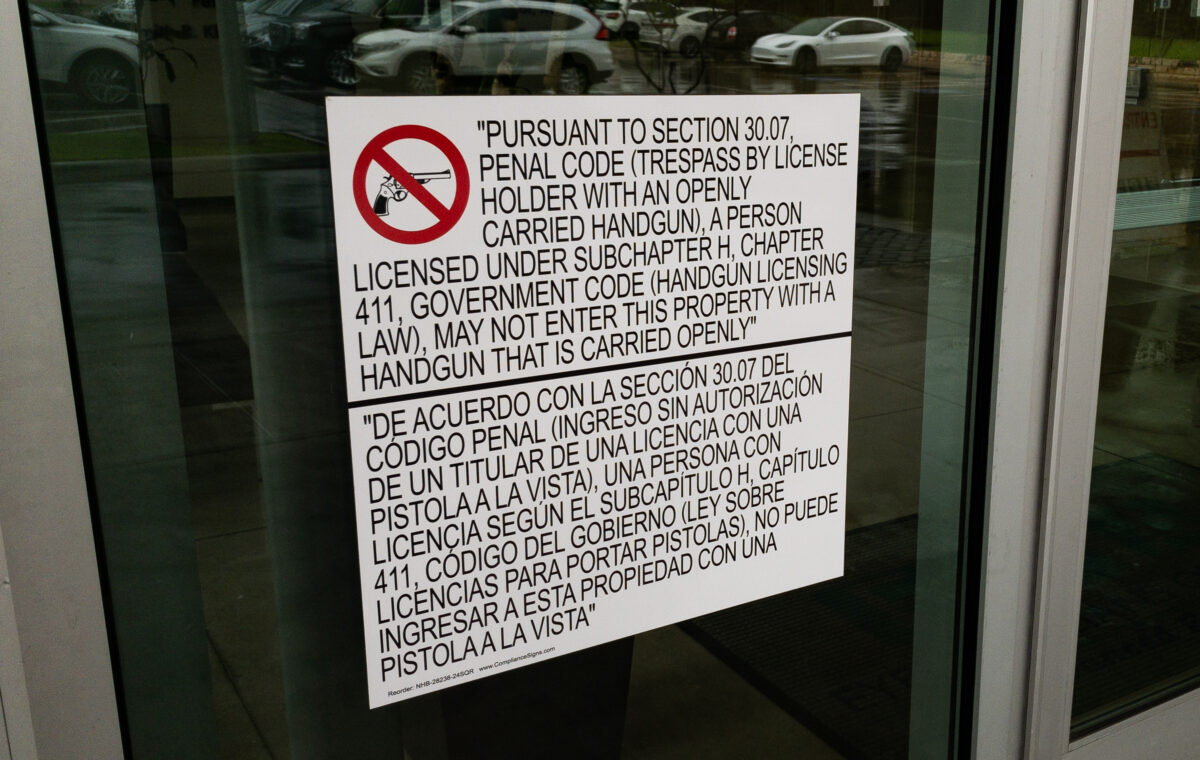
The laws—Texas Penal Codes 30.06 and 30.07—require the posting of signs with specific requirements on the buildings of property owners that wish to ban handguns from their premises. Property owners may alternatively issue a written notice in the form of cards or give verbal notice to potential violators.
Code 30.06 was codified in 1997 to address concealed handguns and Code 30.07 was added in 2015 to address openly carried handguns. Over time, legislators codified highly specific text, size, and bilingual requirements for both 30.06 and 30.07 signs, leading to the familiar large postings seen on many Texas storefronts.
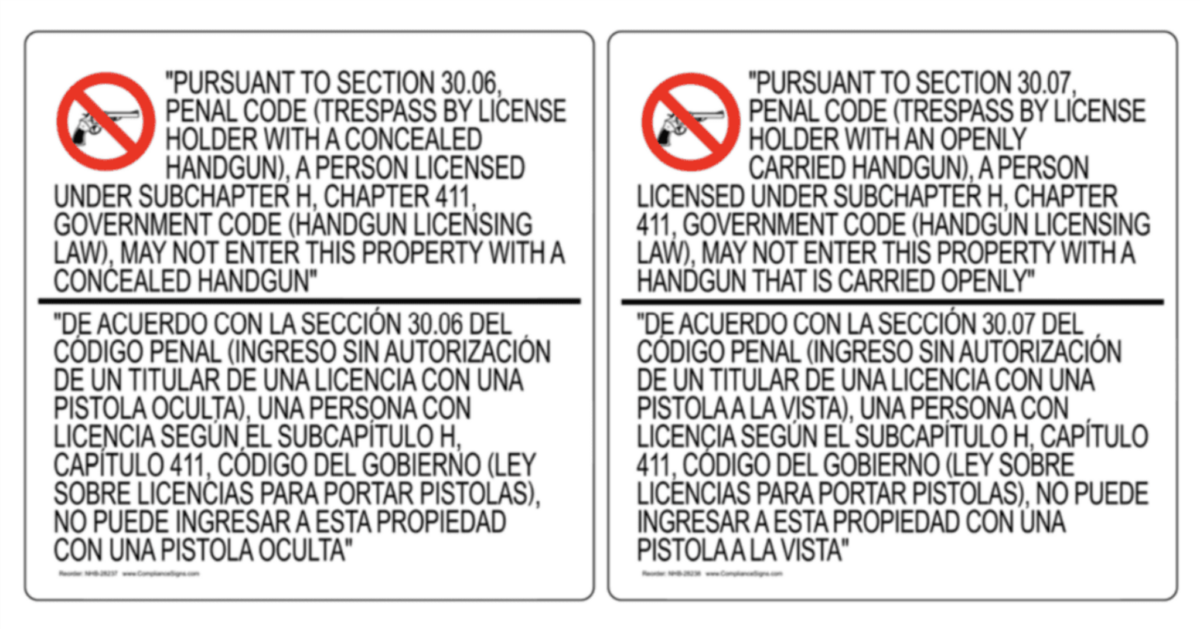
As previously reported, Bay Area Unitarian Universalist Church and Antidote Coffee filed a federal lawsuit in 2020 challenging the signage requirements, arguing they constitute content-based and viewpoint-based regulations on speech. The plaintiffs claimed this violated their rights under the First Amendment to the U.S. Constitution.
Named as defendants were the Harris County District Attorney, the Harris County Sheriff, the Houston Chief of Police, and the Webster Chief of Police.
Although both plaintiffs posted the prescribed signs to fend off handgun-carrying individuals, they objected to the burdensome, “ugly,” and “intimidating” appearance of the required signs. They brought the lawsuit on First Amendment grounds, claiming that the standardized messaging on requirements constituted “government-scripted speech.”
Before proceeding to trial on the merits, District Judge Ewing Werlein, Jr. granted the defendants motion to dismiss—finding that plaintiffs lacked Article III standing to sue under the U.S. Constitution.
The plaintiffs appealed this decision to the U.S. Fifth Circuit Court of Appeals in New Orleans. A divided panel concluded that the plaintiffs did, in fact, have standing to sue—reversing the district court order.
A majority of the Fifth Circuit court then voted for en banc review, meaning the case would be reheard before all justices. This vacated the panel’s ruling.
The Ruling
Last week, the Fifth Circuit agreed with the district court—ruling that “for several reasons” the plaintiffs do not have standing. The district court judgment was therefore affirmed, effectively dismissing the suit.
“The challenged criminal statutes were designed to accommodate property owners’ constitutional right to refuse access to gun toters while protecting the rights of licensed gun owners to carry open or concealed firearms,” reads the opinion.
To establish Article III standing, plaintiffs must show injuries that are traceable to the defendants’ conduct and that can be redressed by a favorable decision.
An important difficulty highlighted by the court is that property owners are not compelled by the criminal statute to post any warnings, and may advise licensed gun carriers to leave. The police may arrest the trespasser pursuant to the challenged statutes if he refuses to comply.
Regarding traceability, the law does not coerce the plaintiffs’ conduct. In fact, the law is not enforced against the plaintiffs at all, but against potential trespassers.
The court noted that it “is not officers of the law who ‘cause’ the injuries of which plaintiffs complain, but the terms of the law itself and actors who decide to intrude against the plaintiffs’ wishes.”
Plaintiffs had admitted in their briefs that “all of the defendants are mandated to enforce Texas criminal laws as written.” Additionally, the plaintiffs “failed to allege any facts that police officers cannot or will not respond to calls about gun-toting trespassers.”
The court also found that the plaintiffs failed to establish redressability, as there is nothing the defendants could be ordered to do in relation to the plaintiffs.
“Even if there were plausible injuries to the plaintiffs, and even if the injuries were somehow traceable to the defendants’ conduct, still, as the district court explained, it is beyond the power of federal courts to redress the injuries,” reads the opinion. “The court cannot order the defendants to re-write the statute. Furthermore, the court cannot order the defendants to arrest and prosecute people carrying guns in a manner permitted by the plain text of the statute.”
As a result of this ruling, the signage requirements remain law for businesses choosing to curb gun toters from entering the premises.
If you or anyone you know has information regarding court cases, please contact our tip line: scorecardtips@protonmail.com.