Two Harris County property owners are challenging state laws that govern when persons carrying handguns can be convicted of criminal trespass if they enter or remain on property where guns are not welcome.
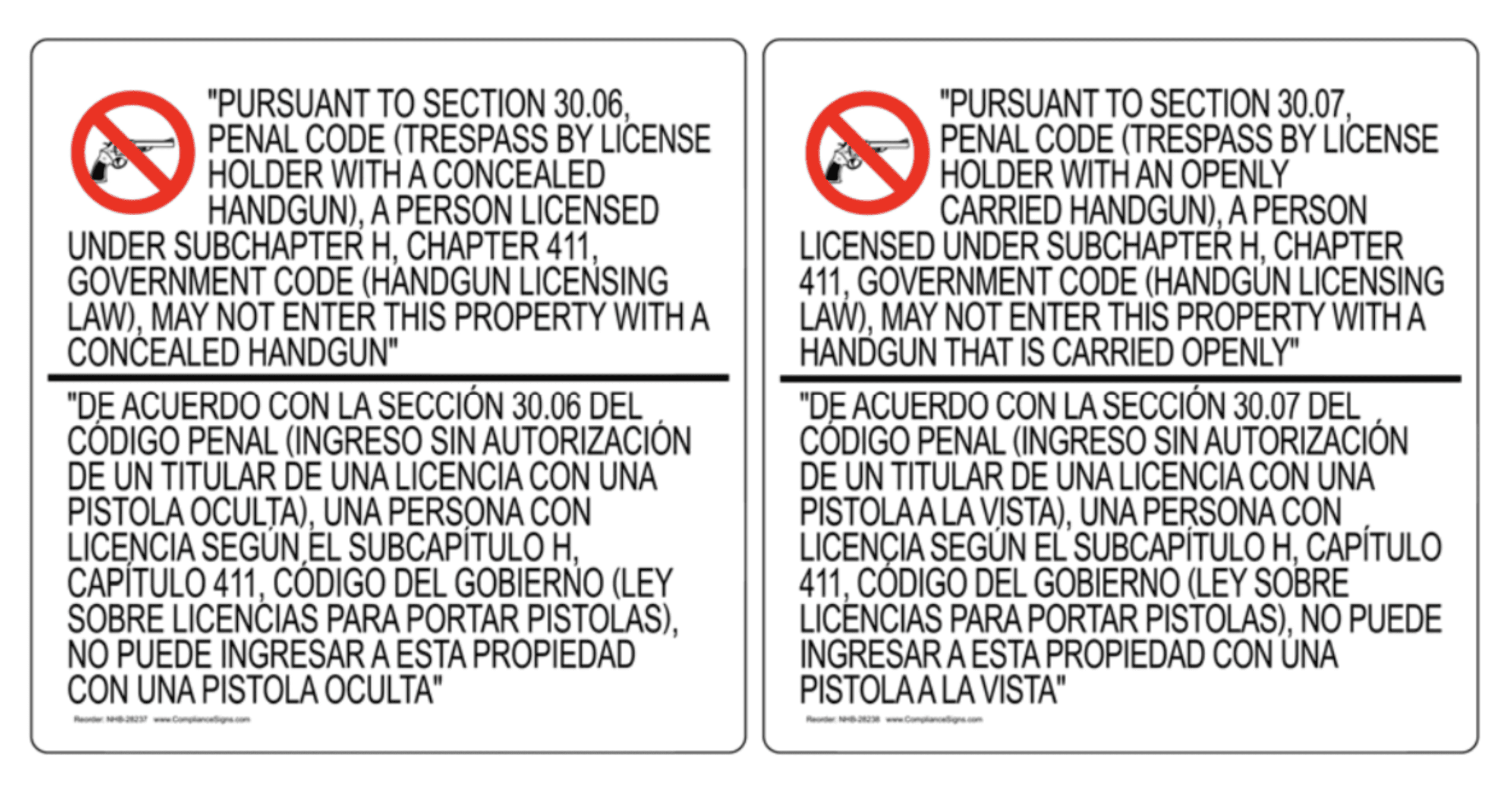
The laws—Texas Penal Codes 30.06 and 30.07—require the posting of signs with specific requirements on the buildings of property owners that wish to ban handguns from their premises. Property owners may alternatively issue a written notice in the form of cards or give verbal notice to potential violators.
The U.S. Fifth Circuit Court of Appeals in New Orleans heard oral arguments in January.
Background
Former Texas Land Commissioner Jerry Patterson, when serving as a state senator, authored Senate Bill 60 in 1995—creating Texas’ original concealed handgun law. The legislature later enacted Penal Code §30.06 in 1997, establishing the specific “30.06 sign” notice requirements.
Patterson told Texas Scorecard that he noticed Texas’ criminal trespass law was labeled §30.05 and thought it would be funny to name the gun bill “30.06”—a play on the “thirty‑aught‑six” rifle cartridge, officially called the .30‑06 Springfield.
When Texas adopted open carry via House Bill 910 in 2015, it added §30.07, creating parallel signage requirements for openly carried handguns. Over time, legislators codified highly specific text, size, and bilingual requirements for both 30.06 and 30.07 signs, leading to the familiar large postings seen on many Texas storefronts.
If a property owner seeks to exclude both concealed and openly carried handguns via signage, they must devote several square feet of space at each entrance to text-heavy signage.
Offenses under the acts are classified as Class C misdemeanors, punishable by a fine of no more than $200. The only exception is for trespassers who, after entering the property, are personally given oral notice but do not depart, in which case the offense is enhanced to a Class A misdemeanor.
The Lawsuit
Bay Area Unitarian Universalist Church and Antidote Coffee filed a federal lawsuit in 2020 challenging the signage requirements, arguing they constitute content-based and viewpoint-based regulations on speech, violating their rights under the First Amendment to the U.S. Constitution.
The lawsuit was filed in the Southern District of Texas in Houston, naming the Harris County District Attorney and Sheriff, and the chiefs of the Webster and Houston police departments as defendants.
Plaintiffs contend that the acts “impose onerous size, language, and text signage requirements that are unjustified and unduly burdensome on a group of property owners who espouse a disfavored viewpoint.”
“This viewpoint-based discrimination was entirely intentional; the Texas state land commissioner who drafted these requirements admits that he ‘intentionally made the sign’s language cumbersome’ to discourage businesses from prohibiting entry to customers carrying guns,” the lawsuit continues.
Indeed, Patterson told Texas Scorecard that he “wanted it large because it would be kind of a reason not to do it,” reasoning that property owners would decide “well, it’s just too damn big,” discouraging them from curbing the right to bear arms.
Patterson also highlighted the importance of having noticeable and standardized signs so that a property’s trespass policies are explicitly clear.
However, plaintiffs are challenging the standardized messaging on the signs as “government-scripted speech.”
Patterson characterized this argument as “illegitimate,” pointing out that many signs—including traffic signs—are standardized so they can be recognized and understood without having to read them in full.
He reasons that the plaintiffs are simply upset at the size of the signs. His solution is for them to not put the signs up or “go to the legislature and have them come up with a smaller standard sign.”
Plaintiffs are seeking declaratory relief that the acts are unconstitutional and injunctive relief to block the state from enforcing the law.
Defendants contend that an injunction would not redress the plaintiffs’ grievances because the laws are not enforced against them, but against potential trespassers. The court also lacks the authority to rewrite the laws’ requirements, as this must be done by lawmakers.
They further argue that the plaintiffs’ injuries stem from their decisions to post the acts’ optional signs, rather than being required to do so—meaning the plaintiffs lack standing to sue.
Standing
Both plaintiffs claim they are directly harmed by the acts because they have banned handguns and are uncomfortable giving oral notice or handing out written notice to each customer—meaning they must comply with the sign requirements should they wish to utilize Texas’ criminal trespass laws.
Plaintiffs claim the signs are divisive, serving as a “Scarlet Letter,” causing passers-by “to deem the establishment to be anti-gun.”
“Because of the stringent requirements, property owners wishing to communicate to patrons in a more nuanced manner would have to add yet another sign to their property front—for example, a sign stating: ‘This is a family establishment. While we deeply respect the Second Amendment, guns are not allowed on this property,’” reads the lawsuit.
No law prevents either plaintiff from doing so.
Plaintiff Bay Area Unitarian Universalist Church is a left-wing religious organization, self-described as a “welcoming community that celebrates diversity” and has been on “the forefront of LGBTQ inclusion for over 40 years.”
The church claims that the signs “detract from the church experience by having visitors, upon entering the building, focus on guns instead of the Church’s religious message.”
As the very next line in the lawsuit reveals, “The Church also displays rainbow stickers on the doors as a way to demonstrate inclusiveness with the LGBTQ community.”
“[T]he Church intends its building to be a refuge for peace and tranquility, and the Church believes that the signs detract from this purpose because they are constant and imposing reminders of guns and violence,” the lawsuit continues.
Plaintiff Antidote Coffee is described in the suit as “a small shop that serves coffee, wine, and ice cream in Houston.” The business complained that it is also required to post alcohol signage in addition to the gun signage.
However, Antidote Coffee is not a mandatory “no‑guns” 51% bar. Rather, it’s a coffee shop that voluntarily bans licensed carry with 30.06/30.07 notices.
“The owners worry that the first things Antidote’s customers are forced to think about when entering the shop are weapons and criminal prosecutions,” reads the lawsuit. They also believe that the signage requirements force Antidote to make “a bold political statement” regarding guns, given the “intrusiveness and size of the signs.”
Antidote’s staff have allegedly encountered customers who are bothered by the signs.
Defendants maintain that the plaintiffs’ alleged injuries are self-inflicted, and that they would not be penalized for failing to post such signage. The only punishments under the acts are directed toward prospective trespassers.
The district court agreed, dismissing the case for plaintiffs’ lack of standing.
Plaintiffs appealed this decision to the Fifth Circuit Court of Appeals, where a three-judge panel ruled last year that the plaintiffs do have standing, remanding the case for further proceedings.
This too was appealed, this time by the defendants, who asked for the Fifth Circuit to re-hear the case en-banc—meaning before the full court of 17 judges. This was granted, the panel opinion was vacated, and oral arguments were heard on January 23.
Oral Arguments
During oral arguments, the plaintiffs continued claiming they are being forced to post signs that conflict with their expressive preferences and freedom to associate for religious purposes. They cite reputational injury resulting from the posted signage.
The judges pointed out that plaintiffs could simply give oral notice and are not compelled to post any signage. They questioned what is unconstitutional about giving oral notice like ordinary trespass law.
Plaintiffs claimed that employees are fearful of confrontation, particularly when the prospective trespasser is armed.
Judges also pushed back on plaintiffs’ claims that police may refuse to remove a trespasser if the signs are not properly posted. It was pointed out that there is not a single instance of this happening under ordinary trespass law.
Although many judges appeared skeptical of the plaintiffs’ claims, others seemed sympathetic to their arguments. The Fifth Circuit is known to be a more conservative court, but a decision has yet to be reached.
This case has drawn attention in Texas’ legal community for testing how far the state can go in prescribing speech for standardized signage, particularly to be used in association with gun-related trespass law.
If you or anyone you know has information regarding court cases, please contact our tip line: scorecardtips@protonmail.com.