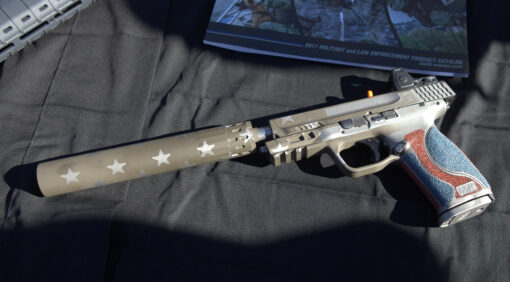
The Bureau of Alcohol, Tobacco, Firearms and Explosives has suspended enforcement of certain federal approval and registration requirements for suppressors, short-barreled rifles and shotguns, and other concealed firearms, but warns the policy could be reversed.
The guidance, issued Friday, follows a federal court ruling and Justice Department decision to extend nonenforcement beyond those covered by the court’s injunction.
Texas Gun Rights President Chris McNutt welcomed the ruling but called for Congress to permanently remove the restrictions.
McNutt told Texas Scorecard that although the announcement is “a tremendous temporary victory,” Congress “must completely gut the NFA before the pendulum swings back and the next anti-gun administration reverses their enforcement policy.”
Passed by Congress in 1934, the National Firearms Act (NFA) was intended to restrict the firearm market, requiring that individuals pay a $200 tax before “transferring or manufacturing particular classes of firearms.”
The agency said that under the new guidance, there will be no more enforcement of the NFA’s “registration, tax-stamp or related requirements for those covered items.” Congress reduced the NFA’s making and transfer taxes to $0 for silencers, short-barreled rifles, short-barreled shotguns, and the NFA’s “any other weapons” category through the One Big Beautiful Bill Act. However, the changes did not eliminate all of the law’s approval and registration provisions.
In August, a federal judge in North Texas blocked the ATF from enforcing restrictions on the covered items, following the One Big Beautiful Bill removing the “constitutional foundation” that the NFA rested on.
Following the decision, U.S. Attorney General Todd Blanche announced that the Justice Department will not be appealing the case.
Blanche also said that the Justice Department’s “enforcement discretion” will be applied to everyone and not just the plaintiffs, as originally ruled by the court.
However, requirements for machine guns and destructive devices will still apply, including a $200 tax. Also, the new guidance will not replace state or local laws that restrict NFA firearms.
ATF’s guidance notably distinguishes the current enforcement policy from permanent repeal.
“Material changes in legal or factual circumstances could cause NFA enforcement to resume,” the agency states in its FAQ. Such changes could include Congress imposing a new tax, the injunction being dissolved or overturned, or the Justice Department rescinding its guidelines.
The agency also warns that owners of unregistered items would not automatically receive protection if enforcement resumed.
“Federal law does not generally permit subsequent registration of unregistered NFA items nor are there provisions that would automatically grandfather unregistered NFA firearms,” the FAQ states.
The attorney general could authorize a limited registration amnesty, but is not required to do so. ATF continues to accept voluntary registration applications under the current policy.
“Federal law hasn’t changed, the ATF only said they will not be enforcing the law,” said McNutt. “This cluster could have all been avoided had the spineless republicans, including our own John Cornyn, stood up to the Democrat parliamentarian during the one big beautiful bill fight. We could have had complete deregulation of suppressors and short barrel firearms. But instead, this issue continues to linger.”
Citizens can view an open letter and frequently asked questions page released by the agency to learn more about the new guidelines.