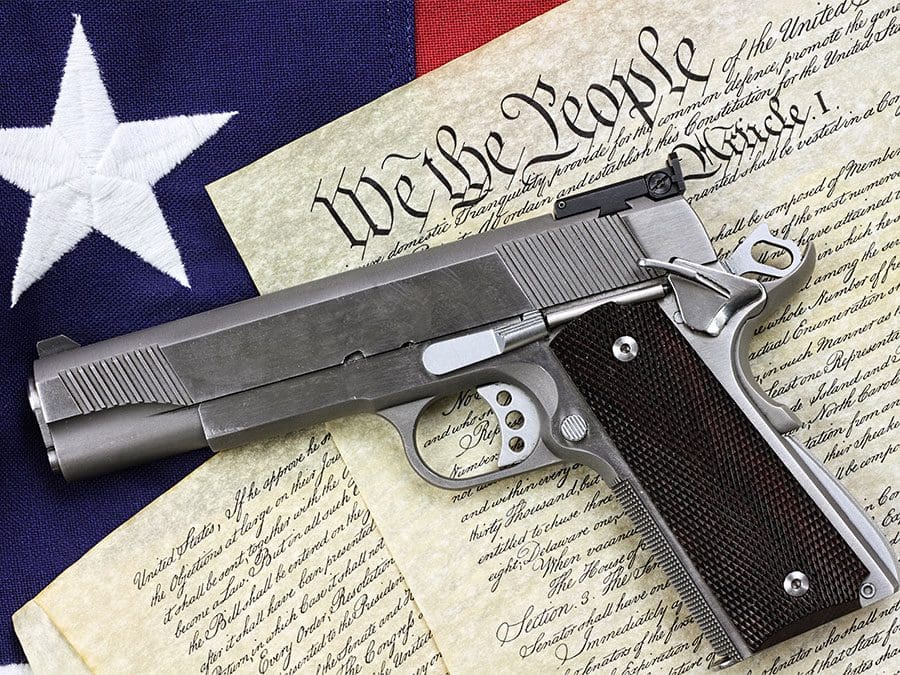
A federal appellate court has struck down longstanding restrictions that barred direct interstate handgun sales between licensed dealers and buyers who live in different states, ruling that the provisions violate the Second Amendment.
The ruling marks another victory for gun-rights groups under the U.S. Supreme Court’s 2022 Bruen precedent, which requires the government to show that modern firearm restrictions align with the nation’s historical tradition of gun regulation.
Background
Several provisions of federal code, originally enacted in 1968, collectively prohibited the buying and selling of handguns across state lines.
The first, Section 922(a)(3), prohibits unlicensed individuals from transporting or receiving into the state a firearm obtained outside of the state. The second, Section 922(a)(5), prohibits unlicensed individuals from selling or delivering firearms to individuals known or believed to reside in another state.
The third provision, Section 922(b)(3), prohibits licensed firearm dealers from selling or delivering firearms to individuals known or believed to reside in another state.
Together, the three provisions categorically outlaw all direct sales of handguns in interstate commerce, regardless of where the transacting parties happen to be located when the sale is made.
Tim Herron of New Mexico and Freddie Blish of Arizona are individuals who have sworn they would be customers of Elite Precision Customs LLC, a federally licensed firearms manufacturer and dealer located in Mansfield, Texas, if not for the ban.
These three parties, alongside the Firearms Policy Coalition (FPC), filed a federal lawsuit in the U.S. District Court for the Northern District of Texas, alleging that the provisions are unconstitutional under the Second Amendment to the U.S. Constitution.
The lawsuit named the Bureau of Alcohol, Tobacco, Firearms, and Explosives (ATF), Acting ATF Director Daniel Driscoll, and U.S. Attorney General Todd Blanche as defendants.
The plaintiffs sought a permanent injunction that would block the provisions from being enforced. The Department of Justice (DOJ) sought to have the lawsuit dismissed.
U.S. District Judge Mark Pittman found that the challenged provisions “do not function as a de facto prohibition on possession but rather a reasonable commercial restriction enacted by Congress.” He therefore concluded that they do not violate the Second Amendment, dismissing the case.
Plaintiffs appealed Judge Pittman’s ruling to the U.S. Fifth Circuit Court of Appeals in New Orleans, where it was heard by a three-judge panel consisting of Judges Jerry Smith, Kurt Engelhardt, and Catharina Haynes.
The only issue before the panel was whether the three challenged provisions are constitutional under the Second Amendment.
The Ruling
On September 18, the panel released its 2-1 decision, finding that the provisions are unconstitutional under the Second Amendment. This reversed Judge Pittman’s order and blocked the provisions from being enforced. Judge Haynes dissented.
As Judge Smith explained in the opinion, the test for determining whether a law is violative of the Second Amendment was laid out in the 2022 U.S. Supreme Court decision in New York State Rifle & Pistol Association v. Bruen.
A court must inquire “whether the Second Amendment’s plain text covers an individual’s conduct,” and, if so, then “the Constitution presumptively protects that conduct.” It then becomes the government’s burden to justify its regulation by demonstrating that it is consistent with the nation’s “historical tradition of firearm regulation.”
The Fifth Circuit concluded that the challenged provisions failed to pass this test.
“Under Bruen, [the challenged provisions] implicate the Second Amendment’s plain text, making them presumptively unconstitutional,” wrote Judge Smith, adding that “the government has failed to meet its burden to justify the provisions as consistent with the nation’s tradition of firearms regulation.”
“The Second Amendment’s plain text makes explicit reference only to the ‘keeping’ and ‘bearing’ of arms, but it is well established in the American legal tradition that the right to keep firearms logically entails the right to purchase them as well,” he continued.
Notably, Judge Smith stated in the opinion that there is “no such thing as a purchase ban unknown at the time of the founding that can evade Bruen analysis.”
Following the favorable ruling, FPC released a celebratory statement.
“This is a massive victory for the People and another major defeat for the federal government’s unconstitutional gun-control regime,” said FPC President Brandon Combs. “Your right to keep and bear arms does not stop at your state line, and the government cannot make you pay a penalty just to exercise it. The Fifth Circuit got it exactly right: this is a purchase ban, it is presumptively unconstitutional, and the government failed to justify it. We told the federal government we were coming for this ban, and today we beat them.”
What Happens Next
The panel’s ruling officially blocked the unconstitutional provisions from being enforced. The Trump Administration’s DOJ is expected to let this decision stand, rather than appeal.
On the same day as the panel’s ruling, the DOJ’s Office of Legal Counsel released a legal opinion on a separate Second Amendment issue, concluding that the federal prohibition against licensed dealers selling handguns to otherwise law-abiding adults ages 18 to 20 is inconsistent with the Second Amendment, and therefore unenforceable.
If you or anyone you know has information regarding court cases, please contact our tip line: scorecardtips@protonmail.com.