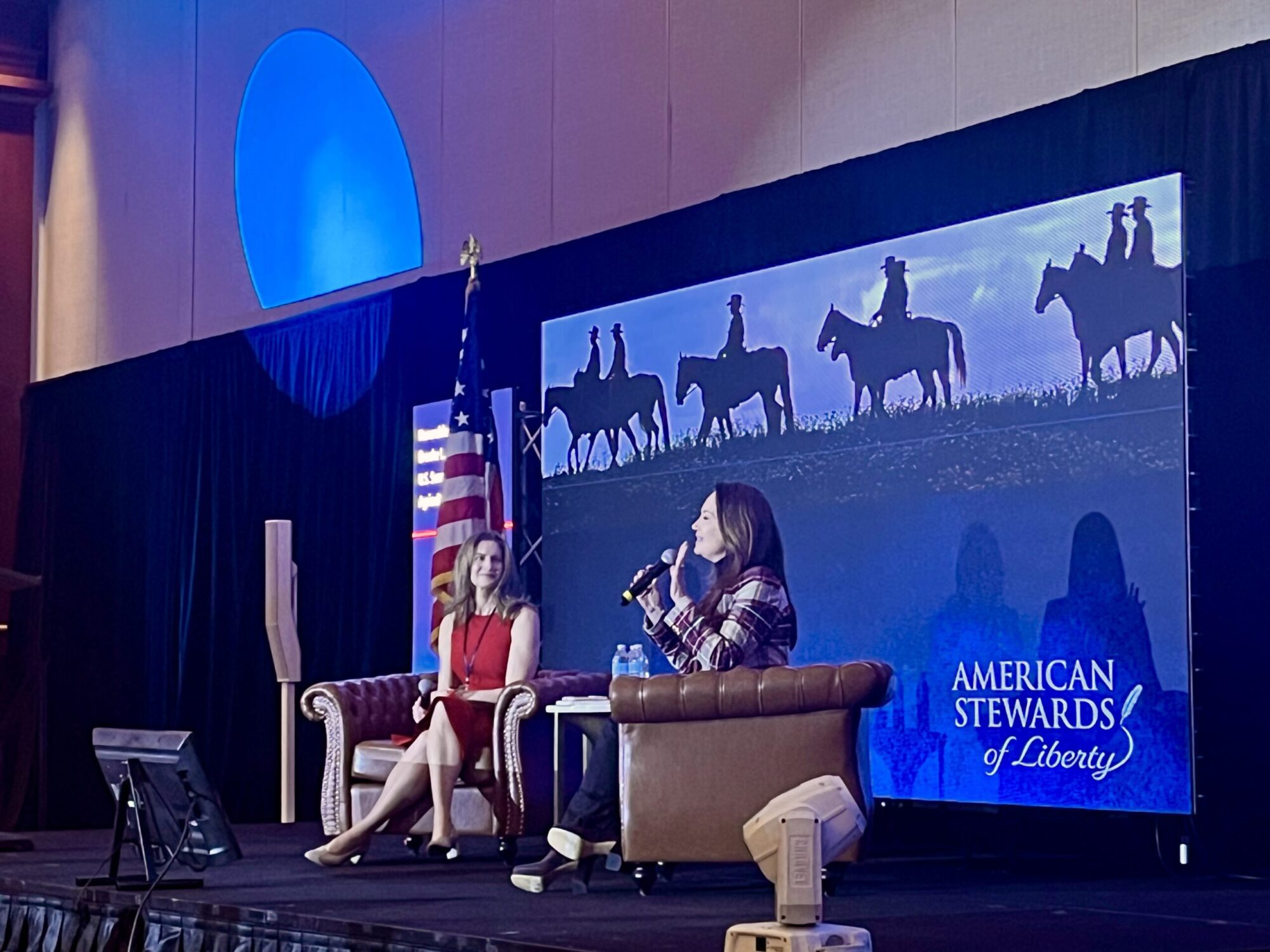
FORT WORTH—Secretary of Agriculture Brooke Rollins highlighted the importance of private property rights during the American Stewards of Liberty conference Friday.
Alongside ASL Executive Director Margaret Byfield, Rollins told attendees that when she arrived at the U.S. Department of Agriculture last year, she found it had drifted far from the original vision of its founder, Abraham Lincoln.
“Abraham Lincoln’s vision, when he founded the U.S. Department of Agriculture in 1862 was an agency for the people, for the farmer, for rural America,” said Rollins.
During her presentation, Rollins emphasized the importance of private property rights for agriculture producers. Since the beginning of the Trump administration, several cases of federal and state overreach against the lands of farmers and ranchers have been brought to the attention of the USDA, which has intervened.
Rollins cited cases involving the Maude family from South Dakota and the King Ranch from Washington as examples of government overreach that she called “agricultural lawfare.”
Rollins also cited the Henry Farm in New Jersey, a 175-year-old, sixth-generation family farm that was going to be taken through eminent domain to build affordable housing.
In order to assist in thousands of other cases of “agricultural lawfare” across the country, Rollins is calling for a new framework that will help change federal, state, and local laws to protect agricultural producers.
She highlighted the Founding Fathers’ intention with the Tenth Amendment of the Constitution. “The government that is closest to the people is the government that should be making all the decisions, and that’s how we keep our constitutional republic.”
“We’ve seen that sort of shift away from those tenants for many, many years, but under the last decade, we’re seeing kind of a reigniting of that flame of liberty in the importance of state and local decision making,” said Rollins.
Earlier this week, Rollins released “The Farmer and Rancher Freedom Framework” to provide the first steps in fighting agricultural lawfare. The framework calls for greater government transparency, deregulation, farmland conservation, and the creation of federal and state partnerships.
According to the document, agricultural lawfare is defined as “the use of administrative, legal, and legislative government systems to adversely impact farmers, ranchers, and agricultural producers.”
Under the framework there are four pillars: protect producers, preserve land and liberty, purge burdensome regulations, and partner for agriculture’s future.
Some of the tenets of the plan include opening up more federal grazing allotments for ranchers, supporting small meat processors, and the need for real and unprocessed food. Rollins also mentioned returning management of national forests back to the states.
She said her goal is to realign the USDA with its original mission by putting farmers, ranchers, and private landowners first. Rollins argued that by doing so, the agency can help save rural America and, ultimately, the country itself.
“If we are not able to reverse the trend in this country of losing thousands and thousands of farms and ranches every single year … if we’re not able to reverse the trend of the chronic disease and chronic obesity and the sickness that our country has … then we will lose America. I believe that’s how existential this is,” said Rollins.