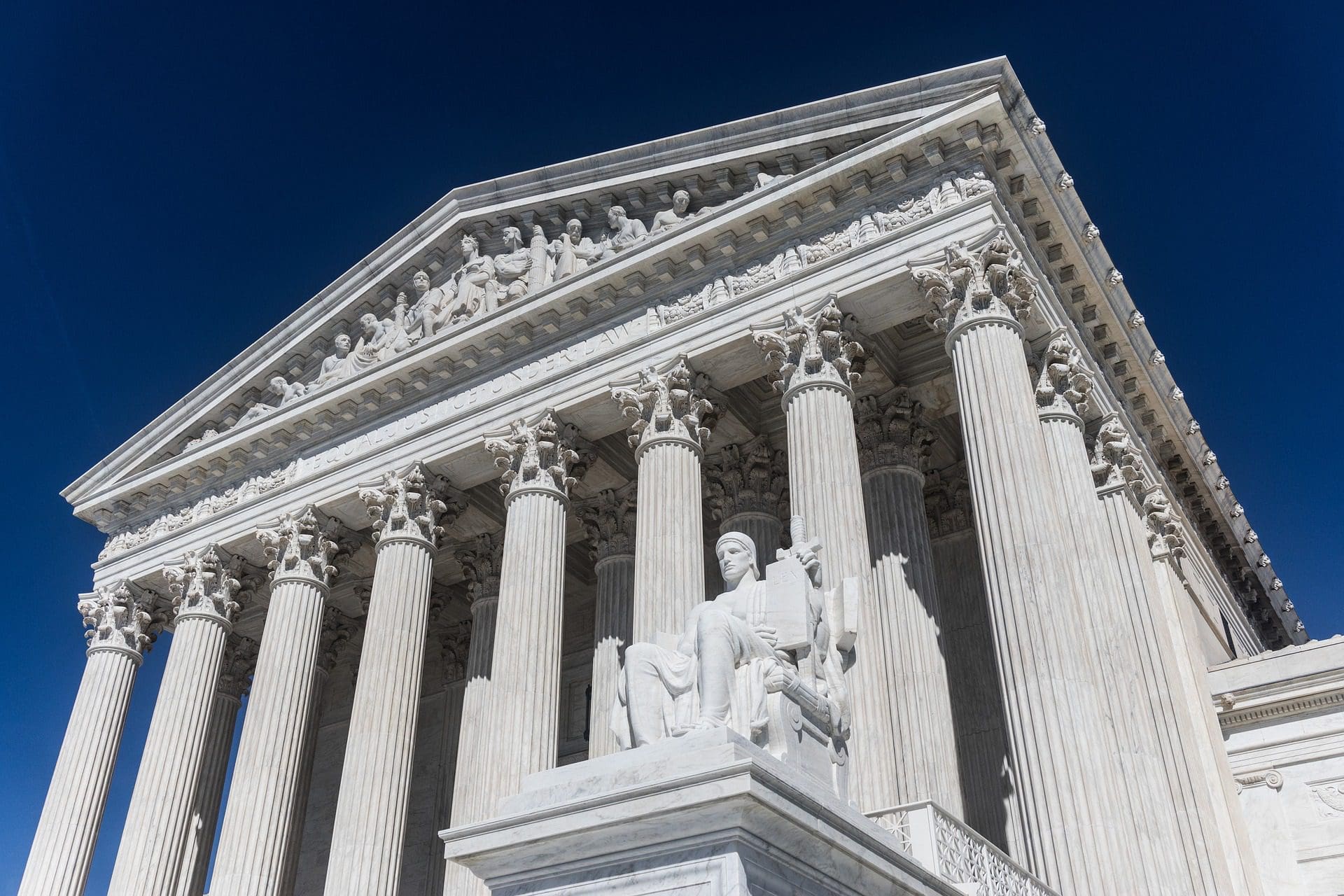
Experts are predicting that the U.S. Supreme Court will dismantle an aspect of the Voting Rights Act that requires racial consideration when redistricting. Oral arguments in a case challenging the practice were reheard on Wednesday, garnering significant attention.
The current precedential understanding of Section 2 of the Voting Rights Act is that certain congressional districts are protected from being redrawn based solely on racial composition.
If the majority of a district’s citizen voting-age population (CVAP) is a single racial minority group, state legislators are restricted from modifying it—even when the change is an unintentional byproduct of drawing a map “blind to race,” as required under the Constitution. This is considered “racial vote dilution” in violation of the Voting Rights Act (VRA).
The VRA and the Constitution are in conflict on this matter.
At present, the way these standards interact is that a mapmaker must draw his map blind to race, to conform with the Constitution. Only after a map has been created can experts analyze the impact it has on VRA-protected districts. It is often left to the courts to decide whether a map is therefore VRA-compliant.
In June, Justice Clarence Thomas wrote in an opinion during an earlier step in the case that there is an “intractable conflict” between the Court’s interpretation of Section 2 of the VRA and “the Equal Protection Clause of the Fourteenth Amendment to the Constitution.”
Justice Thomas asserted that “[t]he Constitution is supreme over statutes … and no intervening developments will change that,” citing Marbury v. Madison.
Background
In 2022, Louisiana legislators passed a congressional map that reduced the number of black-majority CVAP districts from two to one. However, this was a natural byproduct of redistricting “blind to race,” on partisan grounds.
The Fifth Circuit Court of Appeals found this to be in violation of the VRA and required the state to redraw a second black-majority CVAP district.
In January 2024, another congressional map was passed that addressed these concerns. Subsequently, a group of Louisiana voters challenged the map as an unconstitutional racial gerrymander in violation of the Fourteenth Amendment of the U.S. Constitution.
This case, Louisiana v. Callais, is currently before the Supreme Court, with the potential to overturn aspects of Section 2 of the VRA.
Oral Arguments
The Supreme Court heard rearguments on Wednesday, garnering national media attention for comments made by some justices.
The most notable moment from the hearings came when Justice Ketanji Brown Jackson, a Biden appointee, compared black voters to disabled people who need special accommodations. She contended that buildings that did not accommodate disabled people were “discriminatory in effect,” regardless of the intent of the person who designed it.
Justice Jackson said that Section 2 is “responding to current day manifestations of past and present decisions that disadvantage minorities and make it so that they don’t have equal access to the voting system … they’re disabled.”
The “slam-dunk” moment for Callais came when Justice Sonia Sotomayor attempted to argue that “even white Democrats won’t vote for black candidates,” as justification for protecting black-majority districts.
Hashim Mooppan, representing Callais, responded, “If these were white Democrats, there is no reason to think they would have a second district. None. And so what is happening here is their argument is, ‘Because these Democrats happen to be black, they get a second district.’ If they were all white, we all agree they wouldn’t get a second district. That is literally the definition of race subordinating traditional principles.”
It became clear throughout the hearing that the second black-majority district existed only because of race.
This was further highlighted during Justice Thomas’ questioning of Louisiana Solicitor General Ben Aguiñaga, who explicitly said legislators drew the second black-majority district in 2024 because the court told them to. The court said a majority black district was required and the legislature understood the marching orders.
Justice Jackson argued with Aguiñaga over whether the court ordered a second black-majority district or a “remedy” for blacks whose votes were being diluted. Aguiñaga pointed out that these are, in effect, the same.
She then became emotional, stating “No it’s not! Because that, again, uhh, just trust me on this, that the second district is a remedy that one could offer for a problem that we’ve identified.”
Given the conservative makeup of the Supreme Court, experts are expecting Section 2 of the VRA to be reinterpreted. This could eliminate the requirement for states to consider race when redistricting, in conformance with constitutional requirements.
Such a decision could flip more than a dozen U.S. House seats in Southern states that had long been preserving certain Democrat districts based purely upon racial composition. Redistricting on purely partisan grounds is legal under the 2019 precedent of Rucho v. Common Cause.
Relevance to Texas
Louisiana v. Callais comes before the Supreme Court at the same time Texas’ 2025 congressional map is being challenged before a three-judge panel in El Paso.
Texas’ redistricting case rests on two claims: racial gerrymandering and racial vote dilution. The first requires proving an intent to discriminate, but the second claim only concerns whether VRA-protected districts were eliminated, even if done unintentionally.
During the recent preliminary injunction hearings, left-wing plaintiffs did not present any solid evidence of intentional racial discrimination. Their likelihood of success on VRA claims is also questionable, given the 2025 map includes more majority-minority CVAP districts than the 2021 map.
These VRA claims are not relevant to the preliminary injunction request and are expected to be rendered irrelevant by the upcoming Supreme Court ruling in Callais, making Texas’ 2025 map even more likely to hold up in court if the case reaches trial.
If you or anyone you know has information regarding court cases, please contact our tip line: scorecardtips@protonmail.com.