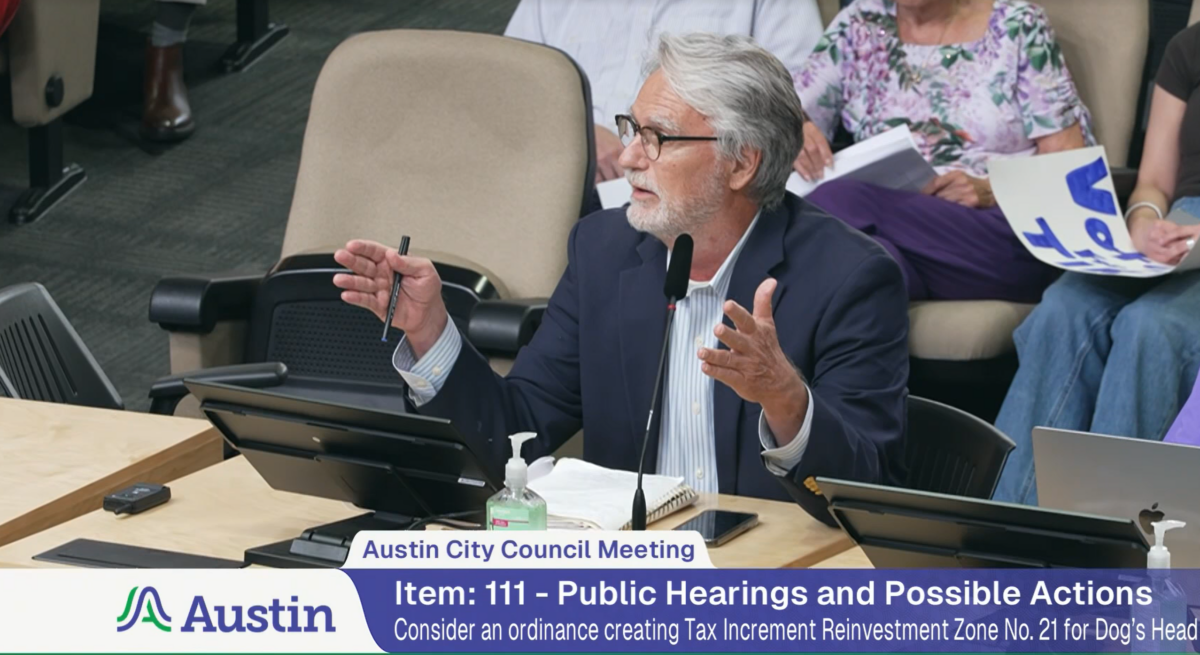
The Austin City Council has approved a series of agenda items to facilitate a colossal new development just east of the city’s current limits. Amazon Robotics, a subsidiary of the online megaretailer, will anchor the proposed complex.
The council approved these items during a marathon meeting on Thursday.
At issue is a proposed municipal annexation followed by the creation of a so-called “tax increment reinvestment zone” that supporters say is necessary to coordinate the extension of basic infrastructure to the currently unincorporated area.
The proposed facility would be located on a spit of land known colloquially as “Dog’s Head” between US Highway 183 and the Colorado River. This is just east of Austin’s Montopolis neighborhood, near the city’s airport.
“This is double the size of downtown. This is ten times the size of the Domain,” one speaker stated during public testimony.
The controversial 2,600-acre proposal came to light this past May when area residents discovered a 37-page development agreement on an Austin City Council agenda. The residents, some of whose homes were directly in the path of the proposed new roadways, had just 57 hours’ notice before the May city council meeting.
In addition to the Amazon facility, proponents envisage an interconnected series of residential developments, commercial developments, and outdoor recreational facilities.
The development in question does not currently have a public-facing website.
Beyond the suddenness with which the project was sprung on local residents, its mechanism raises additional questions.
Tax Increment Reinvestment Zones (TIRZ) are a legal vehicle for Tax Increment Financing (TIF), which typically diverts property tax revenue from the area into a special development fund instead of a municipality’s general budget. They are governed by Chapter 311 of the Texas Tax Code.
Proponents argue that TIF funding eases new development.
Opponents argue that tax carve-outs narrow the tax base, which inevitably begets higher tax rates for everyone else.
“The state law is very clear and it starts with the Constitution, which requires fair and uniform taxation,” local activist Bill Bunch stated during public testimony.
“This is nowhere close to being fair in uniform taxation.”
Resident Lisa Levins told the council that their fiscal analysis “doesn’t make sense,” and raised a series of questions:
- Why is a TIRZ necessary?
- What development would not happen without this public financing?
- Which infrastructure costs belong to the developers and which could eventually fall to taxpayers?
- What is the city’s total anticipated commitment over the lifetime of this zone?
- What protections exist if the promised public benefit never materializes?
The Texas Public Policy Foundation has described TIRZ/TIF funding as a form of “invisible government.”
“TIRZ is a speculative scam that always ends up raising other people’s taxes to subsidize the TIRZ projects,” former Austin City Councilmember Don Zimmerman told Texas Scorecard.
The Dog’s Head TIRZ controversy comes at a time of unprecedented fury at municipal fiscal priorities.
Earlier this month, the city manager released the latest in a string of record–setting budgets that included a record-setting tax increase.
Last month, the city clerk officially certified a ballot measure that could impose new fiscal transparency requirements.
If passed, the referendum would amend the city charter to require independent audits of municipal finances every five years.
Additionally, if the city council wants to pursue a future tax rate election, the proposed charter amendment would require the municipal government to complete such an audit before calling the election.
The referendum follows the landslide defeat of Proposition Q, a ballot measure that could have enshrined hundreds of millions of dollars in municipal spending, in November 2025.
A similar effort to require a municipal audit fell short in 2018. At the time, Austin’s municipal budget was $4.1 billion.
The audit referendum will appear at the bottom of the ballot after federal, state, and local offices.
Gov. Greg Abbott has also proposed a series of taxpayer protections, including municipal spending caps and supermajority approval for tax increases, for consideration during next year’s legislative session. The current Republican Party of Texas platform calls for “receivership” of rogue municipalities.
Legislation that would have abolished the Austin City Council received a committee hearing from state lawmakers in 2025 and is expected to return in 2027.