Gov. Greg Abbott’s property tax reform proposal has already secured the backing of a majority of the Texas House.
Now, the governor is beginning to build support in the Senate, with State Sens. Bob Hall and Bryan Hughes publicly joining his statewide campaign to promote the plan.
Abbott announced this week that 89 Republican incumbents and nominees running for the Texas House have signed his taxpayer empowerment pledge, building on what was already majority support among current House members.
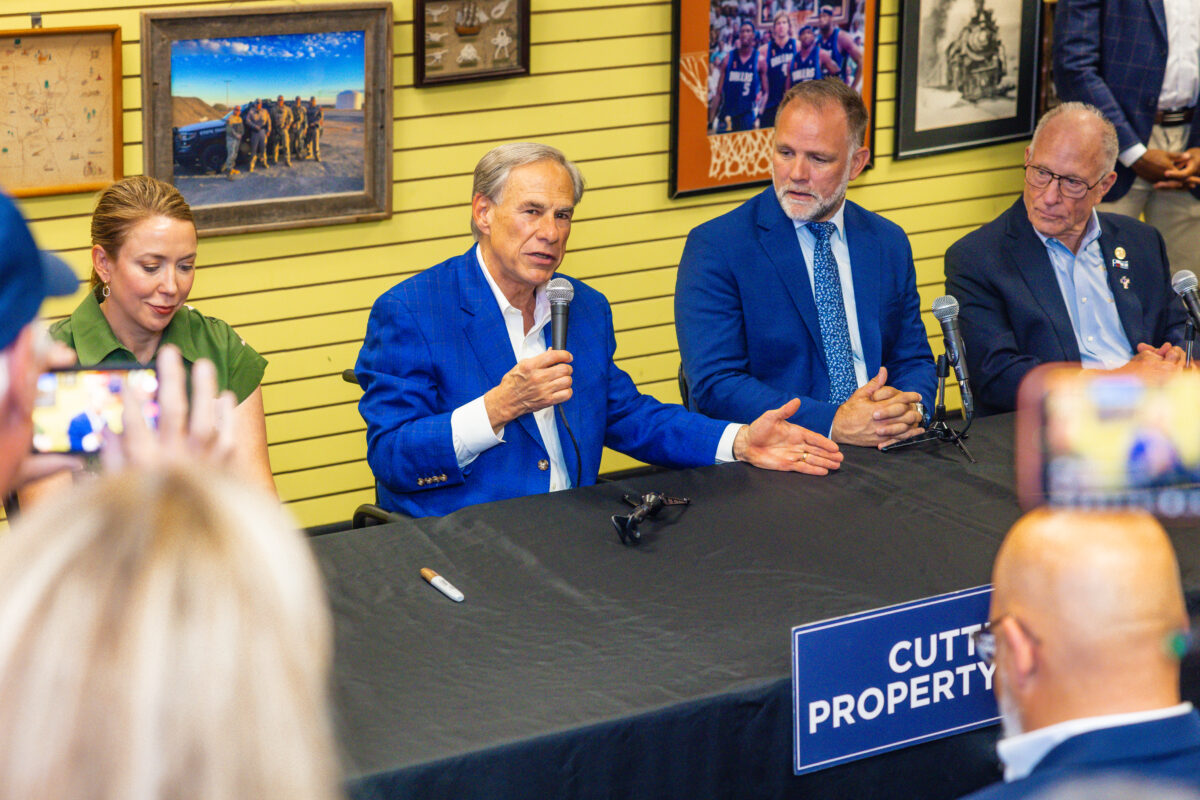
As Abbott continues traveling the state to promote the proposal, both Hall and Hughes joined him at two separate events in East Texas.
Hall and Hughes are the first senators to publicly join Abbott at events promoting the proposal during his statewide campaign.
Introducing Abbott in Canton, Hall praised the proposal.
“Governor Abbott has proposed a property tax plan that will curtail out-of-control local government spending and put control of property taxes where it belongs with the taxpayers, folks,” Hall said.
Speaking in Bullard, Hughes said Abbott was addressing one of Texans’ biggest concerns.
“Governor Abbott is going to be talking about the American dream of home ownership and how property taxes can get in the way, and can really be a problem, and he’s doing something about that,” Hughes said. “Your legislature is doing something about that.”
Abbott said Texas lawmakers have repeatedly increased the homestead exemption over the past decade—from $15,000 when he first took office to $140,000 today—but argued Texans still are not seeing lasting relief.
“None of you, nor anybody else in the entire state of Texas, has come up to me and said, ‘Hey, Governor, I’m perfectly happy with my property tax bill,'” Abbott said. “What I’m talking about today are solutions that will make your property tax bill go down forever and make it affordable for you to live in your home for the rest of your lives.”
Abbott’s proposal would make sweeping changes to Texas’ property tax system. It would require two-thirds voter approval for local property tax increases—including bond elections—limit local government spending, expand taxpayers’ ability to force rollback elections, lower appraisal caps, and ultimately allow voters to abolish school district property taxes on homesteads through a constitutional amendment.
Abbott said the proposal would permanently shift responsibility for funding public education away from homeowners.
“The state should fund public education, not your homestead,” Abbott said. “The amount that you would pay in your property tax bill for school districts is $0. That would be forever.”
Abbott also expressed confidence the proposal already has enough support to clear the Texas House.
“I know I already have enough votes in the Texas House of Representatives to get this plan passed,” Abbott said. “We gotta get it across the finish line and get it delivered for you.”
House leadership has likewise indicated property tax reform will be a priority next session.
Asked whether Speaker Dustin Burrows supports Abbott’s proposal, Burrows’ office stopped short of explicitly endorsing the plan but told Texas Scorecard that lawmakers would work toward a comprehensive package.
“Property tax reform will be prioritized next session. The Speaker is committed to working with Governor Abbott, Lieutenant Governor Patrick, and members of the Texas House on their proposals and is confident that the final legislative package will be the most significant in modern history,” said Kim Carmichael, communications director for Burrows.
The proposal’s path through the Senate, however, remains less certain.
While Hall and Hughes have publicly aligned themselves with Abbott’s effort, Lt. Gov. Dan Patrick has championed a narrower property tax package centered on expanding exemptions rather than fundamentally restructuring the property tax system.
Patrick’s proposal would increase the homestead exemption by an additional $40,000, extend senior-style property tax freezes to homeowners beginning at age 55, and cap city and county budget growth at 3.5 percent.
Patrick’s office did not respond to a request for comment for this article. In other appearances, he has argued his proposal is more affordable—projected to cost less than $4 billion per biennium—and more politically achievable, noting Texans have repeatedly approved increases to the homestead exemption. He has also warned that eliminating school district property taxes could require a significant increase in the state sales tax to replace the lost revenue.