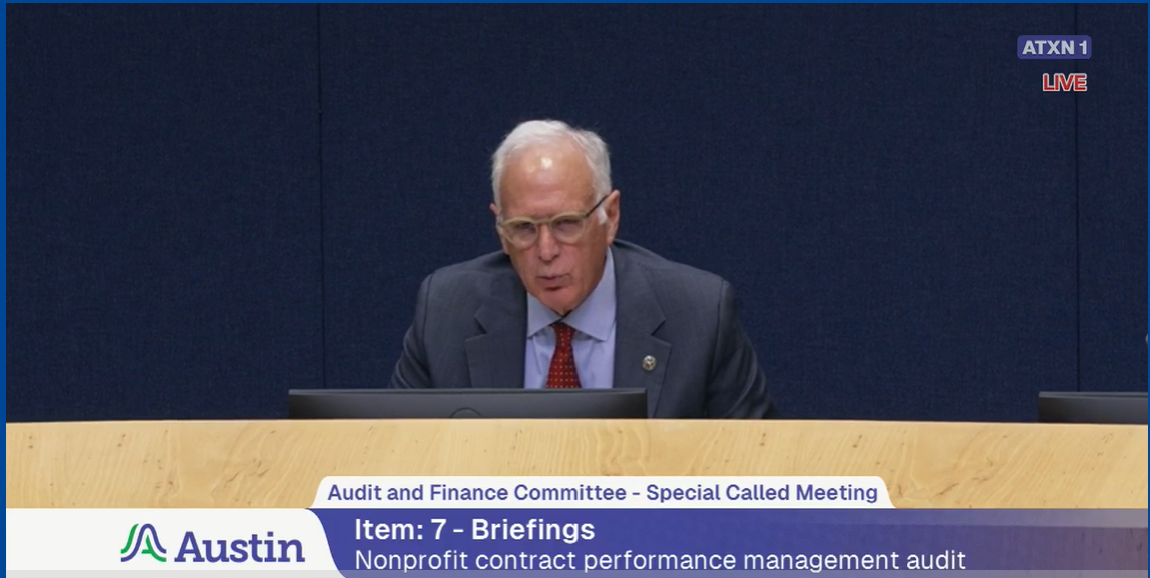
Austin’s municipal government does not use competitive bidding when awarding contracts for “social services,” a committee of the city council learned Monday.
This bombshell revelation came during testimony by the city’s chief government relations officer in a special-called meeting of the Audit and Finance committees.
“Here at the city, when those services are labeled as social services contracts, the path that it goes down exempts those contracts from our anti-lobbying ordinance and it also exempts those contracts from competitive bidding,” said Carrie Rogers.
Competitive bidding, a process whereby governmental entities solicit bids from multiple vendors, is considered a standard good-government practice.
Monday’s hearing followed the release of an internal audit that revealed Austin has overpaid a series of nonprofit vendors for services that were never received.
The city auditor’s examination “reviewed a sample of 25 contracts with a contract amount of about $30 million,” and “for 19 (76%) of the contracts, the nonprofit organizations did not meet one or more performance expectations.”
The audit further reviewed 151 performance expectations. It “found that the nonprofit organizations did not meet 67 (44%) of the expected output and outcome performance expectations. This included 45% of the output and 42% of the outcome performance expectations.”
While the audit does not outline a total amount for the overpayments, the Austin-American Statesman reports that the sum is at least in the “millions.”
For perspective, a 44 percent shortfall from “$30 million” would total $13.2 million.
Provision of social services through so-called “nonprofit” organizations has been criticized as a form of political patronage for left-wing organizations.
The audit findings come at a time of unprecedented public fury at municipal spending.
Earlier this month, the city manager released the latest in a string of record-setting budgets that included a record setting tax increase.
Last month, the city clerk officially certified a ballot measure that could impose new fiscal transparency requirements.
If passed, the referendum would amend the city charter to require independent audits of municipal finances every five years.
Additionally, if the city council wants to pursue a future tax rate election, the proposed charter amendment would require the municipal government to complete such an audit before calling the election.
The City of Austin currently conducts various internal audits. The proposed charter amendment would supplement this process with regular external reviews.
The referendum follows the landslide defeat of Proposition Q, a ballot measure that could have enshrined hundreds of millions of dollars in municipal spending, in November 2025.
Austin’s municipal spending has long been a subject of criticism. This criticism has grown following an explosion of spending for vagrancy services in recent years.
Save Austin Now, a non-partisan watchdog, previously spearheaded a 2021 effort to restore a ban on camping in public places by vagrants. The council had repealed this prohibition in 2019, creating a rash of consequences including fire hazards, health concerns, and public safety issues.
A recent Texas Scorecard investigation also uncovered millions of dollars in public subsidies for groups that promote dangerous sexual activity.
A similar effort to require a municipal audit fell short in 2018. At the time, Austin’s municipal budget was $4.1 billion.
The audit referendum will appear at the bottom of the ballot after federal, state, and local offices.
Gov. Greg Abbott has also proposed a series of taxpayer protections, including municipal spending caps and supermajority approval for tax increases, for consideration during next year’s legislative session.
Legislation that would have abolished the Austin City Council received a committee hearing from state lawmakers in 2025 and is expected to return in 2027.