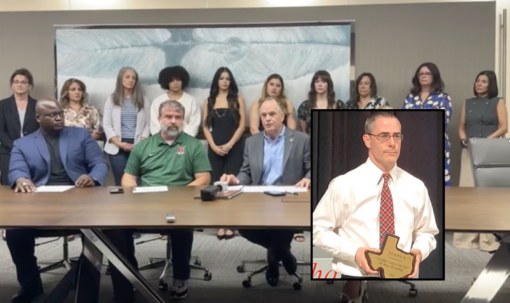
Cleveland Independent School District has escaped a wrongful-termination and retaliation lawsuit after being granted sovereign immunity. The court never considered the merits of the plaintiffs’ claims.
Thomas Everett had accused the district of falsifying employee statements to accuse him of misconduct, firing him for refusing to sign a gag order without review, falsifying workers’ compensation claims, and more.
Background
In January 2023, Everett began working as a substitute teacher for Cleveland ISD. By May, he became a bus driver for the district. When signing up for insurance, he was asked to go back to college to complete his bachelor’s degree.
Everett participated in multiple Bus Road-e-o events in March 2024, which are skills and safety competitions for bus drivers.
Following the events, Everett was called into the office of Cleveland ISD’s Assistant Director of Transportation Janis Rios’ office. Rios reportedly informed Everett that she had received a complaint from another school district, alleging that he “was acting unprofessionally,” was loud, made two ladies move to another table, made another driver cry, refused to participate in one event, and claimed that those running the competition didn’t want them to win.
Everett denied these claims but was not allowed to see the document, which reportedly came from Cypress Fairbanks ISD. The district reportedly placed him under a 15-day gag order, telling him he could not talk to anybody about the complaint, including his wife.
Two weeks later, Everett was called back into Rios’ office where he was reportedly informed that he had to sign a gag order. This order stated that he could not discuss the complaint with anybody for a year and barred him from participating in any school events or trips. Rios told him that if he did not sign the order he would lose his job.
Everett chose instead to quit, writing as his reasoning on the form that he is “tired of being lied on.”
He then allegedly learned that two other drivers were “forced to sign a complaint” against him, and Cypress Fairbanks ISD’s Transportation Training and Compliance Manager Jessica Price informed him that she had not received any such complaints.
It was also reportedly revealed during a Texas Workforce Commission hearing that the complaint did not, in fact, originate from Cypress Fairbanks ISD. Cleveland ISD HR Director Rodrigo Cano had explicitly claimed that it had.
Everett applied for a substitute teaching job with Cleveland ISD but was allegedly blocked from employment opportunities. He was then awarded unemployment benefits until the district appealed on the final day and won. This resulted in a repayment demand of over $6,000.
Through misdirected correspondence, Everett reportedly learned that Cleveland ISD had “fraudulently filed a worker’s compensation claim on his behalf.”
The Lawsuit
This led Everett to file a lawsuit against the district in the 253rd District Court in Liberty County, seeking $5 million in damages.
Specifically, Everett alleged wrongful termination, defamation, fraudulent misrepresentation, intentional infliction of emotional distress, tortious interference with employment, and retaliatory actions in violation of the Texas Whistleblower Act.
Cleveland ISD sought to have the lawsuit dismissed, claiming it is shielded from suit and liability by governmental immunity. For this immunity to be waived, Everett must point to a specific statute explicitly waiving that protection.
After a hearing, the trial court ruled in favor of Cleveland ISD, finding that Everett had failed to locate a statute that would waive the district’s immunity in this case. The court did not consider the merits of Everett’s claims.
The Appeal
Everett immediately appealed to the Ninth Court of Appeals in Beaumont, maintaining that his claims are not barred by immunity.
In part, Everett asserted that “[t]he trial court erred in dismissing Everett’s claims under the Texas Whistleblower Act.” The act expressly waives immunity when a public employee suffers retaliation for making a good-faith report of a legal violation to an appropriate law enforcement authority.
Everett claims that he satisfied this requirement when reporting the alleged fraudulent or unauthorized use of workers’ compensation procedures, cohorts and signatures related to gag orders, and the alleged fabrication of employee statements.
However, the Ninth Court found that Everett had failed to allege a violation of the Texas Whistleblower Act in his lawsuit and instead had merely referenced it.
As a result, the court again ruled in favor of the school district, affirming the trial court’s order on July 1, 2026. Once again, this ruling was based purely on Cleveland ISD’s claim of immunity and did not address the merits of Everett’s claims against the district.
Everett appealed this decision to the Supreme Court of Texas, but the Court denied review on September 18. This left the trial court order in place, dismissing the lawsuit with prejudice.
If you or anyone you know has information regarding court cases, please contact our tip line: tips@texasscorecard.com.