Galveston County is facing another redistricting lawsuit for redrawing its precinct boundaries mid-election cycle, meaning between the 2026 Primary and General Elections.
A federal challenge to the county’s 2021 precinct redistricting led to the landmark Petteway ruling by the U.S. Fifth Circuit Court of Appeals. The court struck down the alleged Voting Rights Act (VRA) requirement that coalition districts—in which multiple minority groups combine to elect their candidate of choice—be maintained when redrawing districts.
The Petteway ruling led Texas to pursue partisan redistricting in 2025, but was further strengthened in April 2026 by the U.S. Supreme Court ruling in Louisiana v. Callais, which held that majority-minority districts were also not required under the VRA.
Background
In response to Callais, Galveston County decided to revisit its precinct maps with a more aggressive partisan approach. It had also not redistricted its justice of the peace (JP) and constable precincts since 2013.
In June 2026, the Galveston County Commissioners Court adopted a new map to ensure compliance with the law, which contained new precinct lines for justices of the peace, constables, and county commissioners.
Months earlier, the county held primary elections for two commissioner and three JP candidates for the November 2026 General Elections. None of the candidates faced primary challengers.
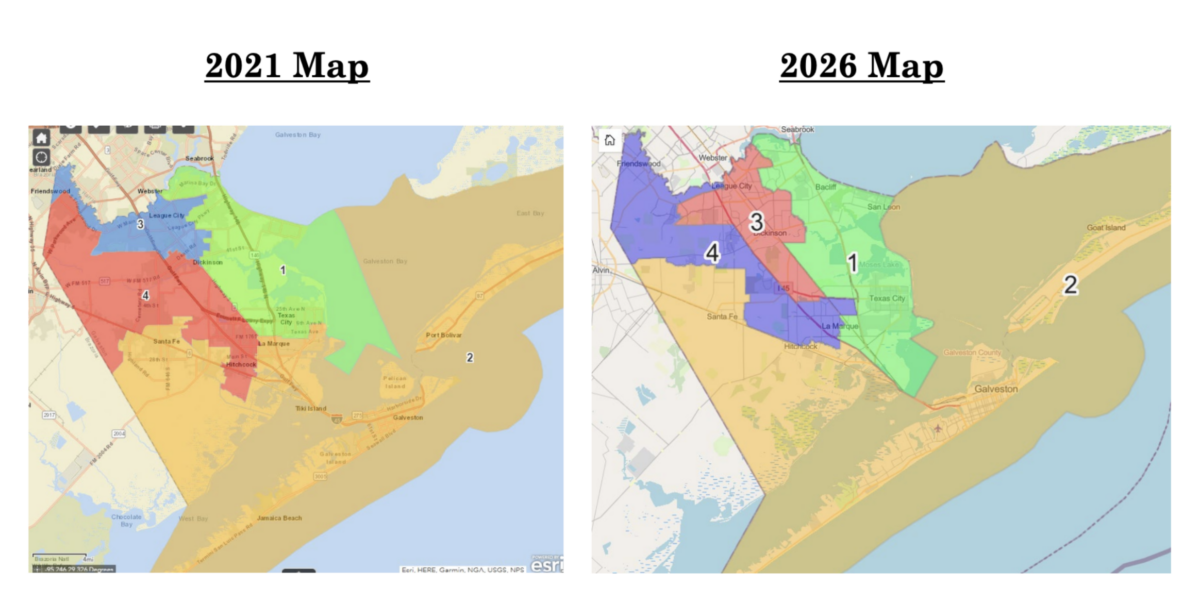
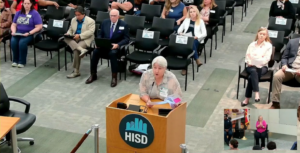
Notably, JP Kathleen McCumber’s seat was not up for election in Precinct 4, and she will now finish the last two years of her term as JP of Precinct 3. JP Billy Williams, who ran unopposed in the Democrat primary for Precinct 3, will now run in the general election for JP of Precinct 4.
The Lawsuit
On August 4, a coalition of Democrat plaintiffs filed an emergency petition for writ of mandamus, directly asking the Texas Supreme Court to block the new map before the 2026 General Election.
Plaintiffs include Democrat constable candidate Derreck Rose and county residents Wilma Green and Diane Merchant. Their attorneys include Chad Dunn, who has led multiple Democrat challenges to Republican redistricting efforts in Texas.
They are asking the Court to revert to the maps used in the primaries—despite this including the 2021 commissioners precinct map that is still being challenged in the long-running Petteway case.
In fact, the current challenge arose from a June 28 Petteway hearing in which attorney Joe Nixon—representing Galveston County—confirmed to Judge Jeffrey Brown that the county will be using the new precinct map for the 2026 General Election, as it is the “legal map that’s now in effect.”
The county had been petitioning Judge Brown to dismiss the case as moot since new precinct boundaries had been passed, but plaintiffs argued that the 2026 map may not stand up to Texas election law. For this reason, they petitioned Brown to allow litigation to proceed against the 2021 map—an argument that he accepted.
In challenging the 2026 map, plaintiffs argue the Texas Election Code prohibits drawing boundaries between the Primary and General Elections. The county argues this is “a fundamental misreading of the Election Code and ignores the constitutional and statutory provisions that authorize and govern mid-cycle redistricting.”
Second, plaintiffs assert that it violates equal protection rights, as certain voters and potential candidates will be denied “the opportunity to have participated in the primary election.”
In the county’s response, it pointed out that “Galveston County voters had access to a primary election, and [the plaintiffs] do not contend that any candidate was excluded from filing or ballot access restriction was imposed. [Plaintiffs’] alleged injury is a change in constituency, not a denial of voting rights.”
Finally, the plaintiffs contend it is a violation of equal protection rights to experience delayed voting for staggered-term offices. Because of the new map, certain voters who were scheduled to vote in November must now wait until the next election cycle in two years.
In response, the county highlighted the 2025 Fifth Circuit decision in Jackson v. Tarrant County, which held that “[n]othing in the Constitution forbids a jurisdiction from adopting a staggered election system. Nothing in the Constitution forbids a jurisdiction from redistricting mid-cycle. And nothing in the Constitution forbids a jurisdiction from combining the two—even when the practical result is that some voters must wait a bit longer to cast their ballots. The Constitution protects the right to vote, not the right to vote on a particular timetable.”
Additionally, the county argued that the plaintiffs are not entitled to relief by pursuing the wrong procedural route and for their delay in filing the petition—36 days after the new map was adopted.
“[Plaintiffs] are not entitled to mandamus relief: they bypassed lower courts with no explanation, waited over 30 days after the map’s enactment to file here, challenge a discretionary act rather than a ministerial duty, and request a judicial prohibition that conflicts with staggered voting in Texas,” wrote the county. “The Court should deny their Petition.”
If you or anyone you know has information regarding court cases, please contact our tip line: scorecardtips@protonmail.com.