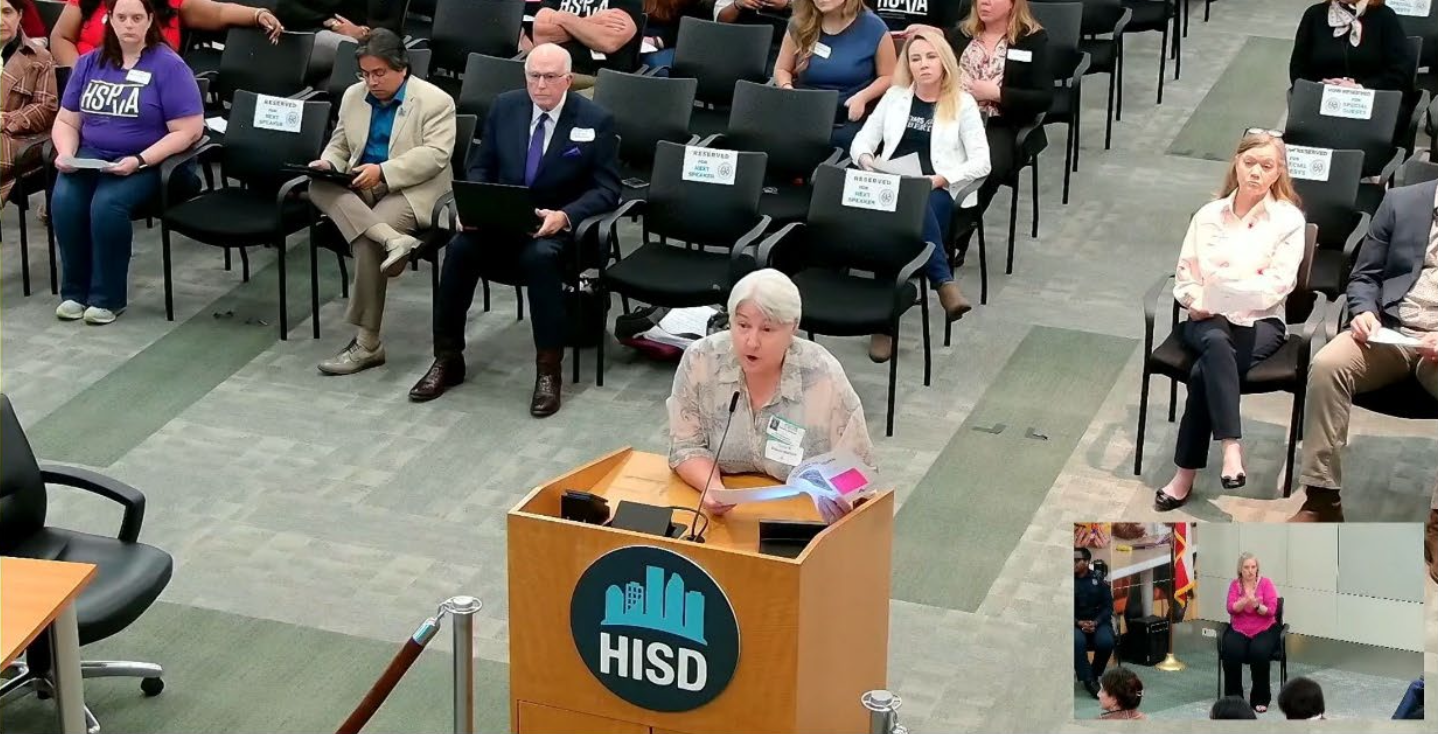
The Houston Independent School District continues to assert that conservative activist Bonnie Wallace was removed from a school board meeting for “reading pornography to children,” despite her reading from a book the district has available to minors.
The district has yet to reconcile this contradiction, and it even doubled down when responding to Wallace’s civil rights lawsuit. The case is set for trial in September 2027.
Background
On March 19, 2026, Wallace spoke during the public comment period of an HISD board meeting that included an agenda item on “instructional materials and library content.”
Before reading, Wallace warned that her remarks would include explicit language and suggested that any children present leave the room, saying she was addressing sensitive material that is already available to students in HISD libraries. She then began reading verbatim from “A Court of Silver Flames” by Sarah J. Maas, a book Wallace says is on the shelves of at least three HISD school libraries and contains graphic sexual descriptions.
Board Vice President Angela Lemond Flowers—the presiding officer—interrupted Wallace, ordered her to stop, and issued “escalating warnings” even after Wallace explained that the explicit language was the point of her criticism.
Wallace ultimately stopped, left the podium, and returned to her seat. Even after she was seated and no longer speaking, Flowers directed three police officers to remove Wallace from the meeting and escort her out of the building and off district property.
Wallace argues her removal, after she was seated and silent, proves that this was not about “maintaining decorum in the meeting” but rather about silencing her.
This led Wallace to file a federal lawsuit on April 30 against HISD, Board President Richard Campo in his official capacity, and Flowers in both her official and individual capacities.
The suit alleged that the defendants’ actions violated Wallace’s First Amendment rights, calling her statements “core political speech” on a matter of public concern—whether sexually explicit and profane books should be paid for by school districts and accessible to minors in school libraries.
Wallace’s attorneys say she did not exceed her time limit, go off topic, or cause any disruption, and that she was removed “solely because of the content and viewpoint of her remarks,” specifically her criticism of HISD’s decision to purchase and circulate “sexually explicit” books.
An Inconsistent Public Posture
Defendants have since filed a motion to dismiss the case, asserting that the lawsuit “identifies no authority requiring the presiding officer to permit the live oral recitation of sexually graphic passages in such a forum under those circumstances.”
The district cited U.S. Supreme Court decisions—Ginsberg v. New York and Free Speech Coalition, Inc. v. Paxton—which recognized “the State’s substantial interest in protecting minors from exposure to sexually explicit material.” Their application of these rulings to Wallace’s removal remains controversial, and her attorneys assert that their characterization of the cases is incorrect.
As justification for her removal, the district noted how Wallace herself considered the content as too graphic for minors—all while failing to acknowledge that they are distributing the same content to minors.
Wallace told Texas Scorecard, “HISD claiming they had authority to remove me because I was reciting sexually explicit passages is such hypocrisy. They evidently thought the book was wildly inappropriate. I agree that this book, and thousands of others, are wildly inappropriate for minors. But HISD should explain why they squandered taxpayer dollars on this sexually explicit content and are now retaining it so minors continue to have access to it. In essence, I was reading HISD’s own speech. If they truly think this speech is inappropriate, all library books containing this sexually explicit content must be removed from HISD libraries. Their request to have the lawsuit dismissed by stating they want to protect minors from exposure to sexually explicit material is HILARIOUS! I guess they only want to protect minors from sexually explicit content during HISD school board meetings but not in HISD libraries!”
The district also failed to acknowledge in making this argument that Wallace had expressly asked any adults with children present to step out for the brief duration of her remarks.
Nonetheless, HISD’s characterization of Wallace’s speech as “disruptive conduct” is not enough to curb her First Amendment rights—a point recently emphasized by the U.S. Supreme Court.
Wallace cited the March 2026 U.S. Supreme Court ruling in Chiles v. Salazar, which held that speech does not lose First Amendment protection merely because the government characterizes it as something other than speech.
“Chiles holds that speech does not become ‘conduct’ merely because the government says so or affixes a regulatory label to it,” wrote Martin Etwop, Wallace’s attorney. “The Court explained that the First Amendment ‘is no word game, and the exercise of constitutional rights cannot be circumscribed by mere labels.’”
Chiles also holds that speech does not lose constitutional protection simply because it occurs in a professional setting.
The case is currently scheduled for trial in September 2027, following the standard 15‑month federal timeline from the filing of the initial complaint through trial.
HISD did not respond to Texas Scorecard’s request for comment before publication.
If you or anyone you know has information regarding court cases, please contact our tip line: scorecardtips@protonmail.com.