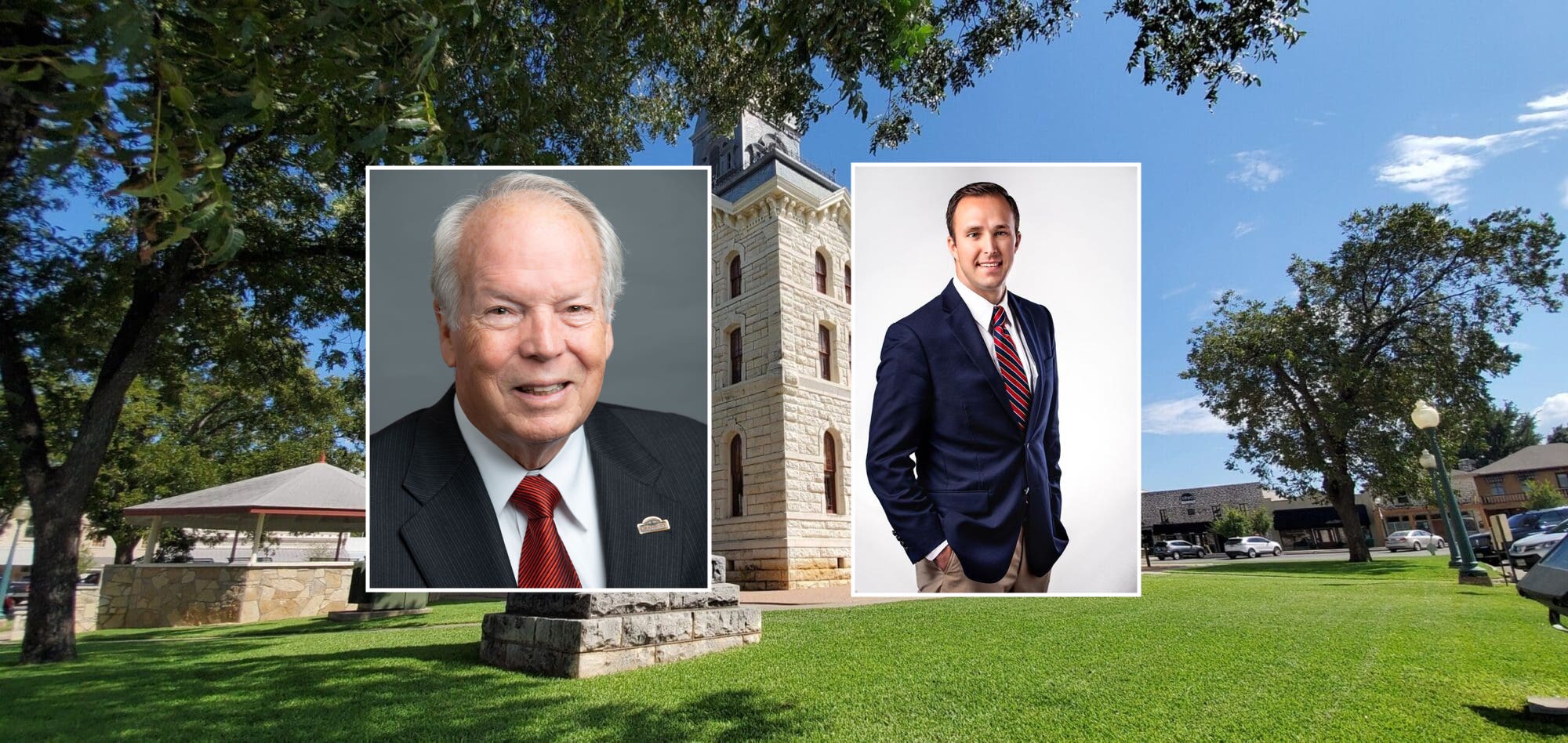
Granbury Mayor Jim Jarratt wants Hood County District Attorney Ryan Sinclair to investigate the local appraisal district after a forensic audit found the appraisal district withheld and spent more than $3 million of surplus taxpayer monies without notifying the local governments that supervise it. While the district has returned $1.9 million, Jarratt said $1.3 million remains outstanding.
The forensic audit warns that the Hood County Appraisal District has few policies governing money management, and that it isn’t the only one in Texas, meaning there could be similar issues elsewhere.
As for Hood County, Jarratt asked county commissioners for help near the end of the February 10 meeting, noting that time was running out. “Over these 10 years, $3,300,000 in excess funds have been moved … to the retirement plan and to build a new building,” Jarratt told the commissioners during his presentation of a forensic audit of the Hood County Central Appraisal District (HCAD).
Published December 1, 2025, the audit, conducted by Weaver & Tidwell, L.L.P., covered the years 2016 to 2023. Weaver & Tidwell found HCAD increased its original $800,000 budget for land and building by $2 million and its $2 million budget for retirement by $800,000.
HCAD made these changes through mid-year “line-item adjustments,” by taking monies from one account and moving it to another without increasing the total budget. Weaver & Tidwell, which stated it is an auditing firm and not a law firm, found state law requires appraisal districts to notify the local governments that supervise them, but the law “does not provide language or guidance defining a budget amendment or a line-item adjustment.” HCAD never notified the local governments.
The source of funds for appraisal districts are the taxpayers, through the local governments that supervise that district. For HCAD, that is 11 taxing entities, which include Hood County, the city of Granbury, and Granbury ISD.
Jarratt presented to the Hood County commissioners a chart comparing these boosts in retirement spending with employee contributions.
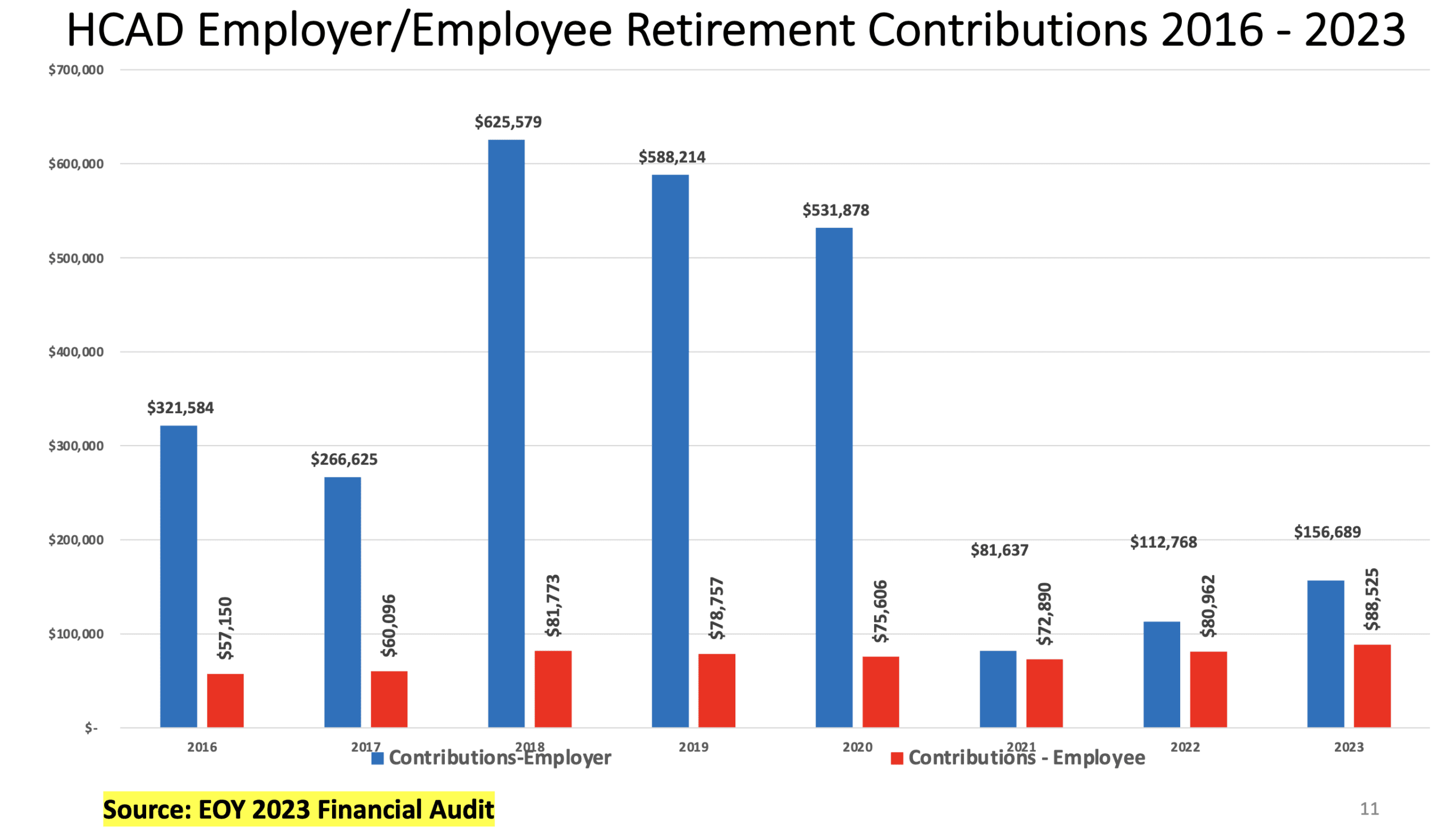
“I look at this, I’m saying what a deal. Where was I in 2018, 19, and 20?” Jarratt said.
“Yeah, me too,” added Commissioner Dave Eagle.
Commissioner Nannette Samuelson asked how many people HCAD employs. “I think there’s 18 to 20 at this point in time,” Jarratt replied.
According to the forensic audit, the sources of funds for these budget changes “were primarily budget surpluses from prior fiscal years,” categorized in an account titled “Use of Prior Year Fund Balance,” but were instead reported on the audited financial statements during the period.
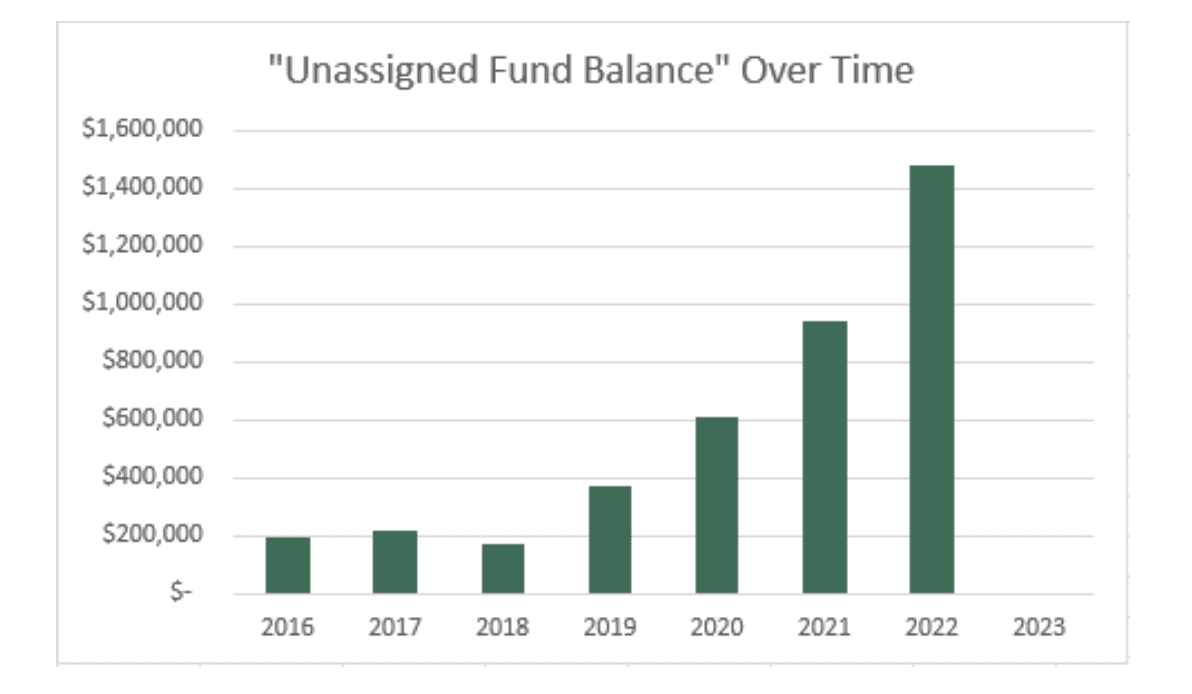
Mayor Jarratt told Texas Scorecard whatever surplus monies left over after all these adjustments remained in an “unassigned fund balance.” The taxpayer funds weren’t assigned for any specific use in the general ledger, but the actual fund was identified only in audited financial statements, the audit found.
Over time, these funds grew to a total of $1.4 million.
The budget adjustments the forensic audit found were “recommended by their external Auditor at the time, Snow Garrett Williams.” Weaver & Tidwell found that the state tax code requires the chief appraiser to credit each local government’s payments when there are surpluses, but that the code doesn’t “define or differentiate funds that are spent, obligated, or committed to be spent in a given year.” Rather, Texas Attorney General Opinion GA-1040 stated that appraisal districts can move surplus funds into “reserves for replacement account, or disaster fund account, or some similar account” instead of refunding or crediting the local governments, but that an appraisal district board must vote to move funds into such accounts for them to become “obligated.” This applies only to “unobligated funds left at the end of the budget year.”
The forensic audit also found that HCAD bought land without permission in January 2019 for $83,545. State law requires three-fourths of the local governments to approve such appraisal district purchases. HCAD sold the land four months later at a close to $5,000 net loss.
Jarratt criticized HCAD’s spending of close to $400,000 of the authorized $800,000 budget for land and building. Weaver & Tidwell found that this spending was only for “planning and design,” not construction or land acquisition. “We have taxpayers [who] have absolutely received nothing, and [this] board of directors there just keep writing the checks anyway,” Jarratt told Texas Scorecard.
During his presentation to Hood County commissioners, Jarratt said that HCAD has returned $1.9 million to the local governments, but there’s still more than $1.3 million outstanding that he wants HCAD to return. He also criticized HCAD Chief Appraiser Jeff Law for his summary about Weaver & Tidwell’s forensic audit, published on HCAD’s website.
Jarratt called Law’s summary “a lot of sugar coating” and said Law had admitted he had used AI to write it.
He contacted Weaver & Tidwell about Law’s summary. In his presentation, Jarratt shared a response from the firm’s General Counsel and Chief Risk Officer Frank McElroy, who wrote that the firm had not prepared the summary and had “no opinion” on it.
“If you’re reading the summary and quoting the summary of the forensic audit, you have the chief appraiser’s opinion of what he wished that audit had been,” Jarratt said. He said that the forensic audit is a government record and that he believes Law’s summary violates Texas Penal Code 37.10, which covers tampering with a government record.
Jarratt wants all of the 11 local governments to ask District Attorney Ryan Sinclair to “expedite” a resolution of the situation. “Make it a formal investigation. Take it to a grand jury or say nothing to see here, and if that’s the case, then write it out for us then we can take it to the insurance company,” he said. “Errors and omissions are something that gets covered by insurance.”
In a statement, the Hood County District Attorney’s Office wrote that it is “aware of this case, and we are in the process of trying to get this reviewed by a financial fraud expert. After that review we will make a decision about the case.”
Commissioner Dave Eagle told Mayor Jarratt the commissioners would revisit the issue at the February 24 meeting. “We’ll include the DA and let him come in here and tell us what he’s going to do.”
Jarratt warned that “these are time-sensitive issues, and if we don’t get on it, we could wind up being timed out.”
Law addressed multiple items in a statement to Texas Scorecard. Of the land purchase and “unreserved funds,” he wrote that “these matters are governed by statutory requirements and historical interpretations of those requirements.” As far as the audit summary, he wrote that “those were prepared as a summary to help the public better understand the report’s contents and were never represented as authored by the audit firm itself … We believe it is important that the audit’s findings be reviewed carefully, in full context, and through the appropriate legal and governmental processes rather than through conclusions reached outside those forums.”
Law became Hood County’s chief appraiser in September 2023, shortly after he resigned as chief appraiser of the Tarrant Appraisal District. During his time at TAD, an employee targeted the livelihood of real estate agent Chandler Crouch, a private citizen who donated his company’s time to help property taxpayers protest their appraisals without charge.
The Weaver & Tidwell forensic audit cautioned that the same kind of environment that allowed these financial decisions at HCAD exists at other appraisal districts in Texas.
The firm found that HCAD had a limited number of formal, standalone policy documents regarding money management. The firm searched other appraisal districts statewide and found similar issues.
“This suggests that it is not uncommon for Central Appraisal Districts to rely primarily on the Texas Tax Code and relevant regulations for fund balance management practices, as opposed to specific internal policies and procedures,” Weaver & Tidwell wrote.
If you are a citizen concerned with local corruption and would like to partner with us to promote transparency, please email scorecardtips@protonmail.com.