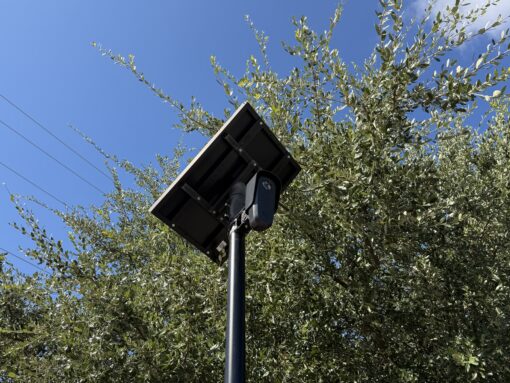
The Manvel City Council voted 6-0 to end the city’s contract with Flock Safety, directing staff to send the company a 30-day cancellation notice and to cover all 16 operating license plate reader cameras within 24 to 48 hours.
The Tuesday evening vote followed an hours-long public hearing that included residents, law enforcement officials, a former elected official from a neighboring city, and a Flock representative who appeared by Zoom. Mayor Dan Davis, who first raised concerns about the contract, said the technology itself was not the issue.
“They have no place in the city of Manvel. It’s time to deflock Manvel,” Davis said.
Flock’s automated license plate readers use AI to scan license plates and save information about a vehicle, such as make, model, color, and other identifiers like cosmetic damage or bumper stickers. The company allows law enforcement officers to access its database without requiring a warrant. This has raised concerns over potential violations of citizens’ Fourth Amendment rights.
During the hearing, Davis pressed the Flock representative on how the company uses data collected from Manvel’s cameras.
When asked whether Flock uses that data to train its artificial intelligence tools, Trevor Chandler, the company’s senior director of public affairs, said the practice is “part of making our cameras more accurate.” Davis replied, “That’s a yes.” Chandler also said the company does not sell customer data and does not use facial recognition technology.
Davis also said that 535 outside agencies still had standing access to Manvel’s camera network, even after the city had already cut 149 agencies from that access. Most of those agencies are in Texas, with the remainder in Louisiana, according to police.
In his Facebook post announcing the council’s decision, Davis pointed to two other cities as examples of what worried him about Flock.
He said officials in Sheboygan, Wisconsin, learned that their Flock cameras were collecting more than license plate data, including traffic volume, vehicle types, speed and movement patterns, and that the city said it had not known this information was being gathered until a Flock representative offered to sell access to the feature.
Davis also said Pflugerville had recently ended its own Flock contract after discovering that more than 400 outside agencies had accessed its camera network, though the city says it had authorized only 83 partner agencies, and that records later showed 459 outside agencies had conducted roughly 1.6 million searches of Pflugerville’s system over six months.
Manvel Councilmember David Lands, who voted for the original 2024 contract along with several of his colleagues, said the program had grown beyond what the council understood at the time. “Flock obviously has turned out to be a huge machine that we were unaware of,” Lands said.
Public comment ran heavily against keeping the cameras. Resident Stephanie Baird argued the system raises constitutional concerns beyond privacy alone. “These cameras in particular potentially violate not only our Fourth Amendment rights, but our Ninth Amendment rights,” Baird said, asking the council to sever the contract and remove the cameras.
Former Pearland City Councilmember Adrian Hernandez, who said he was the only vote against Flock cameras during his time on that council, urged Manvel’s council to weigh their oath of office over convenience.
Former Manvel Mayor Pro Tem Crystal De Leon Sarmiento, who supported the cameras when the council first approved them in 2024, said new information had changed her position, telling the council that past approval does not obligate continued use.
Not all testimony favored removal.
Brazoria County Sheriff’s Office Chief Deputy Ian Patin defended the technology’s record, saying it has helped locate missing people and recover stolen property. Manvel Police Chief Keith Traylor told the council that a recent monthly audit found department personnel had conducted 138 searches in the system with no sign of intentional misuse, though he could not tell the council how many of those searches led directly to a closed case.
The decision to end the contract also cuts off Manvel’s own access to camera data from other participating agencies, a tradeoff council members acknowledged during the meeting.
Manvel’s vote follows scrutiny of Flock’s data practices elsewhere in the region and state.
Harris County Judge Lina Hidalgo has called for a special commissioners court meeting on the county’s own Flock contract, which was renewed on a 4-0 vote in May with Hidalgo abstaining. She has said the renewal lacked oversight provisions that commissioners had intended to add later.
The City of Willis, north of Houston, shut off its Flock cameras on Monday while its city council reviews the program.
Davis posted a video of his full remarks and questions from Tuesday’s meeting to his Facebook page for residents who could not attend.