EDITOR’S NOTE: An earlier version of this story misidentified Greg Harrell. He is the current chairman of the Hood County GOP.
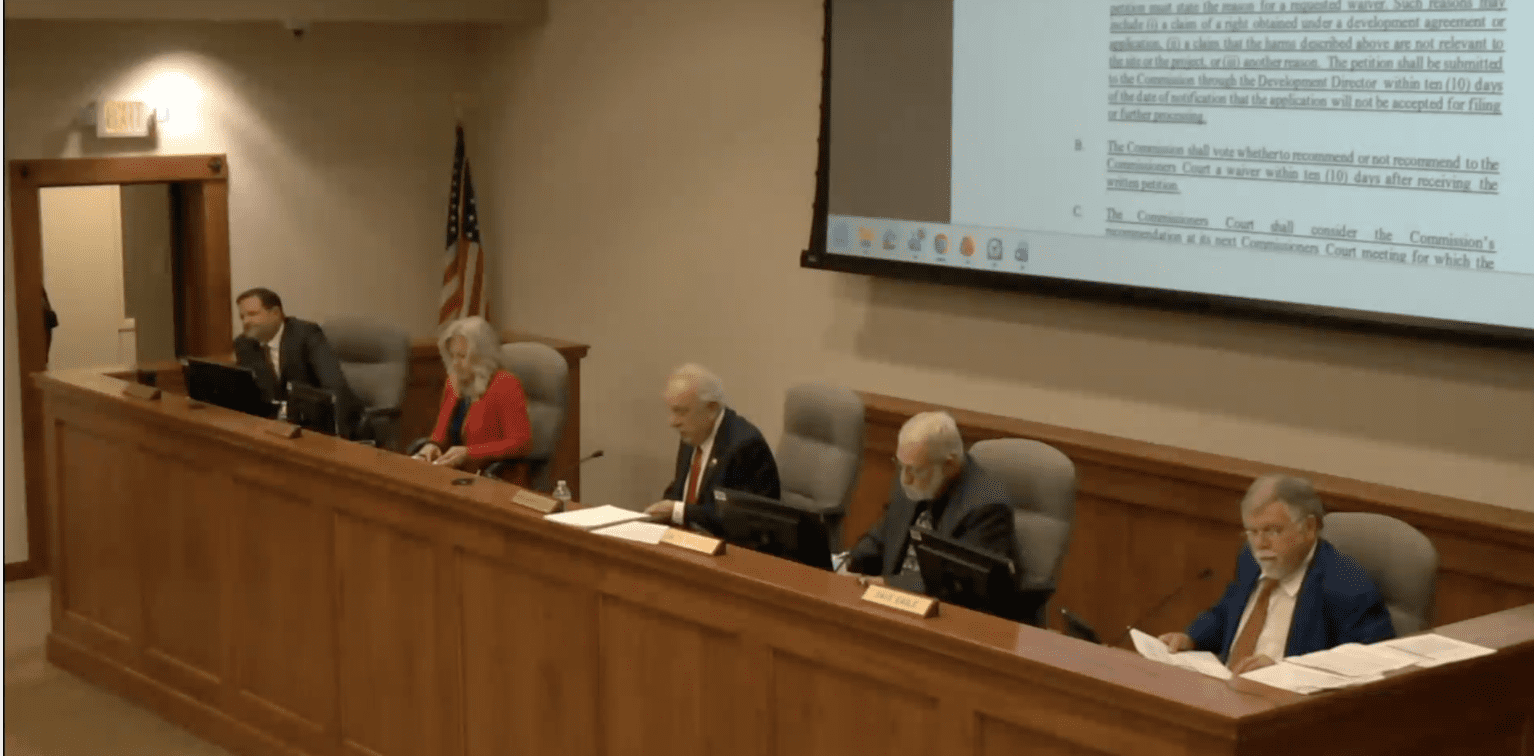
Hood County commissioners unanimously voted Tuesday to postpone action on two data center projects in order to receive and review information. They also prohibited County Judge Ron Massingill from signing on to a solar project without a concept plan.
Citizens who showed up at the March 24 meeting again expressed concerns about the effects of these projects on the local environment, including draining precious water resources, as well as the potential for bad actors to access critical infrastructure through components made in hostile nations.
Projects Red and Yellow
During the meeting, it was revealed that MARA Holdings is connected with the two data center developments, known as Projects Red and Yellow. That company runs a Bitcoin mining operation in Hood County that citizens complained generates noise pollution.
Bonnie Robie spoke to commissioners on behalf of her four friends, who she said live near the operation and “are almost deaf” after two years of exposure.
The MARA revelation came during a back-and-forth between Commissioner Nannette Samuelson and Attorney Thomas Mann, representing the projects.
Mann said Starwood, the developer of Red and Yellow, and MARA aren’t the same.
“But you have a joint venture,” Samuelson replied. She then read a February 2026 press release where MARA announced a “strategic agreement” with Starwood Capital Group and their “dedicated data center platform development Starwood Digital Ventures.”
“But they’re not the same company. What’s out there today, the bitcoin mine … it has nothing to do with Starwood,” Mann said. “The new data centers that would be built would be under the control of Starwood … MARA would not have a say in the development.”
“So, joint doesn’t mean joint? This says ‘joint venture.’” Samuelson pressed.
“I don’t know the entire terms of any agreements between the companies,” Mann replied. “But I’m telling you the way the construction of this project will work is Starwood will be building it.”
Another representative of the projects stepped forward at that moment and added “you can have one party that is the developer with control rights in the venture, and you can have a passive participant. We will not speak any further on our business arrangements with them.”
Samuelson responded, “we’re just asking for you guys to be forthright and honest and transparent.” She then made the motion to postpone approving the two projects, which Commissioner Dave Eagle seconded.
Solar Project
Commissioners reviewed a letter on Country Judge Massingill’s letterhead, awaiting his signature, addressed to Brooke Taylor, project developer for Rain Lily Solar.
The body of the letter stated:
When your company started inquiring about the project and the need for an approved permit, there was no county order, or regulation of Hood County that requires that your company obtain any approval or specific license or permit (such as an environmental permit, development permit, access permit, or construction permit) in order to develop and operate a solar energy project and related infrastructure, unless you developed anything in the Special Flood Hazard Area as designated by FEMA …
Commissioner Samuelson told Texas Scorecard that while the project is in her precinct, she didn’t see the content of the letter until last Thursday, and once she read it she tried to figure out who wrote it. During the March 24 meeting, Massingill said he didn’t, but that his staff typed it. “Rain Lily wanted me to sign a letter,” he said, noting that the developer had spoken with Hood County Development Director Clint Head. “[Rain Lily] wanted to be under the old rules.”
During public comments, citizens alleged or questioned if Rain Lily drafted it.
“This is not from Rain Lilly,” Commissioner Kevin Andrews said, noting they had come to his office beforehand. “A letter similar to this was issued to Yellow Viking, so I said, let’s get something together … that’s where the letter came from.”
Samuelson noted that Andrews did not mention that to her beforehand. She then asked Michael Klein of EE North America, the company behind Rain Lily Solar, if anyone from the project provided any information contained in the letter.
Klein asked not to be quoted, but he believed “this is previous verbiage” that county staff have used.
Members of the Rain Lily Solar project team spoke to commissioners in an attempt to win approval for the letter. They said that the solar project would be environmentally friendly, and would comply with the Lone Star Infrastructure Protection Act—the state law that bans providing control or direct or remote access of any of the state’s core systems to nations identified as hostile.
Samuelson repeatedly told each team member to put the information they provided into a concept plan for everyone to review.
“We have asked multiple times, Commissioner Samuelson, if we needed to get a concept plan to your group,” David Van Gorder of Rain Lily Solar said.
“The regulations say you do,” Samuelson replied.
Earlier, County Attorney Matt Mills told commissioners that Hood County hadn’t been regularly enforcing its regulations.
Greg Harrell, the chairman of the Hood County Republican Party, believes the county’s current process for handling industrial development is “severely flawed.”
“Based on my observation of how some of the recent large scale industrial development requests have been handled, it is my opinion the good people of Hood County have a reason to be concerned about the County’s processes for receiving, handling, reviewing, and approving development plans,” wrote Harrell, who recently won re-election to his post. “This may be a contributing factor in why so many data center developers seem to be targeting our small County.”