
Over 40 years ago, a tax designed to support the handicapped was repurposed for a school district—without voter approval.
Now, the Texas Supreme Court has taken up the case, and it could set legal precedent by clarifying when taxpayers have the right to sue over how government entities spend public funds. Many legal experts view this right as an important check on government accountability.
Taxpayers from Willacy County and the Lyford Consolidated Independent School District have sued to stop a decades-old property tax from being collected. Plaintiffs assert they are paying taxes to two separate school districts.
South Texas ISD boasts that it is the “only all-magnet school district in the state.” It spans 3,643 miles, making it the second-largest school district in Texas by land area.
It’s also flush with cash. As of 2022, it had over $40 million in unassigned funds, compared with Lyford CISD’s roughly $6 million.
But the property tax that funds South Texas ISD (STISD) wasn’t originally supposed to finance a school district.
According to court filings, voters in Willacy County ratified the tax to fund maintenance and operations for the Rio Grande Rehabilitation District for Handicapped Persons in a 1974 election. This district provided education, training, special services, and guidance to handicapped persons or handicapped scholastics particular to their conditions and needs.
However, the rehabilitation district repurposed itself in 1983 without voter approval. It renamed itself to South Texas ISD and went from serving exclusively disabled students to being a magnet school district.
Municipal Attorney Art Martinez de Vara explained to Texas Scorecard that “the wrongful act here is not the collection of the tax, but its expenditure on uses not authorized by voters.”
A few days after STISD levied its property tax rate for August of 2023, taxpayers sued for injunctive relief in the 197th District Court in Willacy County.
The district court granted the plaintiffs’ temporary restraining order, but the 13th Court of Appeals reversed that decision, writing that the taxpayers lacked standing.
As for Lyford’s involvement in the suit, Justice Gina M. Benavides wrote that the school district also lacks standing due to resting its claim to relief on the legal rights or interests of third parties.
Not giving up, taxpayers and Lyford CISD have appealed to the Texas Supreme Court.
Taxpayer Standing
According to the University of Texas Law Review, those who pay property taxes in the State of Texas may sue to enjoin the illegal expenditure of funds based on prior legal decisions in the Texas court system.
“Taxpayer standing is one of the most difficult to establish. The general rule is to have standing one must have individualized harm. In this case all taxpayers are harmed equally, so they must rely on taxpayer standing for the case,” Martinez de Vara explained. “The alternative is for the Attorney General to sue, quo warranto, on behalf of the taxpayers of the district.”
Martinez de Vara pointed out the limitations of the latter option.
“The [attorney general] has limited resources and cannot take up all of the taxpayer standing cases filed each year,” he wrote. “Governmental entities know this and use it as a procedural advantage to avoid accountability.”
There is some light at the end of the tunnel.
Martinez de Vara wrote that “the Supreme Court could issue an opinion that creates new common law, such as expanding taxpayer standing, or clarifying how this fact pattern meets the established standard, or providing clarity for future cases.”
Attorney General Ken Paxton has yet to join on taxpayers’ behalf to stop STISD from levying the property tax. His office did not respond to a request for comment.
In its written decision, the court of appeals agreed with the plaintiffs that the change of the rehabilitation district to a school district needed voter approval, as Willacy County residents only approved the taxes to be used for a rehabilitation district.
Still, the justices denied enjoinment of the tax.
“Because this action was brought forty years after the fact, we conclude that ‘[t]he potential for disruption of government operations is too great’ to extend taxpayer standing in this case,” elected Justice Benavides wrote. “[Ending the tax] would significantly impair the district’s ability to meet its ongoing and rising financial obligations.”
However, Superintendent Mario Salinas of Edinburg CISD, which overlaps with STISD, said in a 2023 interview with The Rider that removing STISD’s taxing authority would not “kill the school.”
Even so, Justice Benavides wrote that “having paid the tax and accepted the benefits of South Texas ISD for forty years without complaint … the voters of Willacy County have effectively ratified South Texas ISD’s change in purpose.”
Martinez de Vara disagreed. “[The] spending of tax revenue on unauthorized purposes constitutes an ultra vires act, and is voidable under Texas law and potentially raises personal liability for the governmental officials,” he stated.
Cash-Rich District
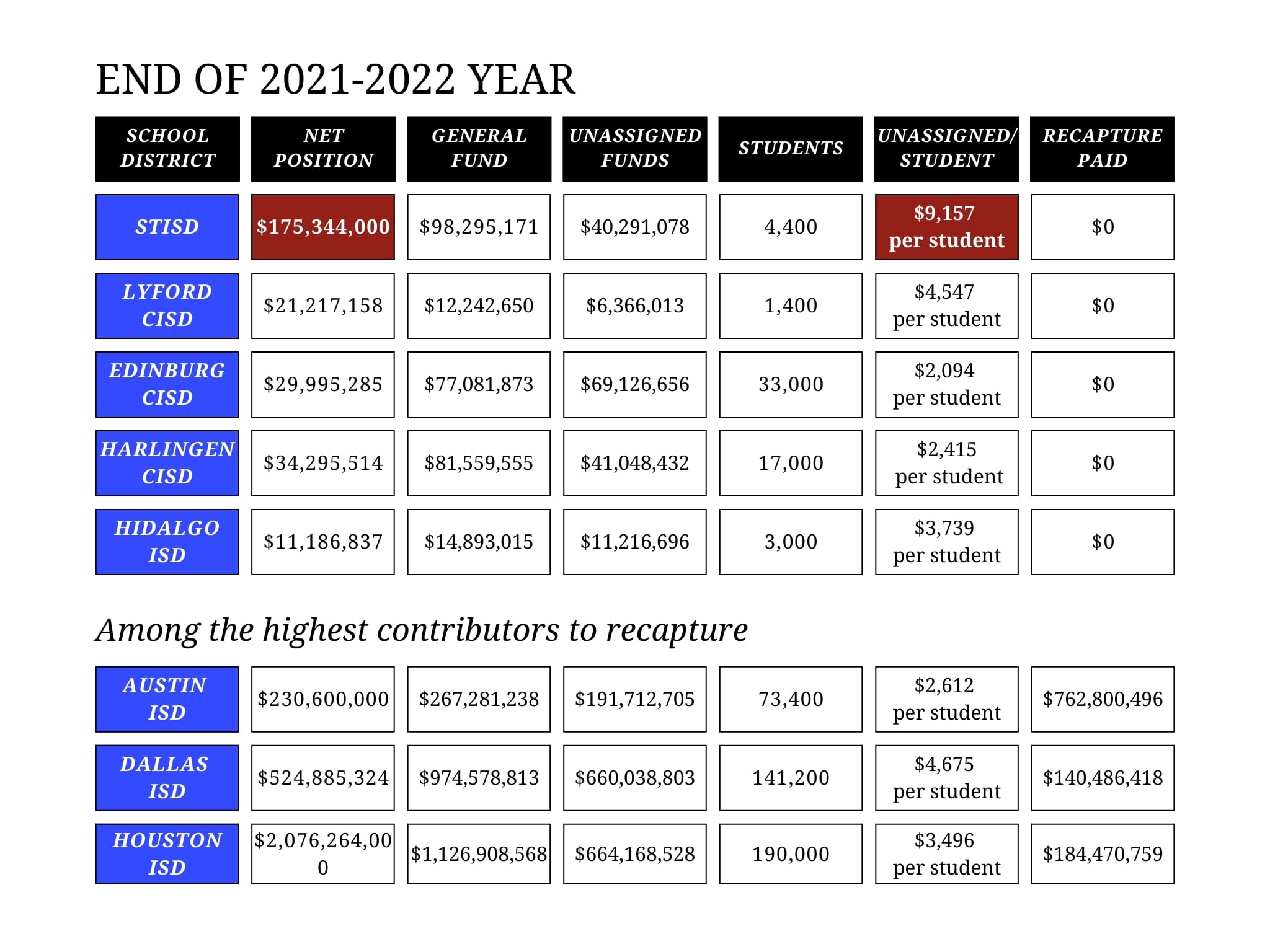
Unassigned funds in a school district’s budget are left over from the general fund balance. They are the net resources for the district’s discretionary spending.
Districts with larger student populations may require more resources. To put the funds into perspective, unassigned funds are divided by the districts’ estimated student populations for the fiscal year.
In STISD’s Annual Financial Report for 2022, records show the general net position of the district is over $175 million, with $40 million unassigned and available for any purpose.
The same year, Lyford CISD indicated in its Annual Financial Report that the district’s net position was a little over $22 million, with just over $6 million unassigned.
Of a few of the school districts that overlap with STISD, Lyford ISD had the most unassigned funds per student.
The controversy regarding STISD does not end there.
The district does not participate in the state’s recapture program, yet it is flush with cash compared to some of the program’s top contributors.
James Quintero, policy director of the Taxpayer Protection Project for the Texas Public Policy Foundation, explained contracted instructional services between public schools, also known as recapture.
“Recapture is complex and confiscatory. Moreover, it is the epitome of a failed redistributionist scheme that makes things worse, not better,” he wrote to Texas Scorecard. “The amount that a [school] district must pay in recapture is determined by how much its wealth per student exceeds the equalized wealth level. Districts with higher property values and relatively few students are more likely to be subject to recapture.”
State-collected funds from this program are distributed among other school districts.
Martinez de Vara wrote that due to “its unique origin and statutory authority, it may be exempted from recapture because the legislati[on] establishing recapture did not include STISD.”
Quintero pointed out that recapture is one of the reasons why the Texas Public Policy Foundation is pushing for the elimination of school maintenance and operations (M&O) property taxes. “No M&O tax means no more recapture,” he wrote.
Next Steps
This issue has drawn the Texas Legislature’s attention.
State Rep. Sergio Muñoz Jr. (D–Mission) introduced two proposed measures in 2023 regarding the STISD tax, House bills 5294 and 5296. One called for an election in which taxpayers could decide if they wanted to abolish the extra tax. The other would cause a gradual yearly reduction and eventual elimination of the tax.
Both died in committee.
Muñoz Jr. did not respond to a request for comment.
Whether the case moves forward is up to the Texas Supreme Court, Martinez de Vara explained.
“If the taxpayers prevail, it will allow their case to proceed and have their grievances heard before the trial court,” he wrote. “The real substantive decision will be made at that future trial.”
The Supreme Court of Texas is set to hear the case on November 5.
South Texas ISD, Lyford CISD, the Office of Attorney General, and the plaintiffs did not respond to a request for comment.
If you or anyone you know has information regarding court actions or cases relevant to Texans, please contact our tip line: scorecardtips@protonmail.com