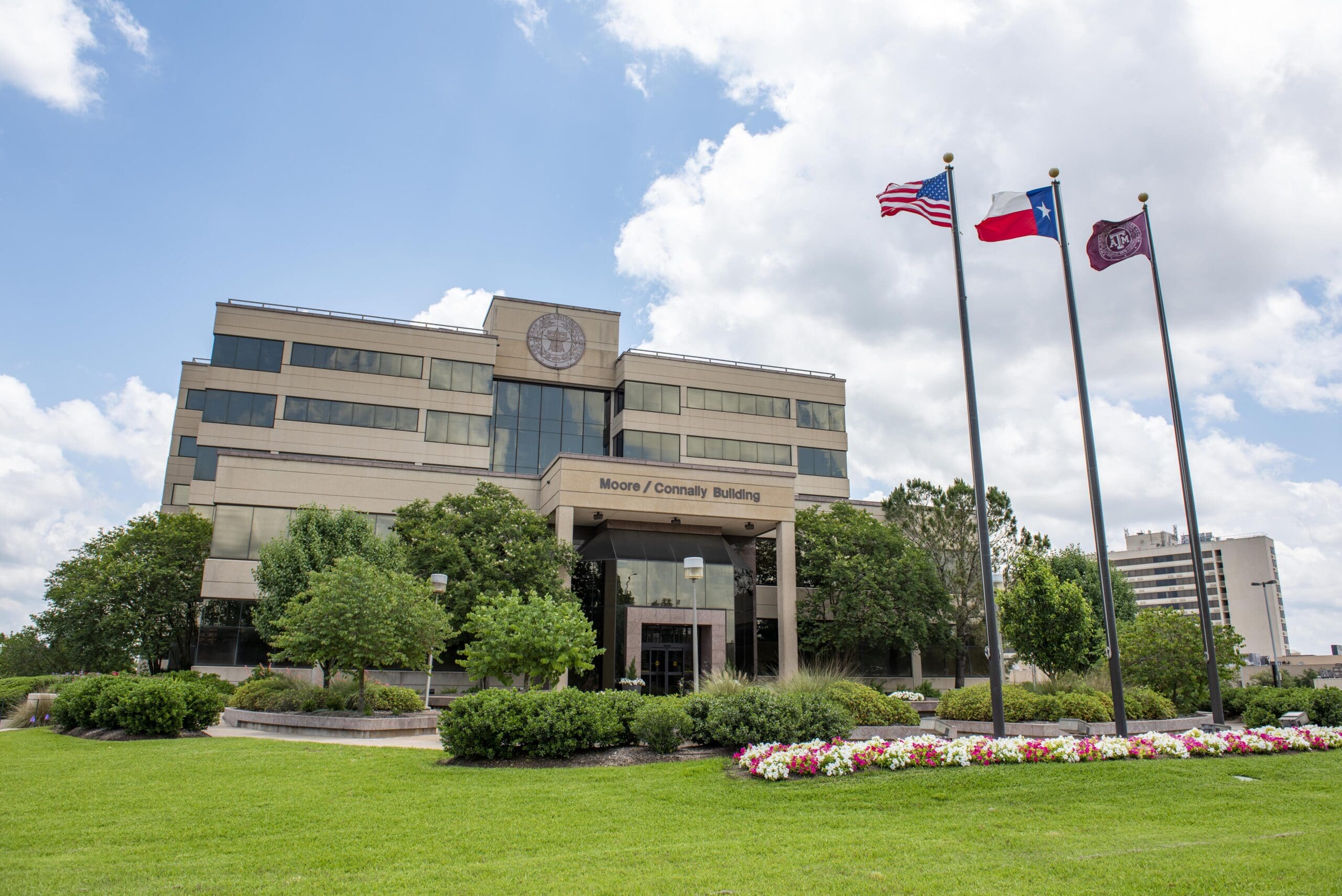
Regents of the Texas A&M University System approved hundreds of tenure applications, without public discussion, as part of their recent quarterly meeting in Kingsville.
The tenure applications covered faculty members from 11 of the 12 A&M System campuses. Supporting documents for these applications covered more than 20 percent of the 505-page agenda book for the meeting.
James Hallmark, the system vice chancellor for Academic Affairs, testified to the regent’s Academic Affairs Committee that these applications were subject to “a rather rigorous review process that is multi-layered” at the campus level and that “we further review them” at the system level.
However, Texas Scorecard performed a basic search on applicants from Texas A&M’s main campus in College Station and uncovered a dozen tenure applicants with backgrounds in critical race theory/DEI, feminism/LGBT activism, and environmental activism.
Several others obtained bachelor’s degrees from institutions in communist China.
Chaddrick D. James-Gallaway is currently an assistant professor in education administration and human resource development in TAMU’s Race and Ethnic Studies Institute. His biography lists specialization in “Black Feminist Theory,” “Critical Race Theory,” “Blackness/Anti-Blackness,” “Black Geography,” and “Critical Race Discourse Analysis.”

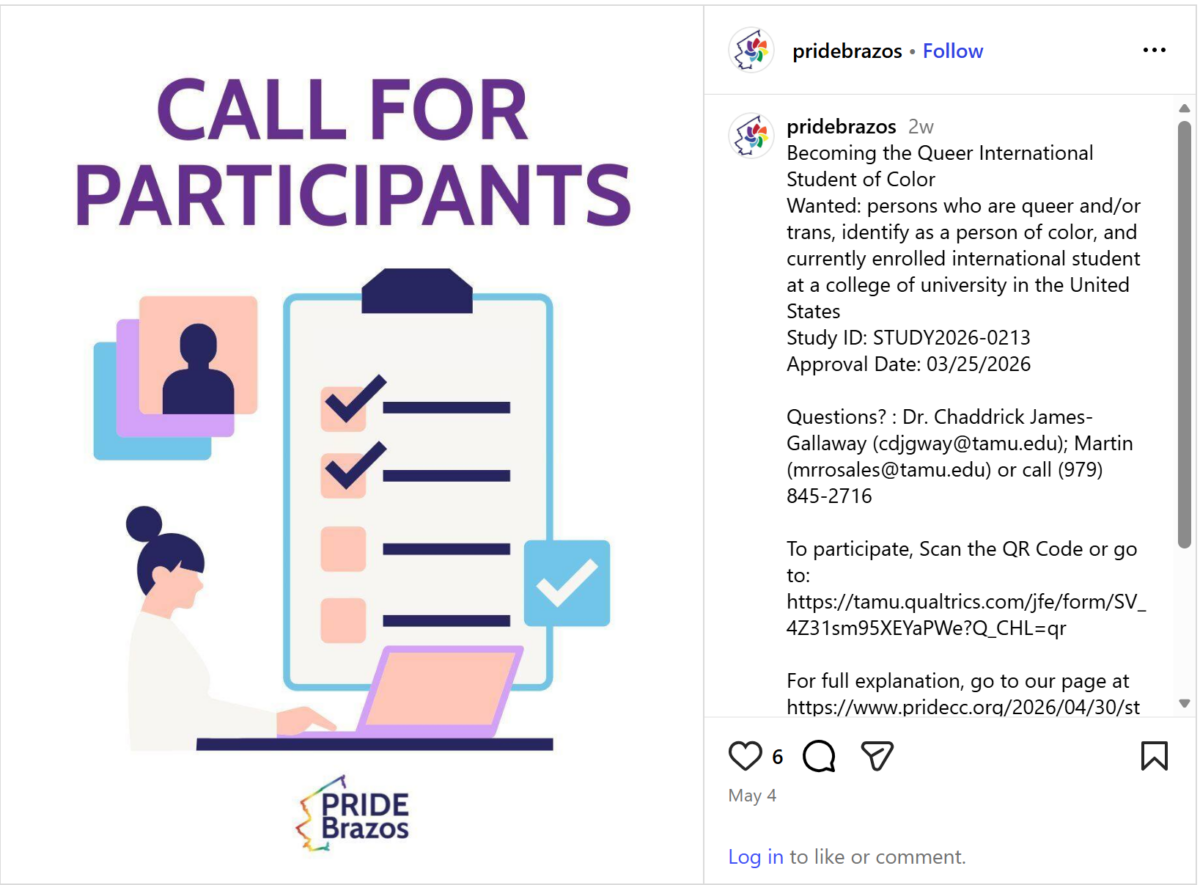
James-Gallaway was also listed as the contact to recruit a “Queer International Student of Color” for an academic study by the activist group “Brazos Pride.”
ArCasia D. James-Gallaway, currently an assistant professor of Teaching, Learning, and Culture and Chaddrick’s wife, also received tenure in this cohort.
Together, Chaddrick and ArCasia James-Gallaway have written “Racing Culture: Critical race theory, culture wars, anti/Blackness, and in/formal education in the 1990s.”
Stacy Vincent, who currently runs the Texas A&M Department of Agricultural Leadership, Education and Communications, has written extensively about critical race theory and LGBT issues as it relates to agriculture.
Earlier this year, Vincent co-authored an academic paper, “Power, Privilege, and Perceptions: A Critical Case Study of FFA and GSA Members’ High School Experiences in a Southern Rural High School,” in the Journal of Queer and Trans Studies in Education. Vincent’s essay was part of a section dedicated to “Queering Rural Education.”
“School cultures reflect the systemic privileging of heterosexual and cisgender identities, which places queer students at an increased risk of victimization and harassment,” the paper’s description states. “Rural schools have been found to uphold heteronormative and cisnormative cultures more than suburban and urban schools, which increases safety concerns for rural queer students.”
In 2021, Vincent co-authored “The Value of Education between Two African American Male Populations in a Rural Southern Community.”
Through “the lens of Critical Race Theory and Symbolic Interactionism,” the researchers explored how 16 young men value a secondary and postsecondary education.
Sara Decaglio is currently an assistant professor of English. Her official Aggie biography states that “[h]er interdisciplinary research is situated in the fields of rhetoric of health and medicine, feminist science studies, disability studies, feminist theory, and health humanities.”
“She has developed 11 undergraduate and three graduate courses in areas such as health humanities, gender studies, and rhetoric,” according to the meeting agenda book (p. 380).
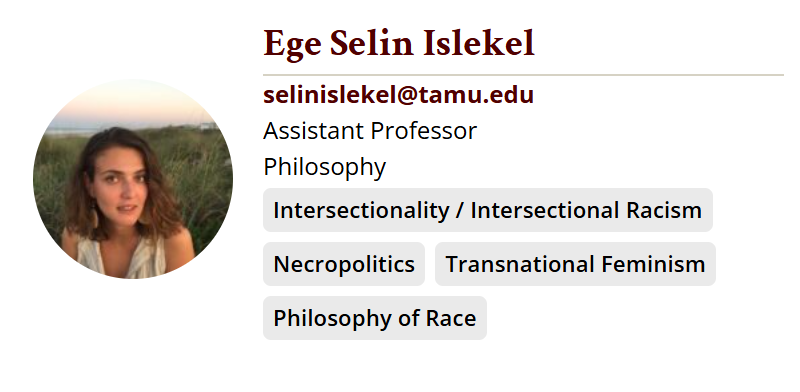
Ege Selin Islekel, currently an assistant professor of philosophy, lists “Feminist Philosophy” and “Philosophy of Race” as areas of specialization in her official Aggie bio.
“Her work is on 20th Century Continental Philosophy, Post-Foucauldian Biopolitics, and Decolonial Feminisms, focusing on critical approaches to the politics of death especially,” her Aggie bio reads.
Islekel is also listed as a “faculty affiliate” in the previously discussed Race and Ethnic Studies Institute where she lists “Intersectionality/Intersectional Racism,” “Necropolitics,” “Transnational Feminism,” and “Philosophy of Race” as specialties.
Christopher Owens, currently a TAMU assistant professor of Health Behavior, is “a health behavior scientist with specific training and expertise in rural HIV prevention and care, rural LGBTQ adolescent and adult health, and LGBTQ adolescent HIV prevention,” according to his official Aggie biography.
Owens got his Phd. from the Center for Sexual Health Promotion at Indiana University. The Center for Sexual Health Promotion works closely with the Kinsey Institute, which was founded by deviant sex researcher Alfred Kinsey in 1947.
“I am a health behavioral scientist,” Owens told an alumni publication in 2023, “who studies … LGBTQ adolescent and young adult sexual health.”
Angela Wilson, currently a Vice President for Research in the Chemistry department, has an extensive history of promoting DEI as Texas Scorecard has previously reported.
Christopher Bonner, currently an assistant professor in the Department of Global Languages and Cultures, has used critical race theory to examine “the cultural politics of Negritude” during the cold war. Negritude was a literary movement among French-speaking African and Caribbean writers living in Paris that explored early iterations of what is today known as critical race theory.
Jenna Lamphere, currently an assistant professor of Maritime Studies, has written about “multilevel Sustainability Transitions” and “Situating the Green Economy” as part of her academic research. In 2018, she was declared an “Aggie Ally,” and received a “Certification in Civic Literacy, Inclusion, Diversity, and Equity.”
Garrett Sansom, currently an assistant professor of Environmental and Occupational Health, lists “sustainable development” as a “teaching interest” in his official Aggie biography.
Sansom’s academic writing includes discussions about “environmental justice,” “race,” and “equity.”
Regents approved tenure for a series of researchers, Zhiping Lu, Xianming “Simon” Dai, Shoufeng Lan, HeonYong Kang, and Yan Jing who obtained undergraduate degrees in Chinese universities.
While none are accused of specific acts of wrongdoing, Chinese researchers have received extensive scrutiny due to potential security risks. This has been especially the case at Texas A&M.
Senate Bill 18, a law passed in 2023, requires boards of regents to approve all new tenure designations. That law also placed several new restrictions on tenure, while leaving the basic structure in place.
Texas A&M released the following statement in response to Texas Scorecard’s questions regarding the vetting process for tenure:
| The System and the Board of Regents have drawn a clear line. In December, the Regents took a leadership role across higher education in Texas by establishing policies which prohibited system faculty from engaging in advocacy in the classroom, banned the teaching of race and gender ideology in core curriculum courses and restricted the teaching of race and gender ideology to those non-core courses where the material is critical to the knowledge necessary for a career in relevant fields of study such as medicine or psychology. Further Board action ensured transparency in course offerings by requiring course descriptions and syllabi to accurately reflect course instruction.
Faculty may engage in lawful research, including on controversial topics, but classroom instruction is held to different standards. Because students are present, classroom instruction must comply with System and institutional rules designed to ensure students understand course topics clearly before choosing to enroll in a course and are taught course material in an appropriate setting. Tenure review and final decisions are conducted in accordance with the law and are based on the full record as well as whether faculty are meeting their obligations as researchers, scholars, educators, and employees. No violations of law or policy were found during the review process for the faculty granted tenure during the May board meeting. If policies are violated by any member of the faculty regardless of tenure status, there are processes in place to address those violations. |
The Texas A&M University System includes twelve academic institutions. It is overseen by a Board of Regents that is appointed by the governor and confirmed by the Texas Senate. Robert Albritton of Fort Worth is the current board chairman.