This article has been updated since publication.
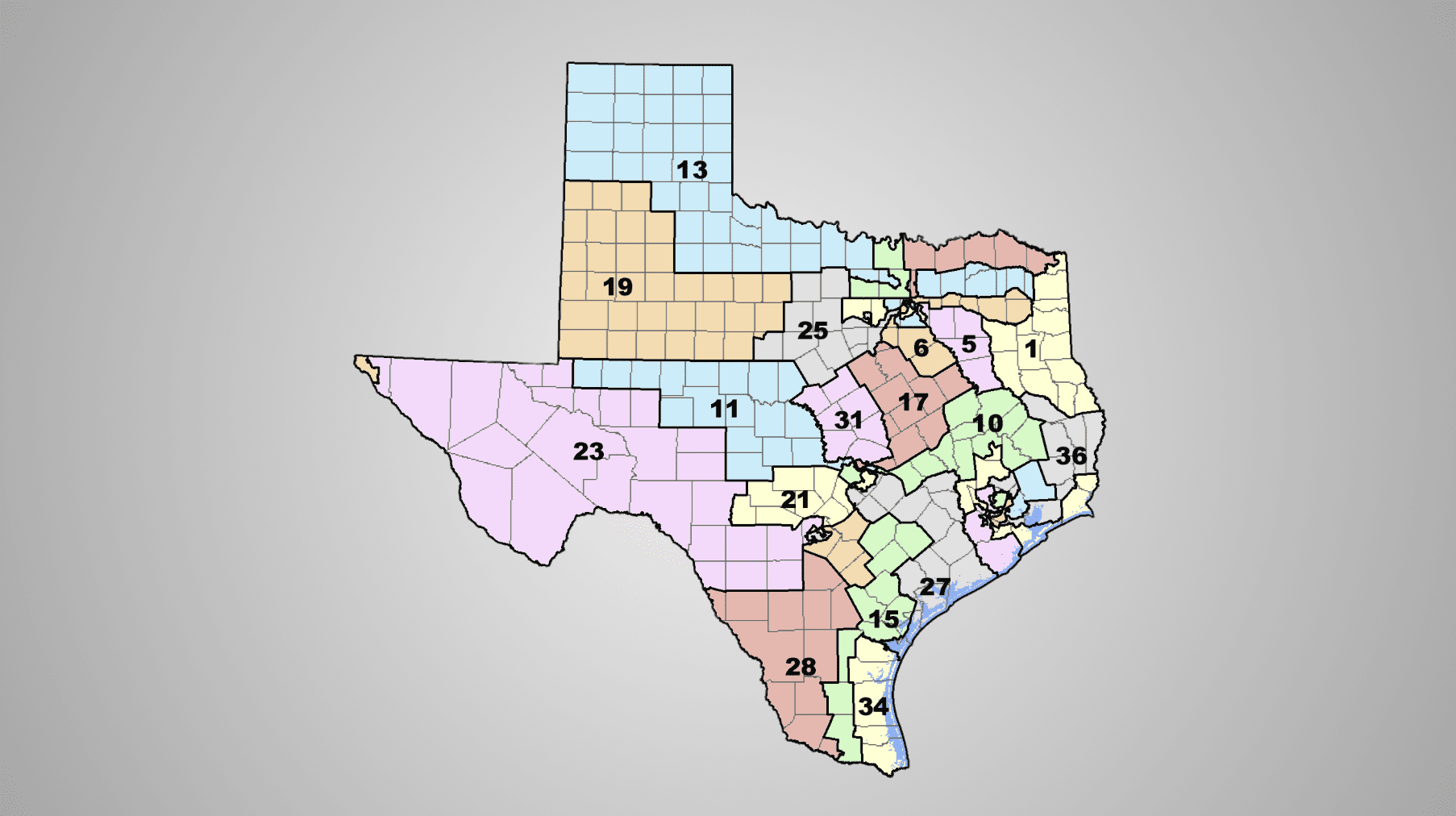
A federal court in El Paso has halted Texas’ newly enacted congressional map—one designed to create five additional Republican-leaning seats—ordering the state to scrap the 2025 boundaries and revert to the 2021 map for the 2026 elections.
The injunction throws the upcoming election season into immediate turmoil.
In a 160-page ruling, the three-judge panel concluded in a 2-1 decision that the Legislature “racially gerrymandered” the map after Gov. Greg Abbott added redistricting to the summer special session. The court said the state acted primarily on the racial demands of the U.S. Department of Justice rather than traditional or political considerations.
The decision was written by Judge Jeffrey Brown, a Trump appointee who has ruled against Republican redistricting efforts in the past. He is joined by Judge David Guaderrama, an Obama appointee.
Judge Jerry Smith, a Reagan appointee who was widely expected to side with the State, will be releasing a dissenting opinion.
At the center of the court’s decision is a July 2025 letter from the Department of Justice demanding that Texas dismantle several congressional districts based solely on their racial composition. Within 48 hours, Abbott expanded the special session agenda to include redistricting and told lawmakers to address DOJ’s “constitutional concerns.”
The panel concluded that Abbott’s proclamation, along with subsequent public statements, made clear the map was redrawn with race as the “predominant factor”—a violation of the Fourteenth and Fifteenth Amendments.
The judges also rebuked the DOJ’s letter as “legally unsound.” The State itself, along with state legislators and the mapmaker Adam Kincaid, acknowledged this fact.
The ruling orders that Texas’ 2026 congressional elections must proceed under the state’s 2021 maps, which were used in the 2022 and 2024 cycles. These were the Plaintiffs’ wishes, despite having previously alleged the 2021 maps were racially gerrymandered.
What Happens Next
The candidate filing period for the 2026 primary election opened on Nov. 8, under the now-invalid 2025 map, leaving candidates and election officials scrambling. Several candidates have already filed for seats that may no longer exist.
Texas’ primary election is scheduled for March 3, 2026, but that date is now uncertain. During a similar redistricting fight in 2012, the state’s primaries were delayed into late May.
Legal precedent resulting from the 2006 Purcell decision holds that “courts should not change election rules during the period of time just prior to an election because doing so could confuse voters and create problems for officials administering the election.”
Additionally, a preliminary injunction is considered an extraordinary measure. Judge Brown wrote that he found “substantial” evidence of racial gerrymandering.
An appeal of redistricting litigation goes directly from a federal three-judge panel to the United States Supreme Court. Attorney General Ken Paxton and Gov. Greg Abbott already announced that the state will be swiftly appealing the decision.
“The Legislature redrew our congressional maps to better reflect Texans’ conservative voting preferences – and for no other reason. Any claim that these maps are discriminatory is absurd and unsupported by the testimony offered during ten days of hearings,” said Abbott. “This ruling is clearly erroneous and undermines the authority the U.S. Constitution assigns to the Texas Legislature by imposing a different map by judicial edict. The State of Texas will swiftly appeal to the United States Supreme Court.”
A statement from Paxton’s office added that “Attorney General Ken Paxton will file an appeal with the Supreme Court of the United States and ask for a stay of an order of a three-judge district court that has temporarily blocked Texas’s new map for congressional districts from implementation.”
The Supreme Court could issue an emergency stay in a matter of days or weeks.
“For years, Democrats have engaged in partisan redistricting intended to eliminate Republican representation. Democratic states across the country, from California to Illinois to New York, have systematically reduced representation of Republican voters in their congressional delegations,” said Paxton. “But when Republicans respond in kind, Democrats rely on false accusations of racism to secure a partisan advantage. I will be appealing this decision to the Supreme Court of the United States, and I fully expect the Court to uphold Texas’s sovereign right to engage in partisan redistricting.”