A federal district judge has temporarily barred the University of Texas from enforcing a new state law designed to prevent disruptive activities on university campuses.
Judge David Ezra wrote in his fifty-two-page opinion that several provisions of the law unconstitutionally restricted speech because they are content-based restrictions that fail strict scrutiny. He contends they are unconstitutionally overbroad and are not the least restrictive means of achieving the state’s interest.
At issue are several components of Senate Bill 2972, a measure passed during the regular legislative session in 2025, which sought to create a balance between political speech and public order.
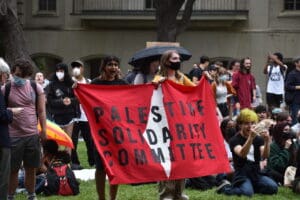
The law was a response to disruptive anti-Israel protests at the University of Texas at Austin, and elsewhere, in 2024.
SB 2972 rolls back a 2019 law designating all outdoor state university spaces as open forums for public speech. It restricts overnight protests and prohibits amplified sound during class hours or if it intimidates or interferes with campus operations, employees, or peace officers.
It also bars encampments, replacing the U.S. flag with another, and wearing disguises to avoid identification or intimidate others. SB 2972 further requires university employees and students to show ID when asked by a university official.
The lawsuit was brought by the Fellowship of Christian University Students at UT-Dallas and several other student organizations. The organizations claim restrictions in the new law would prohibit aspects of their activities.
Plaintiffs argued that the specific bans are unconstitutional, content-based restrictions that violate the First Amendment because they apply to noncommercial expressive activities but exempt commercial speech. They are also accused of being overbroad and are not the least restrictive means available to achieve the state’s interests.
Defendants countered that the law’s restrictions are content-neutral time, place, and manner regulations that serve the state’s compelling interest in maintaining an environment conducive to learning at institutions of higher education. They also contended that the statute’s preamble directs universities to enforce the law in a manner that protects First Amendment rights, making plaintiffs’ alleged injuries speculative until universities demonstrate how they will actually apply the restrictions.
Judge Ezra prohibited the University of Texas from enforcing provisions related to invited speakers, amplified sound, drum usage, and overnight camping that may constitute “expressive activities,” as defined by state law.
In his opinion, Ezra found that the law “vests discretionary authority in administrators and law enforcement to determine what is ‘disruptive’.” He argued that this could lead to different outcomes based on the content of speech.
Citing the precedent case Speech First, Inc. v. Fenves, Ezra noted that courts have previously found that regulations governing “rude, uncivil, harassing, or offensive speech” can in fact cover speech otherwise protected by the First Amendment. He wrote that by failing to place similar restrictions on commercial speech, university officials “betray the stated goal of preventing disruption.”
The University of Texas System is expected to appeal Ezra’s ruling.
The UT System told Texas Scorecard, “While we cannot comment on matters involving litigation at this time, the UT System complies with the law and court orders.” In a statement, UT-Austin wrote, “We are reviewing the order and will comply with the injunction.”
UT-Austin and UT-Dallas are components of the University of Texas System. The UT System is overseen by a Board of Regents that is appointed by the governor and confirmed by the Texas Senate. Kevin Eltife is the current board chairman.
If you are a student, parent, professor, staff member, or concerned taxpayer who would like to partner with us to promote transparency in taxpayer-subsidized higher education, please e-mail scorecardtips@protonmail.com.