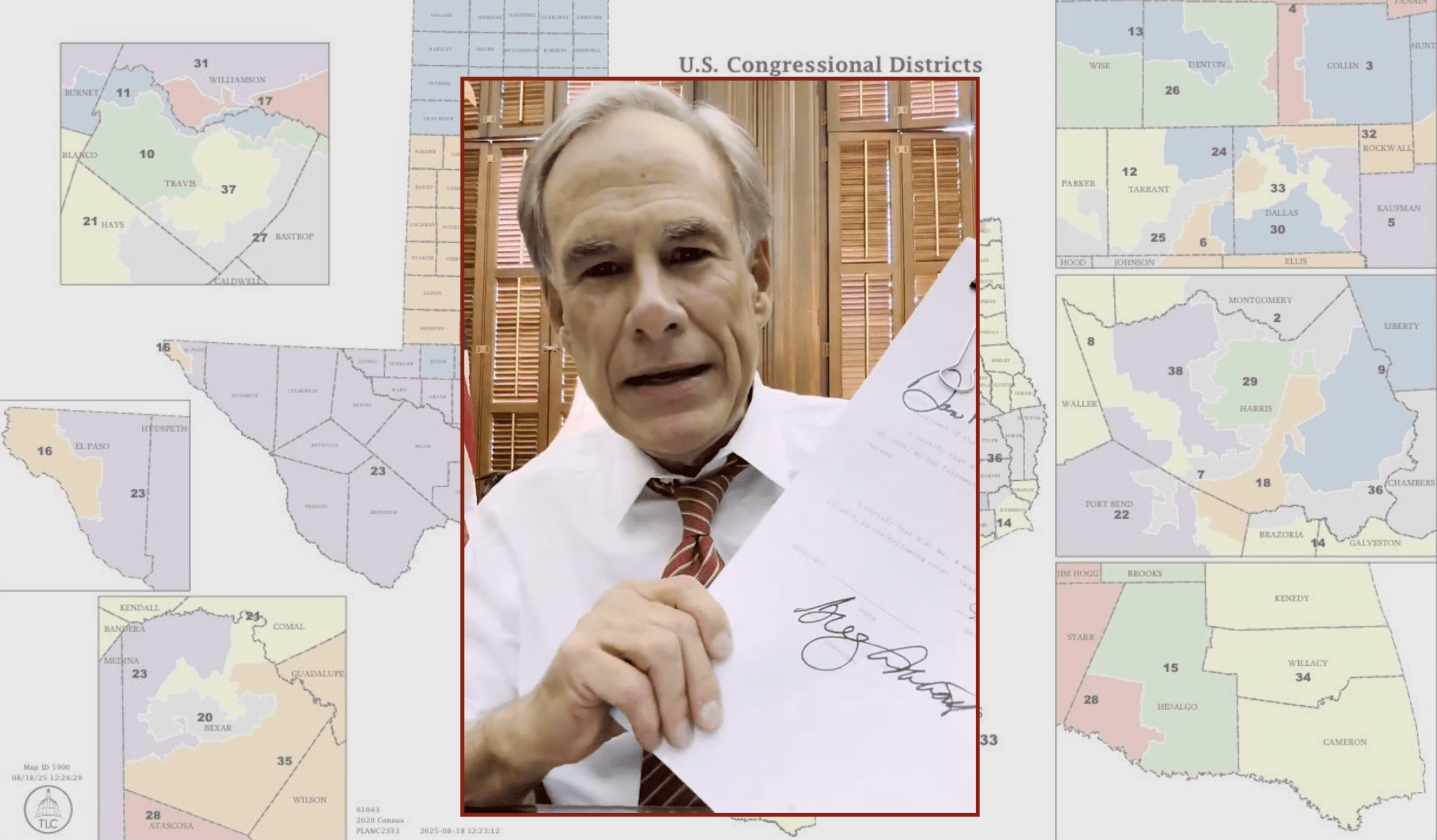
Texas Gov. Greg Abbott has signed into law a Republican plan to make the state’s congressional district map “more red” ahead of the 2026 midterm elections.
“Today, I signed the One Big Beautiful Map into law,” Abbott announced in a Friday afternoon video post on X.
The Republican redistricting plan adds five new GOP-opportunity congressional districts.
Republicans currently hold 25 of the state’s 38 U.S. House seats.
Recent legal decisions cleared the way for Texas Republicans to redraw district boundaries based on partisan political performance and increase the party’s advantage in future elections to reflect voting shifts seen in 2024, when President Donald Trump won support from unprecedented numbers of minority voters.
Abbott said the new map “ensures fairer representation.”
The governor also thanked “all of the legislature who stayed in the Capitol and got this law to my desk.”
Texas lawmakers passed the Republican redistricting plan last week on party-line votes, after House Democrats delayed the inevitable by breaking quorum for two weeks.
“Texas is now more red in the United States Congress,” said Abbott after signing the measure, known as House Bill 4.
Several Democrat-aligned groups filed legal challenges to the new congressional map before it was signed into law.
Organizations suing include the League of United Latin American Citizens (LULAC), the National Association for the Advancement of Colored People (NAACP), the Mexican American Legal Defense and Educational Fund (MALDEF), and the Mexican American Legislative Caucus (MALC). A group of Texas residents is also suing.
Plaintiffs claim the new map is racially gerrymandered to eliminate majority-minority districts required by the Voting Rights Act, unconstitutionally diluting the voting strength of minority voters, and is “intentionally discriminatory.”
The author and sponsor of HB 4, State Rep. Todd Hunter (R–Corpus Christi) and State Sen. Phil King (R–Weatherford), assured lawmakers that the map is “legal under all applicable law” and meets the requirements of “one person, one vote” and compactness.
Both Hunter and King repeatedly emphasized that the new district lines were drawn based on partisan political performance, which the U.S. Supreme Court has ruled permissible, not racial data.
State Sen. Adam Hinojosa (R–Corpus Christi) said the map represents a political shift in the state, including South Texas, which he represents.
“This is not a racial shift. This is a values shift, and no amount of shouting ‘racism’ is going to change that,” argued Hinojosa on the Senate floor.
We have all seen the political shift in South Texas over the past several years. It came to a head this last election. I won my seat.
President Trump won counties all along the southern border that had not voted Republican in generations, if ever. President Trump won with 55 percent of the Latino vote, and doubled his support among black voters from where it was in 2020.
“So let’s stop pretending that this is all about race. It is about values. It’s about representation. Real representation,” added Hinojosa.
“The fact that we’re redrawing the maps is to ensure that as these shifts have happened and continue to happen, that the people are able to have representation that reflects their values, not their last name, not their skin color.”