Concerns over Chinese Communist Party influence and espionage took center stage Tuesday as Texas House lawmakers considered whether state universities have sufficient safeguards for sensitive research, data, and technology.
The Higher Education Committee explored actions by the CCP, which is actively attempting to collect intelligence from Texas universities.
Michael Lucci, founder of the non-profit State Armor and a member of the Texas Advisory Commission on Geopolitical Conflict, emphasized the historical context of this infiltration, describing it as “in the DNA” of the CCP. Lucci stated that UT-Austin was an early focus of this activity.
He highlighted a pattern beginning with “elite capture” of academic institutions followed by “grassroots activism,” suggesting that current infiltration efforts are a sophisticated continuation of these strategies.
Lucci further discussed recent revelations regarding drone research at UT-Austin and materials science work at Rice University involving CCP-aligned companies.
The U.S. Department of War announced earlier this week that it would audit UT-Austin as part of a nationwide review of research security.
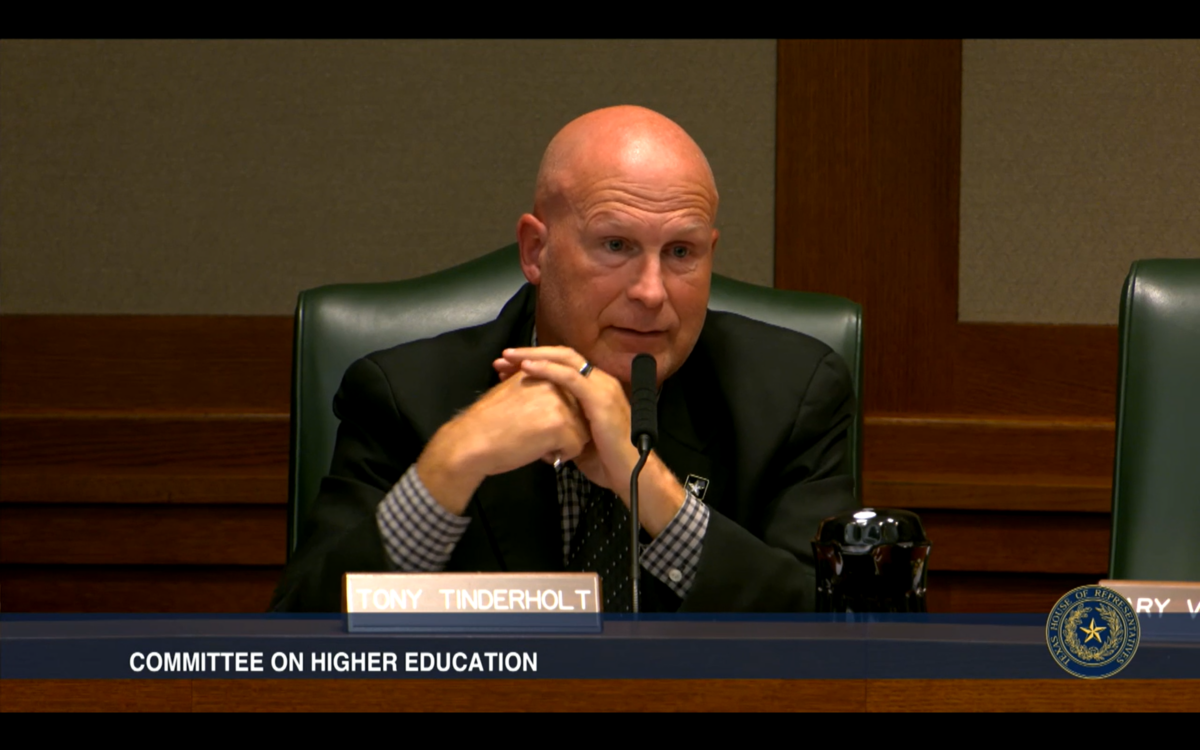
In response to a question from State Rep. Tony Tinderholt (R–Arlington), Lucci told the committee that while Texas is in a better security position than any other state, it only ranks “35 out of 100” in terms of its total security.
Tinderholt emphasized that every major campus in Texas has “some degree” of espionage occurring daily, which led him to call for “more rigorous” inspections from either the state or federal government.
To combat these threats, the panel proposed several policy interventions. One suggestion is the creation of an independent entity, modeled after the Higher Education Coordinating Board’s DEI ombudsman, to provide oversight outside university structures.
There was also a strong push to establish a dedicated research institution focused on studying the CCP’s unconventional warfare tactics, as speakers noted that such specialized study is currently lacking elsewhere in the U.S.
State Rep. Cole Hefner (R–Mount Pleasant) predicted a “good, solid, slate of bills” to address this issue next session but did not elaborate further. Hefner chairs the House Homeland Security Committee but is not a member of the Higher Education Committee.
A separate panel discussion featured input from Kevin Gamache of Texas A&M, Trey Atchley of MD Anderson, and Tam Dao of Rice.
That panel discussed the complexities of managing research expenditures and data protection. Legislative efforts such as House Bill 127 and House Bill 130 were noted as critical tools for enhancing oversight.
Earlier Tuesday, the committee explored ongoing collaboration between the U.S. military and major state universities, including Texas A&M and the University of Texas. These partnerships span highly sensitive research areas such as directed energy, EMP technology, robotics, and Space Force initiatives.
On Monday, the committee conducted oversight of a series of technical functions.
Legislative oversight is expected to continue throughout the interim. The 90th Texas Legislature begins on January 12, 2027.