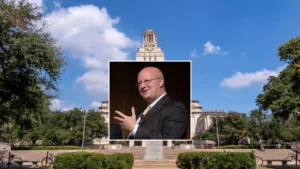
AUSTIN – Regents of the University of Texas System certified the completion of a systemwide review of core curriculum requirements as mandated by state law during Thursday’s quarterly meeting.
Discussion of the review primarily occurred during Wednesday’s meeting of the Academic Affairs Committee.
During his presentation, Vice Chancellor for Academic Affairs Archie Holmes told the committee that state law places explicit responsibility for the core curriculum with the board. Under this framework, following this initial review, each institution is expected to update its core curriculum annually for board approval or revision.
Standardizing these requirements ensures students can complete core courses anywhere in the state and “seamlessly” transfer the credits between institutions.
Holmes cited the current relationship between UT-El Paso and El Paso Community College as a model for every system institution.
Board Chairman Kevin Eltife stressed that affected courses are not being eliminated entirely; rather, they simply no longer satisfy specific core curriculum requirements.
Regent Stuart Stedman asked Holmes about core curriculum revisions recommended by the Higher Education Coordinating Board earlier this week.
Holmes replied that many of the changes under discussion at the coordinating board require legislative approval, whereas the items considered in this meeting fulfill the system’s obligations under current state law. Holmes expressed optimism that the system could integrate future legislative revisions into future reviews.
UT-Austin President Jim Davis gave a detailed presentation on the core curriculum overhaul at the system’s flagship campus during the board’s August meeting.
The review in question was required under Senate Bill 37, a 2025 state law that reformed several aspects of university governance.
As part of those changes, the new law requires governing boards of taxpayer-subsidized university systems to conduct a review of all general education curricula every five years. General education requirements are a set of courses all students must complete, regardless of major.
Higher education authors Jason Brennan and Phil Magness have criticized these mandates as a subsidy for economically unsustainable programs that frequently protect woke curricula from accountability.
The full board approved the certification on Thursday following committee approval on Wednesday.
Also on Thursday, regents approved their 68-item consent agenda without discussion.
As part of the consent agenda, regents approved tenure designations for a series of faculty members from across the system, including several new hires at UT-Austin’s School of Civic Leadership. Tenure designees were significantly less controversial than previous cohorts.
Also on the consent agenda, regents approved $15 million each for upgrades to UFCU-Disch Falk Field and Red and Charline McCombs Field. The former is home to the Texas Longhorn baseball team while the latter hosts the back-to-back national champion Texas Longhorn softball team.
During public testimony Thursday morning, a handful of speakers expressed opposition to the core curriculum overhaul and called for the board to fire Davis. One speaker referred to Davis as a “fascist.”
Eltife reiterated that the board implements laws written by the legislature and that the courses that lose core status are still available as electives. He also stated that “name calling” was an ineffective strategy to change board policy.
During his opening remarks on Wednesday, Eltife congratulated Democrat Gov.-elect Gina Hinojosa on her election and pledged to work with “all elected officials” moving forward.
While Democrats will control the governor’s mansion and the Texas House, Republicans continue to hold a majority in the Texas Senate.
Eltife has overseen unprecedented success in academics, athletics, fundraising, and health care operations as chairman. Recent media reports have suggested Hinojosa wants to replace him with a diversity hire.
The University of Texas System consists of twelve academic institutions and four health institutions. The UT System is overseen by a Board of Regents that is appointed by the governor and confirmed by the Texas Senate.