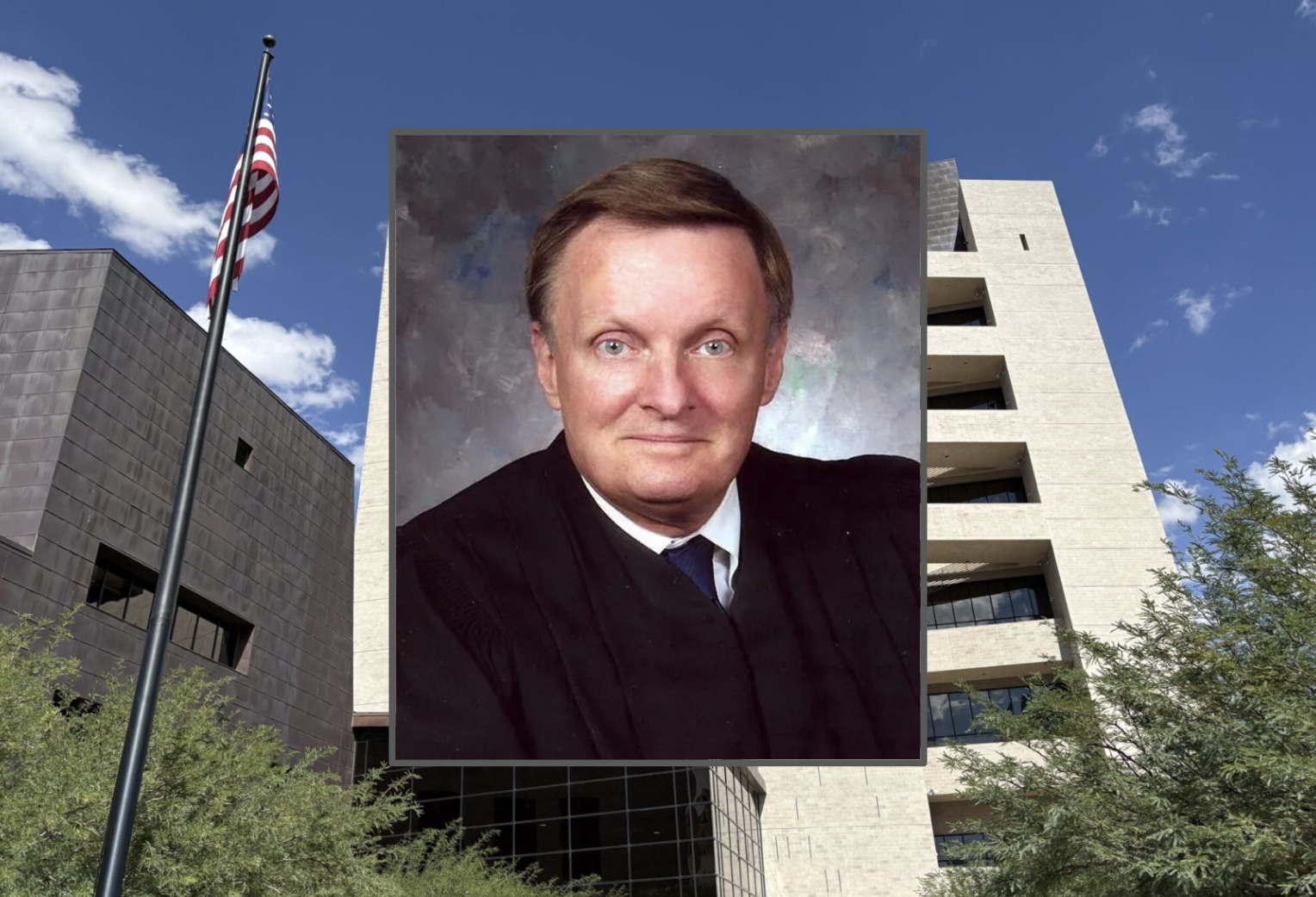
Judge Jerry Smith filed his dissent from the three-judge panel’s 2-1 decision to issue a preliminary injunction blocking Texas’ 2025 congressional map on Wednesday. Smith accused his fellow judges of judicial misconduct and leaving him out of the process.
The dissent accused Judge Jeffrey Brown—who wrote the majority opinion—of not giving Smith time to review the decision and not taking the time to review the dissent before issuing the injunction.
Judge Smith was appointed by Ronald Reagan in 1987 while Judge Brown was appointed by President Donald Trump in 2019. Brown had previously ruled against a Republican-led Texas redistricting effort for being “mean-spirited.”
Brown was joined in his decision by Judge David Guaderrama, who was appointed by Barack Obama in 2011.
Procedural Misconduct
Judge Smith began his 104-page dissent by slamming Judge Brown directly.
“I also need to highlight the pernicious judicial misbehavior of U.S. District Judge Jeffrey Vincent Brown,” wrote Smith. “In my 37 years on the federal bench, this is the most outrageous conduct by a judge that I have ever encountered in a case in which I have been involved.”
He proceeded to accuse Judge Brown of issuing a “160-page opinion without giving me any reasonable opportunity to respond.”
Judge Smith argued that to write a dissent, it is important to have sufficient time with the final decision in-hand. Similarly, it is important for the majority opinion to have taken into consideration all points made in the dissent before being released.
This is the deliberative process of fair and accurate judicial decision making—each judge has a role to play regardless of their position.
Before releasing the majority opinion, Judge Brown reportedly notified Judge Smith that he would issue the injunction as soon as it was ready and would not wait for the dissent.
“We are not trying to cut you out, we just don’t have the time,” said Brown, according to Smith. “Ideally, of course, we’d have liked to have seen your dissent before we issue our opinion, but that will also be impossible.”
Judge Smith did not take kindly to this reasoning.
“This outrage speaks for itself,” wrote Smith. “Any pretense of judicial restraint, good faith, or trust by these two judges is gone. If these judges were so sure of their result, they would not have been so unfairly eager to issue the opinion [without] my dissent, or they could have waited for the dissent in order to join issue with it. What indeed are they afraid of?”
“Judges in the majority don’t get to tell a dissenting judge or judges that they can’t participate. If the two judges on this panel get away with what they have done, it sets a horrendous precedent that ‘might makes right’ and the end justifies the means,” Smith continued.
He then framed Brown and Guaderrama’s mindset as, “We don’t need to wait for your dissent and wouldn’t read it if we did.”
Judge Smith also highlighted the practical effect of releasing the dissent separately from the majority opinion—as Judge Brown forced him to do.
When opening the district court docket, only the majority opinion is included in the entry. To access the dissent, one must navigate to separate non-consecutive docket entries. Smith argued that this severely diminishes the impact of the dissent and the public’s access to it.
Judicial Activism
Judge Smith wrote that Brown could have saved himself and readers a lot of time by simply writing the following:
“I just don’t like what the Legislature did here. It was unnecessary, and it seems unfair to disadvantaged voters. I need to step in to make sure wiser heads prevail over the nakedly partisan and racially questionable actions of these zealous lawmakers. Just as I did to the lawmakers in Galveston County in Petteway, I’m using my considerable clout as a federal district judge to put a stop to bad policy judgments. After all, I get paid to do what I think is right.”
Instead, Smith contended that Brown used a series of misrepresentations—if not lies—to reach his desired conclusion. He repeatedly accused Brown of imagining himself to be a legislator, activist, and even a god—something Smith stated is a common way for district judges to think of themselves.
This brings into question the proper role of federal judicial officers.
“The ultimate question is whether unrestrained ideological judicial zeal should prevail over legislative choice. This isn’t my first rodeo,” wrote Smith. “This is the most blatant exercise of judicial activism that I have ever witnessed.”
Smith’s evidence for this was extensive, even for having been rushed into releasing his dissent.
Judge Brown is accused of using a false standard for issuing a mandatory preliminary injunction, saying plaintiffs must only show a “likelihood of success on the merits,” rather than a “substantial likelihood.”
A preliminary injunction is considered an extraordinary and drastic remedy that “should not be granted except in rare instances in which the facts and law are clearly in favor of the moving party.”
Judge Smith also criticized Brown’s excuses for the Plaintiffs’ failure to provide an alternative map. Smith contends this is because they were looking to achieve better political representation rather than addressing their ostensive racial grievances against the 2025 map.
Although Brown argued that Plaintiffs “didn’t have time” to produce an alternative map and that it would be too much to ask of them, Smith responded that “[t]his is not how the law works for a preliminary injunction.”
Similarly, Brown is accused of making excuses on behalf of the Plaintiffs regarding the Purcell precedent, which holds that “courts should not change election rules during the period of time just prior to an election because doing so could confuse voters and create problems for officials administering the election.”
Brown blamed the state for enacting the new map “within Purcell’s ranger,” dismissing the fact that Democrats delayed the map’s enactment by breaking quorum.
Nonetheless, Smith argued that “the State, which has the prerogative to redistrict mid-decade, is in a fundamentally different position from that of a federal court, which must exercise extraordinary caution before intermeddling with an intimately vital local prerogative such as redistricting.”
“[I]t is unfair to the Texas voters who are having a map implemented by their duly elected legislature overturned by a self-aggrandizing, results-oriented court,” wrote Smith.
Racial Gerrymandering
To achieve a preliminary injunction, Plaintiffs needed to prove racial gerrymandering, something Brown claimed there was “[s]ubstantial evidence” of.
However, to prove racial gerrymandering, Smith noted that one must distinguish “between a racial gerrymander and a cynical partisan gerrymander by disentangling race from politics where ‘race and partisan preference are highly correlated,’ as is strictly required under Alexander.”
Smith contended that Judge Brown failed to do this, and blatantly disregarded expert testimony from both sides.
“Judge Brown, in his 161-page opinion, omits any discussion of the following five plaintiffs’ experts: David Ely, Stephen Ansolabehere, Loren Collingwood, Matt Barreto, and Daniel Murray,” wrote Smith. “And the reason is obvious—their testimony is unhelpful at best, or their analysis is flawed at worst. Judge Brown won’t tell you that. I just did.
To prove racial gerrymandering, the most useful resource would be testimony of the mapmaker, in this case Adam Kincaid.
Kincaid appeared in El Paso—despite reportedly receiving a “credible death threat”—and thoroughly denied that racial considerations were used in the redistricting process. Smith found Kincaid to be “credible in every respect.”
Yet, in ruling that racial gerrymandering took place, Judge Brown necessarily denied the credibility of Kincaid’s testimony.
“Knowing that [Kincaid] is credible, Judge Brown makes every effort to ignore or circumvent Kincaid’s solid testimony. Judge Brown avoids the details of that testimony. Because he won’t tell you that, I do so now,” wrote Smith.
“Because the ‘obvious reason’ for the 2025 redistricting ‘of course, is partisan gain,’ Judge Brown commits grave error in concluding that the Texas Legislature is more bigoted than political,” Smith concluded.
Soros Connections
Judge Smith asserted that “[t]he main winners from Judge Brown’s opinion are George Soros and Gavin Newsom. The obvious losers are the People of Texas and the Rule of Law.”
He proceeded to highlight the financial connection between George Soros and the Plaintiffs—admittedly only doing this to point out how both sides of the issue were overtly partisan.
“One of the plaintiffs’ top experts is Matt Barreto. He is a paid Soros operative and does not attempt to hide it. His CV confirms it. He expects to receive $2.5 million from George and Alexander Soros,” wrote Smith. “Unsurprisingly, Barreto has been on quite a road show for years, parading across the country opposing Republican redistricting.”
“That is the tip of the iceberg. The lawyers are involved as well,” stated Smith.
He proceeded to highlight the Soros connections of Plaintiffs Chad Dunn (lead counsel), Mark Gaber, David Fox, and Mark Elias—whose own news outlet has been reporting on the case.
“This order, replete with legal and factual error, and accompanied by naked procedural abuse, demands reversal,” Smith concluded.
What Happens Next
An appeal of redistricting litigation goes directly from a federal three-judge panel to the United States Supreme Court.
The State immediately appealed the decision, asking the Supreme Court for an emergency stay. The Court could issue the stay in a matter of days or weeks.
Meanwhile, candidate filing for Texas’ Primary Election is ongoing and the injunction has thrown congressional races into chaos as some candidates have filed for seats that now no longer exist.
If you or anyone you know has information regarding court cases, please contact our tip line: [email protected].
No ads. No paywalls. No government grants. No corporate masters.
Just real news for real Texans.
Support Texas Scorecard to keep it that way!