Once again, the agency that oversees public education in Texas is “encouraged” by elementary and middle school students’ academic assessment results—even though a quarter to a third of the students failed to even approach grade-level expectations in reading and math.
On Tuesday, the Texas Education Agency released results of the Spring 2026 State of Texas Assessments of Academic Readiness, known as STAAR, for students in grades 3-8.
The standardized academic achievement tests are “designed to measure the extent to which a student has learned and is able to apply the defined knowledge and skills in the Texas Essential Knowledge and Skills at each tested grade, subject, and course,” according to the TEA website.
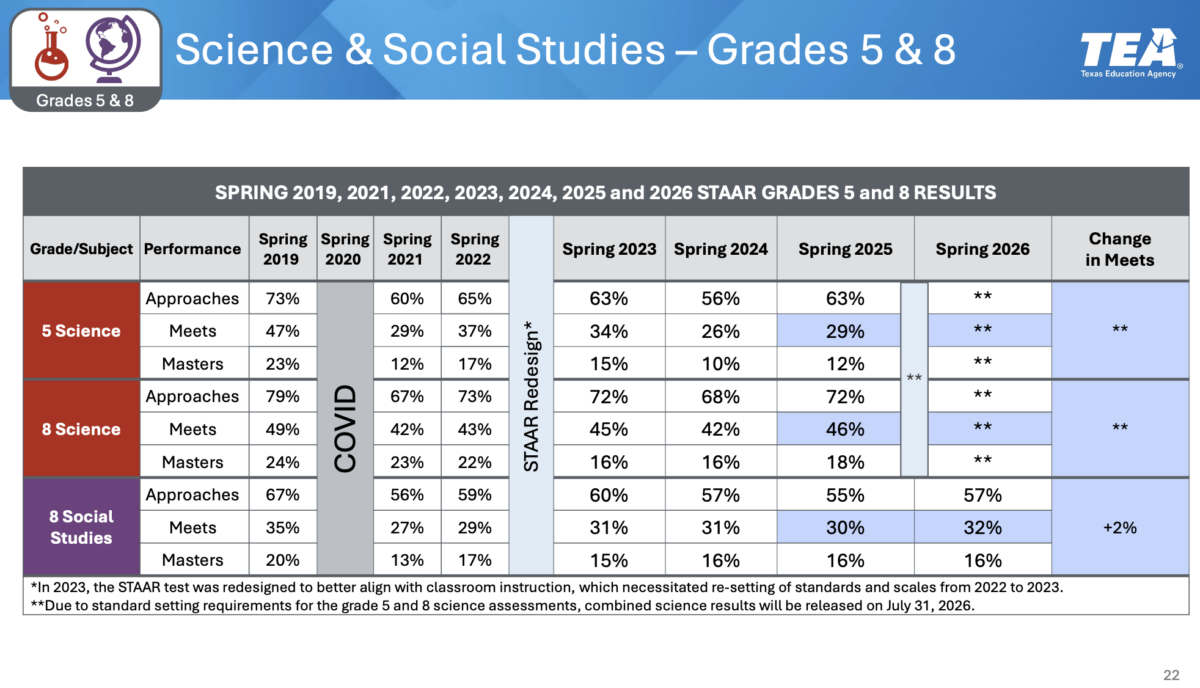
The latest STAAR results include assessments in math and reading language arts (RLA) for 3rd through 8th grade students, as well as 8th grade social studies. Due to updated content this year, TEA delayed release of science results until July 31.
“The 2026 results demonstrate both the progress Texas students are making and the work that remains ahead of us,” said Texas Education Commissioner Mike Morath. “We are encouraged by continued gains in mathematics, especially with the growing number of students participating and succeeding in advanced mathematics courses.”
Morath likewise called last year’s results “encouraging,” while acknowledging “more work is needed.”
The 2026 results are mixed compared to 2025—from a 1-percent drop in 3rd grade reading to a 4-percent gain in 4th grade math.
Yet the percentages of students meeting grade-level expectations remain low.
Results for reading proficiency—the most critical component of student success—range from just 49 percent of 3rd graders meeting grade level to 59 percent of 8th graders meeting expectations.
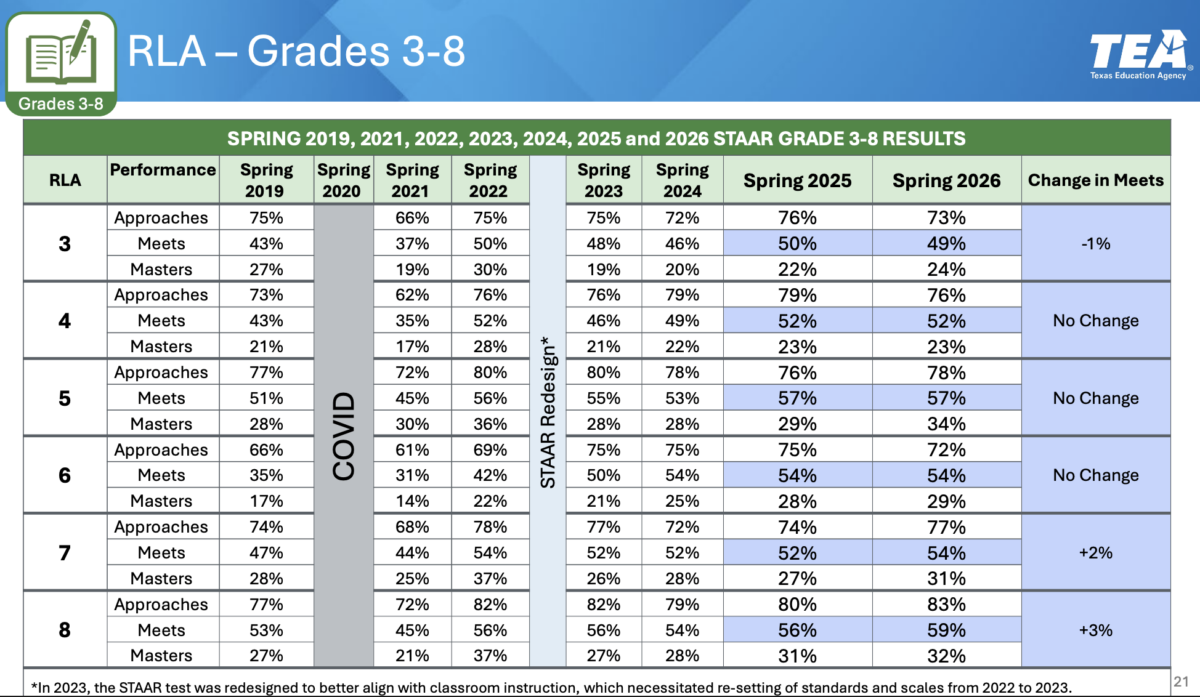
Under the state’s new Parent Access to Supplemental Supports (PASS) program, families of 3rd grade students who did not meet grade level on the STAAR reading assessment can apply to receive up to $400 for parent-selected literacy tutoring services.
Morath speculated that reading gains in 7th and 8th grade could partly be due to the statewide ban on using cell phones in school.
Math results, touted for their improvements, reveal less than half of students meeting grade-level expectations—from a low of 39 percent in 7th grade to a high of 49 percent in 4th grade.
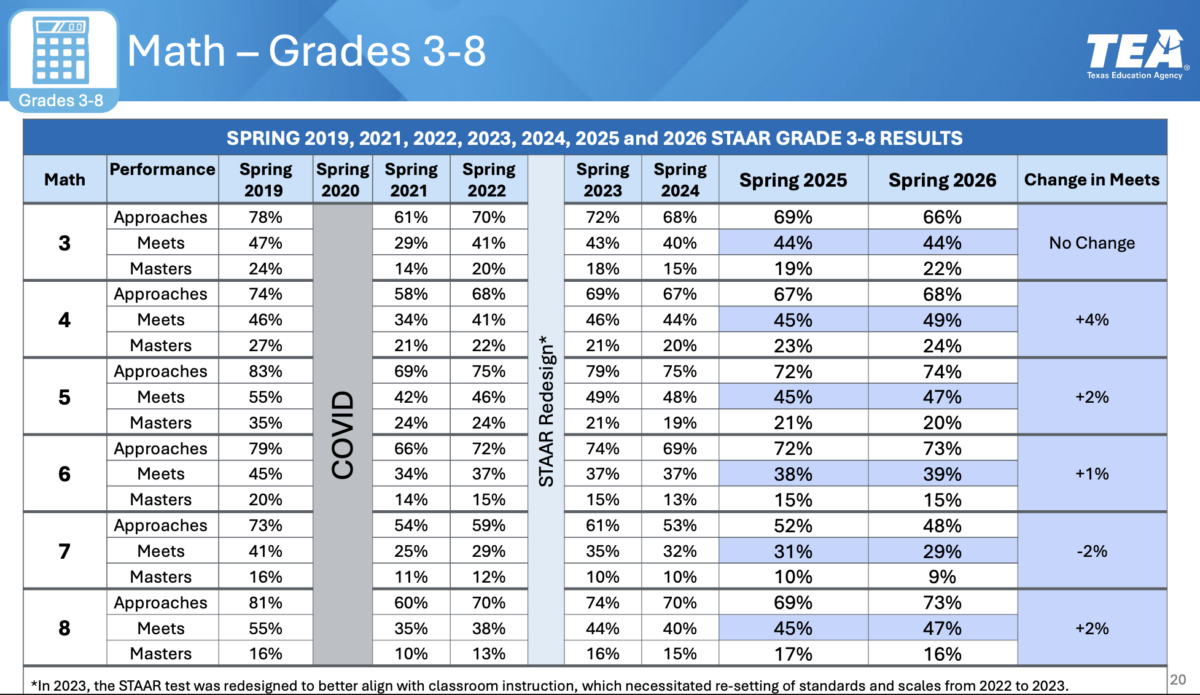
TEA attributed the 2-point decline in 7th graders meeting grade level to an increasing number taking an 8th grade math assessment—32 percent in 2026 compared to 16 percent in 2023.
A state law enacted in 2023 automatically puts elementary students who perform well in math into advanced courses in middle school.
Scores for social studies showed a 2-point gain from 2025, to 32 percent meeting grade level. Yet the scores have not returned to pre-COVID levels, and 43 percent of students failed to meet grade level.
Last week, the TEA released Spring 2026 End-of-Course STAAR results for students in grades 9-12.
Statewide results show the percentage of high school students meeting grade-level expectations increased across all assessed subject areas and student groups, although barely above half met expectations in English I or Algebra I.
Parents can access their child’s STAAR results through their school district’s family portal or by visiting TexasAssessment.gov and using the access code provided by their child’s school.
Aggregate STAAR data by state, region, district, or campus can be found through the Texas Assessment Research Portal.
The “high stakes” STAAR tests are scheduled to be replaced with a new assessment program starting in the 2027-28 school year.
Legislation enacted in 2025 as House Bill 8 replaces STAAR with the Student Success Tool, which will include shorter tests at the beginning, middle, and end of school years. High school students will only be required to take end-of-year assessments.