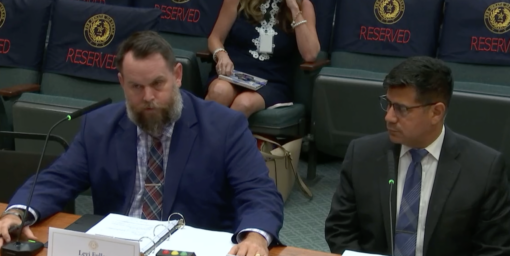
A Texas Senate hearing on patriotic instruction in public schools turned to allegations of Sharia influence, with witnesses questioning foreign-funded curriculum and school-sponsored activities involving Islam.
The Texas Senate Committee on Education heard testimony Wednesday on the State Board of Education’s efforts to promote patriotic instruction, along with recommendations to restrict foreign influence in classrooms.
Kate Bierly of the Texas Public Policy Foundation raised concerns regarding the Arabic curriculum in Austin ISD that was supplied by foreign sponsors like the Qatar Foundation International (QFI).
Bierly noted that Austin ISD accepted a $100,000 grant from QFI to establish an Arabic language and culture program at three schools. She also questioned instructional materials that included “Mahmoud Darwish’s poem entitled ‘Identity Card.’”
“Darwish was a high-ranking member of the Palestine Liberation Organization, who the U.S. designated as a terrorist organization in 1987,” said Bierly, adding that “Students are asked to journal about being victims of racism” as part of the course.
Bierly told the committee that Austin ISD asked for materials written entirely in Arabic, and district officials offered $50,000 to hire a translator, unable to sift through the information themselves.
According to Bierly, QFI contracts worth $85,000 involving the Houston Arabic Immersion Magnet School “allow QFI staff and consultants to observe classroom instruction. QFI requested access to teachers’ lesson plans before an observation.”
“Foreign entities are currently observing Texas classrooms and influencing what is being taught. Across Austin and Houston, public records show more than $1.5 million in QFI funding to the two school districts since 2015,” she said.
Susan Perez, founder of Citizens for Education Reform, told the committee that students at several Texas schools had been taught or participated in Islamic prayer during the school day. She also raised concerns about school-sponsored mosque visits and activities involving the hijab.
Perez contended that “this push is to normalize Islam and barbaric Sharia law into our culture, where women are degraded and there are no consequences for rape. All violations of our constitution.”
Her testimony, along with Bierly’s, prompted recommendations for restrictions on foreign funding and certain instructional materials.
Bierly pointed to House Bill 4195, which would have prohibited districts from accepting gifts or donations from foreign adversaries or hostile foreign sources. It also required reports of gift and contract amounts and their sources. HB 4195 did not pass the Legislature last year.
“Texas has taken steps to protect its universities from foreign influence, but those protections stop at the college gate and do not apply to K through 12 schools,” she said.
Perez recommended prohibiting materials from the Council on American-Islamic Relations (CAIR), the Muslim Brotherhood, and materials promoting socialism, Marxism, or communism.
Stephen Lara, a leader of the Lubbock Turning Point USA chapter, suggested legislation to legally recognize CAIR and the Muslim Brotherhood as terrorist organizations following Gov. Greg Abbott’s designation of two as such.
SBOE Chairman Aaron Kinsey also discussed the implementation of House Bill 4509, passed in 2021.
HB 4509, the Informed American Patriotism Act, requires educators to “cultivate in students an informed American patriotism and lead students in a close study of the founding documents of the United States and Texas.”
The SBOE has statutory authority for instructional materials review and approval. It worked to implement HB 4509 and House Bill 1605, which mandated creation of a list of required literary works.
He said additions to the SBOE’s list “highlight America and Texas exceptionalism. Some examples include topics such as George Washington, Davy Crockett, Frederick Douglass, Harriet Tubman, Susan B. Anthony, Patrick Henry, the Mayflower Compact, Sam Houston, Teddy Roosevelt, and Martin Luther King, Jr.”
Kinsey also discussed a suitability rubric that seeks to “ensure instructional materials reviewed did not run counter to the legislature’s intent to increase America and Texas patriotism.”
The testimony comes amid broader Republican efforts to restrict Sharia’s influence.
In March, 94 percent of Republican primary voters supported a nonbinding ballot proposition that suggested Texas prohibit Sharia law.