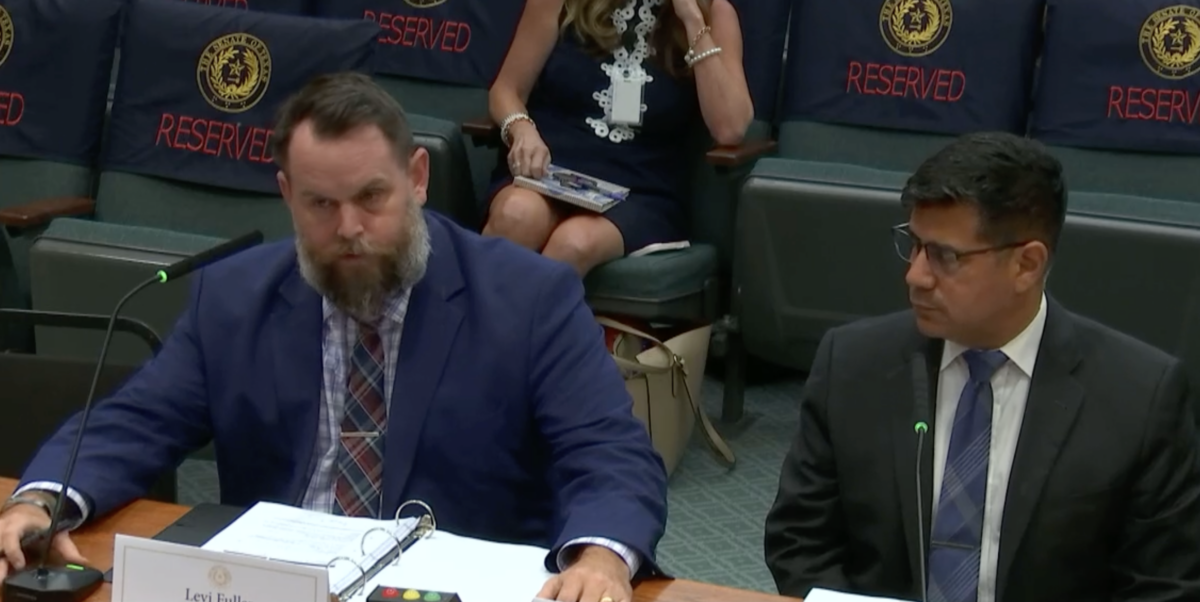
State senators met this week to review the impact of legislation enacted last year to prevent “passing the trash” in Texas schools, and to consider what more can be done to protect students from sexual abuse by school employees.
Members of the Senate Committee on Education held an interim hearing on Tuesday that included an update on Senate Bill 571, a measure designed to strengthen the state’s educator misconduct reporting, investigations, and enforcement.
Data presented by the Texas Education Agency showed the measure is succeeding in getting a record number of bad actors out of kids’ classrooms, even as the agency deals with the expected flood of new reports.
“The child needs to be the focus in education,” said committee chair State Sen. Donna Campbell (R–Bulverde) at the outset of the hearing, which covered several topics.
The committee’s vice chair, State Sen. Paul Bettencourt (R–Houston), authored SB 571 but credited its passage to overwhelming bipartisan support from members of the Texas Senate and House as well as child protection advocates statewide.
Levi Fuller, appointed in February as the Texas Education Agency’s first Inspector General for Educator Misconduct, was tasked with managing SB 571’s implementation.
Fuller testified Tuesday about the measure’s provisions, its successes, and remaining challenges.
What Senate Bill 571 Changed
SB 571 reduced the required time to report suspected child abuse to the Texas Department of Family and Protective Services and law enforcement from 48 hours to 24 hours. Fuller noted that SB 571 disqualified school district police departments as eligible agencies for reporting purposes, as reinforced by a recent opinion from the Texas Attorney General’s Office.
The new law also reduced the time to report misconduct allegations to TEA from seven days to 48 hours, expanded reporting to add more noncertified school staff and contractors (including requiring the comptroller to report Texas Education Freedom Account provider misconduct), requires schools to submit allegations through the agency’s online misconduct reporting portal, and mandates disclosure of reporting data on the TEA website.
SB 571 also expanded educators’ required pre-employment affidavit disclosures of criminal or administrative investigations, terminations, or resignations in lieu of termination.
In what Fuller called the “big, meaty part of the bill,” SB 571 created a mandatory process for the agency and State Board for Educator Certification to temporarily suspend teaching credentials of educators arrested for certain serious crimes (sexual offenses or Title 5 felonies).
Both certified and noncertified school employees arrested for qualifying offenses are added to the state’s Do Not Hire Registry, keeping them out of classrooms while criminal charges against them are adjudicated.
“This expanded the TEA and SBEC authority to sanction individuals who have harmed children,” explained Fuller. “It also required the agency to conduct additional child abuse monitoring, and it expanded TEA jurisdiction over noncertified employees.”
How SB 571 Has Been Implemented
“It’s been a very busy year,” Fuller told senators.
Fuller said his team has provided guidance to school districts on SB 571’s new reporting requirements, developed additional SBEC rules for boundary-crossing and inappropriate communications between educators and students, put in place the temporary suspension process, and established a child abuse reporting and response team.
TEA also launched the Educator Misconduct Reporting Dashboard, a transparency tool mandated by SB 571.
The dashboard reveals the numbers and types of misconduct complaints submitted to the TEA each month, as well as criminal history reports the agency receives from federal and state law enforcement.
Misconduct reports tripled in 2026 compared to 2025, and additions to the Do Not Hire Registry nearly doubled.
The increases were anticipated, and Fuller framed them as signs of success in terms of reporting bad actors and removing them from classrooms.
Fuller told senators that 19,766 misconduct reports were filed in the 2025-26 fiscal year, compared to 5,707 the previous year. In addition, TEA received 27,655 criminal history hits, up from 23,369 last year.
“That’s a 47,421 total number that the TEA is currently dealing with,” said Fuller.
He explained how those initial reports received preliminary reviews, whittling the numbers down to 6,587 that proceeded to formal investigations.
Of those, 1,177 investigations were completed, 714 are in suspense (primarily due to ongoing criminal proceedings), and 4,696 are still under investigation.
“We are extrapolating and predicting that of that number, 550 of those will not settle and will have to go to trial,” said Fuller. “This will double the amount of cases we’re dealing with.”
“I do want to highlight some good numbers here,” he said, pointing to the 14,630 reports submitted by superintendents. Last year, superintendents submitted just 3,140 reports, accounting for less than half of complaints filed.
“The superintendents are getting the message across the state of Texas that they have to report to TEA. They have to report to law enforcement. They have to report to DFPS. That’s an important number we should be celebrating,” Fuller testified. “But that being said, this number is high.”
Fuller said the key to SB 571’s success is the temporary suspension and registration process, which he called “an alternate pathway forward” for protecting students.
In 2026, TEA added 1,079 school employees to the Do Not Hire Registry, compared to 589 last year. Of those, 455 were added temporarily based on a triggering arrest under SB 571, making them ineligible to be hired by a public school while the criminal charges against them are prosecuted.
“We’ve also sought more stringent penalties, more appropriate penalties for harm to kids,” he said. Fuller told senators that the only acceptable administrative sanction for an educator proven to have physically or sexually abused a child is revocation of credentials and permanent Do Not Hire status.
What More Is Needed
Fuller identified more staff, more efficient processes, and/or stiffer penalties that encourage more settlements as ways his office can handle the increased caseload as well as the backlog of cases that pre-date SB 571.
“If we get none of those above, then we’re going to have to triage and take the more serious cases to trial and try to find settlements to alleviate our docket,” said Fuller.
“We’re going to ask for more staff to try to deal with this increase,” he added.
Bettencourt asked if a “multi-agency approach” could help work off the backlog.
Fuller noted that his office has already partnered with the U.S. Department of Justice in its Project Safe Schools initiative, launched in August in the Northern District of Texas.
“United States Attorney Raybould was ready to get after it,” said Fuller, adding that his office also works with the state’s comptroller and attorney general on educator misconduct cases.
Bettencourt told Fuller he would contact the new U.S. Attorney for the Southern District, Aaron Reitz, and encourage him to work with the IG’s office as well.
“Whatever it takes to protect kids, we’re willing to do it,” said Fuller. “Our goal is to get them out.”
Fuller added that if a district attorney doesn’t take an accused educator to trial, but there is evidence and a victim willing to testify, his office will still take a case to an administrative trial.
“In a lot of our cases, we’re the last resort,” he said.
Bettencourt noted that he has been filing bills since 2017 to prevent “passing the trash,” school officials allowing educators accused of sexual misconduct to move to other campuses or quietly resign and get jobs in other districts.
“If we can finally take the trash out to the curb and have it picked up and it is gone, then it basically helps the reputation of all the remaining people,” said Bettencourt. “But the key thing is, you cannot turn a blind eye to this.”
In July, U.S. Education Secretary Linda McMahon issued guidance instructing school districts nationwide to stop passing the trash or risk losing federal funding.
Advocates’ Responses to SB 571
Two representatives for the Texas School District Police Chiefs’ Association asked senators to reverse a key reform in SB 571 and restore ISD police departments as eligible agencies for receiving abuse reports and investigating the crimes.
Sherman ISD Police Chief Heath Wester argued that officers who are on campuses daily have “relationships” with students that could help them “feel safe enough to disclose abuse.”
“We understand concerns about districts investigating their own employees,” he said. “We support required outside reporting in coordination with prosecutors, while preserving ISD police authority to investigate … with transparency and accountability.”
Jacksonville ISD Chief of Police Bill Avera, executive director of TSDPCA and a member of the Texas School Safety Center board, testified that the “additional caseload” of school-based complaints is burdening law enforcement agencies across the state.
“We understand the concern that some school districts may have swept things under the rug or otherwise taken inappropriate actions when reporting these,” Avera told senators. “But we also realize that we are seeing limited patrol and detectives being taken away from violent crime and emergency response to manage internal school investigations.”
“We respectfully ask you to consider restoring ISD police departments, and we will ensure both accountability and efficiency along with you,” concluded Avera.
Faith Colson, a survivor of educator abuse who now advocates for others, pushed back against Avera’s assertions. She testified that 10 to 17 percent of K-12 students will experience sexual misconduct before they graduate.
Colson told senators that when students are sexually abused in schools, “this is not a school matter. It’s a violent crime inflicting lifelong harm.”
“Outside reporting and investigation is not optional, but necessary to ensure kids are safe and to remove conflicts of interest,” she said.
Colson also recommended that lawmakers extend the criminal statute of limitations for the offense of improper relationship between educator and student, which is currently three years.
Paige Williams, director of policy and advocacy for the Texas Classroom Teachers Association, recommended that lawmakers codify the current rule requiring administrative cases to be completed within 240 days.
“I want to make sure that I emphasize we fully support the goals of this bill,” said Williams. “We don’t want predators in the classroom either, and we don’t want to protect bad actors.”
“Good teachers are furious when they see news reports about bad actors in the classroom and predators in the classroom,” she said. “We just want to make sure that the process does not take an overly burdensome amount of time.”
“SB 571 was the right law, and the inspector general is doing the work required,” testified Tami Rodriquez Brown, CEO of Untrafficked. “Now we must make sure that the pathway actually protects the child.”
The full committee hearing can be viewed here.